

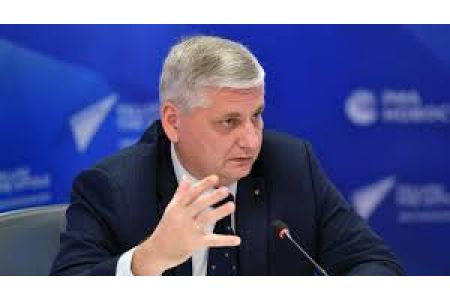
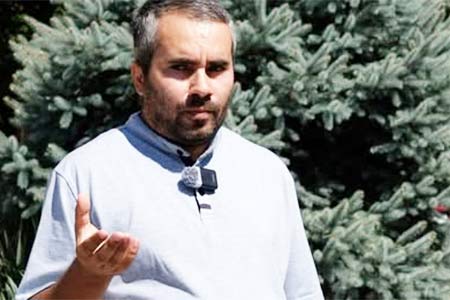
ArmInfo. Kazakhstan cannot aspire to a "sovereign" policy on a grand geopolitical scale, but Astana's task is to achieve maximum results with minimal means, while trying to avoid a head-on collision with geopolitical giants. This is the opinion of Sergei Markedonov, PhD in history, leading researcher at the Center for Euro-Atlantic Security at the Institute of International Studies at MGIMO University, and editor-in-chief of the journal "International Analytics."
Touching on the emergence of the South Caucasus on Kazakhstan's foreign policy radar, the expert noted that in April 2026, the words "South Caucasus" and "Kazakhstan" began appearing together in the media and on social media more frequently than usual due to Kazakh Foreign Minister Yermek Kosherbayev's official tour of the Caucasus states.
The Russian political scientist recalled that Kosherbayev held talks with the Prime Ministers of Georgia and Armenia, Irakli Kobakhidze and Nikol Pashinyan, and was also received by Azerbaijani President Ilham Aliyev.
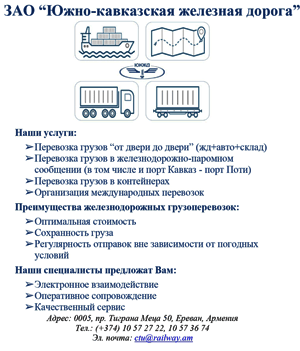
"The main topics of the talks were strengthening bilateral relations, but above all, transport and logistics issues in the context of global and regional transformations. The topic of Kazakhstan was also raised in the context of the development prospects of the South Caucasus Railway (SCR). However, there are more questions than answers here," Markedonov believes.
In this vein, he noted that the headlines of many publications dedicated to the Kazakh minister's Caucasus tour relied on the idea of "Astana's arrival" in one of Eurasia's most complex regions. The expert added that, as is often the case, current events prevent a deeper look at the problem and prevent a superficial adherence to the "current agenda."
"Today, the trend of the 'internationalization' of the South Caucasus is being intensely discussed in expert circles. Russia's influence is no longer exclusive; the countries of the region themselves are striving for diversification. However, discussions about external players are limited to either the prospects of the notorious TRIPP, Turkey's growing influence, or China's growing attention to Azerbaijan, Armenia, and Georgia," Makedonov believes.
According to him, such an important trend as the post-Soviet states' increased activity outside their "regions" is being unfairly overshadowed. Meanwhile, the political scientist is confident that recently, not only has Kazakhstan shown increasing interest in the Caucasus, but also Azerbaijan and Georgia-in Central Asia as a whole, and in individual Central Asian states.
"Kazakhstan cannot aspire to a 'power' policy on a grand geopolitical scale," wrote Russian political scientist and journalist Alexander Karavaev. However, he also aptly noted that "Astana's task is to achieve the greatest possible results with minimal means," while trying to avoid a head-on collision with geopolitical giants. It's worth noting that the Kazakh leadership had been making inroads into the Caucasus long before the advent of the "new normal" in the region, the expert emphasized.
Markedonov continued his remarks by suggesting recalling the 1991 Zheleznovodsk Communique on the Nagorno-Karabakh settlement, as well as the 2010 OSCE summit in Astana (under Kazakhstan's chairmanship), where this same issue was a central one. Of course, the same applies to the increased investment in the Georgian economy in the mid-2000s, when Kazakhstan gained a strong position in both the banking sector and Georgia's recreational industry.
"Thus, Astana's current revitalization of the Caucasus region draws on both certain traditions and experience. Ties with Azerbaijan are perhaps the closest (we share the Caspian Sea, after all). This includes energy, Caspian port infrastructure, and participation in the economic development of Karabakh. The issue of territorial integrity has always united Baku and Astana. Georgia is a key link for Kazakhstan's access to the Black Sea. In matters of territorial integrity, the two countries largely follow the same pattern as between Azerbaijan and Kazakhstan. Until recently, Astana's relations with Yerevan were more reserved. This, however, did not prevent cooperation through the EAEU. Nevertheless, during Nikol Pashinyan's visit to Astana last November, the two countries agreed to develop a strategic partnership," the political scientist noted.
Markedonov noted that Kazakhstan is positioning itself, on the one hand, as Russia's ally and an important participant in Eurasian integration projects, but also as a reliable partner of the US and the EU, having joined Trump's Peace Council initiative. "There is also a third party-the Organization of Turkic States, which is particularly interesting in the context of building relations with Azerbaijan and developing ties with Turkey, whose involvement in Caucasian affairs is growing year by year," the expert concluded.










 Political analyst: While Pashinyan pledges peace with Azerbaijan, Baku continues promoting the "Western Azerbaijan" project
 Political analyst: In light of new realities, Yerevan may propose advancing peace process with Baku without constitutional referendum
 Present-day geopolitical competition shifts from territorial control to infrastructure flows
 Prosecutor General`s Office petitions Central Electoral Commission for criminal prosecution of Robert Kocharyan
 Dutch Prime Minister expresses his support for Armenia`s democratic reform and economic diversification agenda
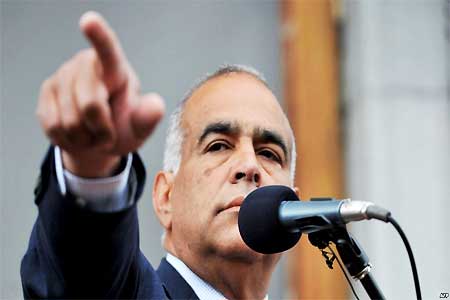 Heritage: It`s time for Armenia`s opposition to present people with legitimate alternative to power
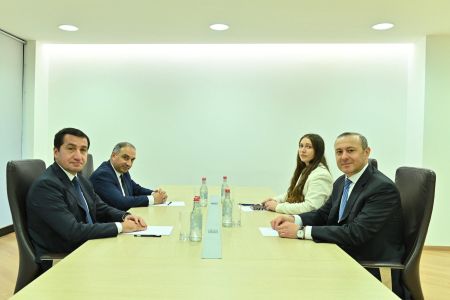 RA Security Council Sec, Assistant to President of Azerbaijan hold negotiations in Dilijan
 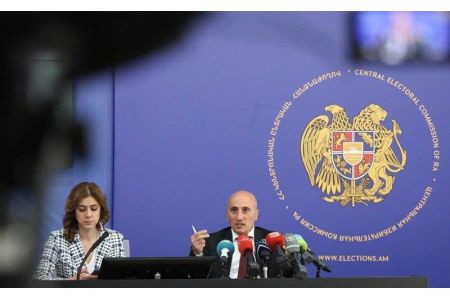 CEC Neutralizes PAP: Three Political Forces to Enter Armenian Parliament Following Election Vote
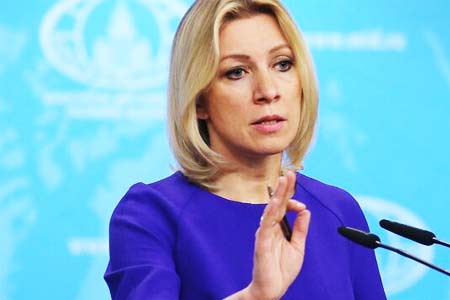 Elections in Armenia were accompanied by unprecedented pressure on opposition, RF MFA spokesperson claims
  Expert: Even OSCE observers recorded numerous violations during elections in Armenia
  Moscow to await official results of Armenian elections - Peskov
 Antonio Costa: EU to deepen its partnership with Armenia, expanding cooperation in energy, trade, and digitalization
 Israeli MFA congratulates Pashinyan
 Turkish MFA comments on results of Armenian elections
  Zakharova: International observers cannot ignore `flagrant violations` in Armenian elections