
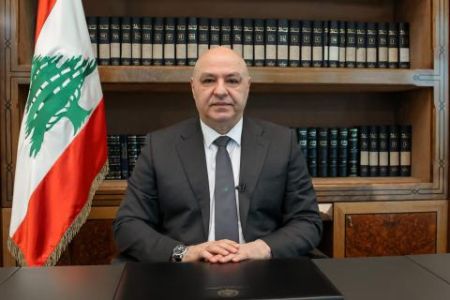
ArmInfo. In a message on the 111th anniversary of the Armenian Genocide in the Ottoman Empire, Lebanese President Joseph Aoun called for the preservation of historical memory.
"We remember with deep sorrow the victims of this humanitarian tragedy and reflect on the importance of resilience and loyalty to one's identity. Lebanon became a haven for Armenians, who found a second homeland here, contributed to its development, and became an integral part of its national fabric and rich diversity," he emphasized.
At the same time, Aoun noted that this anniversary is an opportunity to reiterate the importance of preserving collective memory, promoting the values of justice and human dignity, and working for a future based on peace and mutual respect among peoples. "We welcome the Armenian people and reaffirm Lebanon's commitment to its mission as a land of freedom and diversity, as well as its conviction that preserving memory is fundamental to preventing the recurrence of tragedies," the Lebanese leader concluded.
On April 24, 1915, in Constantinople, the capital of the Ottoman Empire, the extermination of Armenian subjects began. It began with the arrests of representatives of the Armenian intelligentsia-writers and poets, architects and parliamentarians-and then escalated into the complete extermination of Armenians. As a result of these actions by the Turkish authorities, more than 1.5 million Armenians were deported, starved, and tortured to death.
The Armenian Genocide has been recognized by the Council of Europe (1998, 2001), the European Parliament (1987, 2000, 2002, 2005), the UN Sub-Commission on Prevention of Discrimination and Protection of Minorities[7], the World Council of Churches, the Parliamentary Coalition of South American Countries (Mercosur), and the Parliament of Latin America (2015).
The Armenian Genocide has been recognized and condemned by many countries and influential international organizations. The first to officially recognize and condemn the mass killings of Armenians was the Parliament of Uruguay (1965). The extermination of Armenians has been officially recognized as genocide (under international law) and condemned by: Austria (joint statement of the chairmen of parliamentary factions, 2015), Argentina (2 laws, 5 resolutions; 2004, 2007), Armenia (1964 as part of the USSR, 1988, 1990), Belgium (1998, 2015), Bulgaria (2007, 2015), Bolivia (2014), Brazil (2015), Vatican City (2015), Venezuela (2005), Germany (2016), Greece (1996), Italy (2000, 2019), Canada (1996, 2002, 2004), Cyprus (1975, 1982), Latvia (2021), Lebanon (1997), Libya (2019); On April 18, 2019, the Interim Government of Libya adopted a resolution recognizing the Armenian Genocide. Lithuania (2005), Luxembourg (2015), Netherlands (2004, 2018), Paraguay (2015), Poland (2005), Portugal (2019), Russia (1995), Syria (2020), Slovakia (2004), USA (2019, 2021); On April 24, 2021, US President Joe Biden officially recognized the Armenian Genocide. Uruguay (1965), France (1998, 2000, 2001, 2006), Czech Republic (2015, 2017, 2020), Chile (2007), Switzerland (2003), Sweden (2010). Turkey continues its policy of denial of this crime against humanity.


















 Expert: Gagik Tsarukyan embodies post-Soviet model of big business-state relations; this model is used in many other post-Soviet countries
 Expert: Azerbaijan promoting aggressive plans against Armenia at state level
 Iranologist: Baku`s propaganda of might masks the country`s inability to provide water to its own population
 Moscow: NATO seeking to "Pull" Armenia away from CSTO Allies
  Political analyst: Russia intends to determine which "Camp" Armenia will choose through a referendum
 Narek Karapetyan will give up his parliamentary salary in favor of charitable contributions.
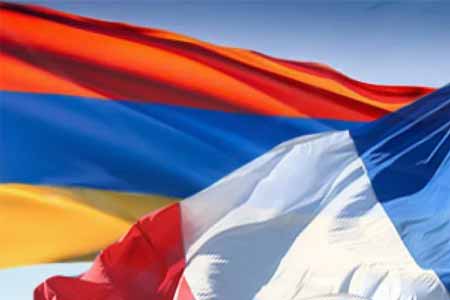 Armenia and France discuss further development of strategic partnership and EU cooperation
  To overcome risks Armenia must reduce domestic escalation - expert
  Zatulin: Pashinyan was eager to get back to Russia because he actually lost the elections
 Human rights activist Ruben Melikyan dismissed from YSU
 Zakharova: Armenia`s pro-EU pivot poses economic security risks to EAEU member states
 It`s time for South Caucasus countries to think of South Caucasus as single, unified region - RA premier
  Pashinyan: Armenia and Azerbaijan should leave each other alone
 Moscow sees situation with Armenia as attempt to attack Russia-involving integration associations - Russian presidential aid