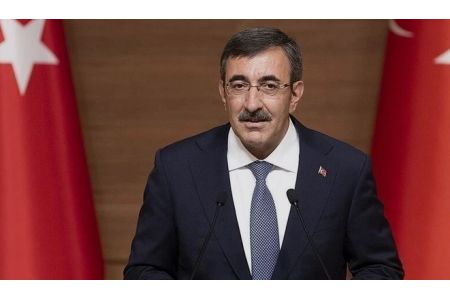
ArmInfo. Turkish Vice President Cevdet Yilmaz arrived in Armenia to participate in the 8th European Political Community Summit in Yerevan. He was met at the Yerevan airport by Deputy Speaker of the Armenian Parliament Ruben Rubinyan.
Turkologist Varzhuna Geghamyan noted in this regard that Turkish official media, as well as some influential publications, are presenting Yilmaz's visit as "the first visit of this level." He added that this phrasing lends a certain historicity to the Turkish figure's visit and presents it as "an important step, marking a new stage" in the Armenian-Turkish dialogue. "It should also be noted that until recently, Turkish media outlets noted that if President Recep Tayyip Erdogan had not participated in the Yerevan summit, Turkey would not have been represented at any other level, as the rules only allow for heads of state," the expert recalled.
Geghamyan further noted that the position of Vice President of Turkey was created in 2018, when the country completed the transition from a parliamentary to a presidential system of government. Therefore, from a purely factual standpoint, Y?lmaz's visit is the first of its kind.
"However, he is by no means the highest-ranking Turkish official to visit Armenia since 1991. It's enough to recall that in December 2013, influential figure and Turkish Foreign Minister Ahmet Davutoglu, who became Turkey's prime minister a year later, visited Armenia. Even earlier, in September 2008, Turkish President Abdullah Gul made a working visit to Yerevan. The latter's visit was truly historic not only in terms of the formality of his assumption of the presidency, but also in terms of Gul's real weight in the Turkish political arena and the scale of the Armenian-Turkish 'football diplomacy' that was taking place at the time," the Turkologist emphasized.
Geghamyan noted that, unlike Gul or Davutoglu, Y?lmaz is considered a figure completely dependent on Erdogan, lacking his own political trajectory and independent influence. According to him, therefore, in this sense, Y?lmaz's visit to Yerevan is difficult to evaluate as historic, much less a turning point. The Armenian expert also hastened to note that just last year, Armenia visited Turkey with a much higher level of representation (Prime Minister of the Republic of Armenia N. Pashinyan visited Istanbul on a working visit in June 2025, and Speaker of the National Assembly A. Simonyan visited Istanbul on a working visit in April 2026), in response to which the Turkish visit cannot be considered equivalent.
"From this perspective, it is worth recalling that Prime Minister Pashinyan personally invited President Erdogan to Yerevan. Both Erdogan and Azerbaijani President Ilham Aliyev declined the invitation, continuing the trend of recent decades," the Turkologist noted.
He also noted that, according to Turkish media, a bilateral meeting between the Turkish official and Armenian Prime Minister Nikol Pashinyan is expected in Yerevan. "Nothing is known about the meeting's agenda, but given that one of the stated topics of the conference itself is transport accessibility, and Yilmaz himself frequently speaks of the so-called 'Zangezur Corridor,' it's possible that the Turkish politician's agenda will also include presenting the Turkish perspective on this issue.
It should be noted that Turkish Vice President J. Yilmaz, since his appointment to the post in June 2023, has always been one of the key figures responsible for Ankara's relations with Azerbaijan, and his rhetoric is based on official propaganda statements established within the framework of relations between the two countries," Geghamyan noted. According to him, Yilmaz is apparently also involved in promoting another expansionist agenda against Armenia, the so-called "Western Azerbaijan."













 Political analyst: Pashinyan- Putin phone call confirms deepening strategic rift between Yerevan and Moscow
 Opinion: Resolving conflict between Yerevan and Baku allows Washington to deprive Russia of key levers of influence in South Caucasus
 Narek Karapetyan will give up his parliamentary salary in favor of charitable contributions.
 Armenia and France discuss further development of strategic partnership and EU cooperation
  To overcome risks Armenia must reduce domestic escalation - expert
  Zatulin: Pashinyan was eager to get back to Russia because he actually lost the elections
 Pashinyan removed from INNOPROM guest list
 Zakharova: Armenia`s pro-EU pivot poses economic security risks to EAEU member states
 It`s time for South Caucasus countries to think of South Caucasus as single, unified region - RA premier
  Pashinyan: Armenia and Azerbaijan should leave each other alone
 Moscow sees situation with Armenia as attempt to attack Russia-involving integration associations - Russian presidential aid
 Zakharova: Armenia views relations with Russia as tool for financially securing reorientation toward EU
 The Armenian Minister of Justice and the EU Ambassador discussed visa liberalization issues for Yerevan.
 Azerbaijan`s aggressive plans against Armenia became possible in wake of Pashinyan`s decisions on Artsakh - expert
  Zakharova: Russia sent a note of protest to Armenia over the act of vandalism at the "Mother Armenia" memorial in Gyumri