


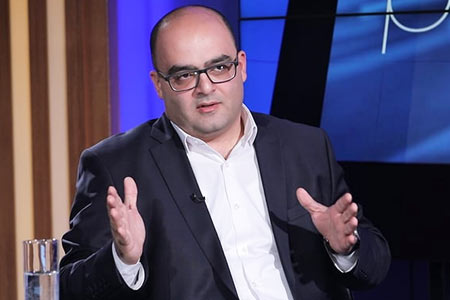
ArmInfo. The sections of the joint declaration adopted following the Armenia-EU summit concerning critical infrastructure are, at first glance, presented as an agenda for development, modernization, and "connectivity." However, this language conceals a more serious problem: the gradual restructuring of control over infrastructure. Vahe Davtyan, a doctor of political science and professor, voiced this opinion on his Facebook page.
He noted that the energy sector emphasizes diversification, energy transition, strengthening networks, and integration with European markets. However, according to the expert, the issue is not so much about energy development as the nature, or rather, whose logic, will drive this development. "Diversification is presented as a reduction in dependence, but in practice, it could simply result in its transformation-in the direction of European regulatory and technological systems," Davtyan noted. The political scientist believes that nuclear energy remains the most sensitive issue. EU support for developing a roadmap for decommissioning the Armenian Nuclear Power Plant (ANPP) is framed as technical and safety cooperation. However, as Davtyan noted, the de facto outcome is clear: the closure of the existing nuclear unit.
"The question arises: what will replace it? The declaration doesn't provide a clear answer. This means that the basic, stable capacity of Armenia's energy system is being called into question without providing an equivalent alternative. It's enough to recall the Ignalina Nuclear Power Plant, which was mothballed after Lithuania joined the EU without the creation of new capacity. As a result, Lithuania is still forced to import expensive electricity from Scandinavia," the political scientist noted.
According to him, the declaration mentions the prospect of connecting Armenia to the Black Sea power cable. This is a joint initiative of the EU and Azerbaijan aimed at exporting Azerbaijani "green" energy to the European market. Davtyan noted that it's clear that without stable generating capacity, Armenia will have virtually no role in this system. And under current conditions, Baku will do everything possible to prevent Armenia from joining this project, which is the result of Azerbaijani lobbying.
A similar logic, he said, can be seen in the declaration's transport section. This refers to integration into trans-European networks, the opening of communications, and the "Crossroads of the World" project. "However, here too, it's important to understand: Armenia is viewed not so much as an independent entity formulating its own transport policy, but rather as a transit corridor," the expert emphasized.
In this context, he believes, the EU's "Global Gateway" strategy, which estimates investment in Armenia at up to ?2.5 billion, is particularly significant. As Davtyan noted, this is presented as an incentive for developing connectivity and infrastructure, but in reality, it is directly linked to the formation of the Middle Corridor and the restructuring of the Europe-Caucasus-Asia logistics chains. "The TRIPP program, presented in the same spirit as an initiative to develop regional connectivity, reveals yet another layer. In fact, it strengthens the US role in the Middle Corridor, securing control over Europe's connections with Asia. An obvious contradiction arises: on the one hand, European integration is being declared, while on the other, the corridor's architecture itself is being shaped by US strategic interests aimed at establishing control over Europe-Asia logistics links and their possible configurations," Davtyan explained.
The political scientist emphasized that, under these circumstances, Armenia acts not as a co-author of these processes, but as a space for their implementation, as an instrument in a logistics system designed by external centers.
"Therefore, the Armenia-EU joint declaration is not so much about development. It is a political roadmap for the gradual dismantling of Armenia's infrastructural sovereignty," he concluded.






















 Political scientist: Real recount will deprive Pashinyan of any constitutional majority
 Expert: Even OSCE observers recorded numerous violations during elections in Armenia
  Armenia`s ex-minister of justice calls on opposition to honestly answer questions troubling Armenian citizens
 Elections in Armenia were accompanied by unprecedented pressure on opposition, RF MFA spokesperson claims
  Moscow to await official results of Armenian elections - Peskov
 Antonio Costa: EU to deepen its partnership with Armenia, expanding cooperation in energy, trade, and digitalization
 Israeli MFA congratulates Pashinyan
 Turkish MFA comments on results of Armenian elections
  Zakharova: International observers cannot ignore `flagrant violations` in Armenian elections
 Strong Armenia to issue statement after vote count completed - Narek Karapetyan
 Russian Senator: Opposition complaints regarding election violations by ruling party remain unanswered
 RA premier receiving congratulations on his victory in parliamentary elections
 Head of IPA CIS Council Secretariat: Extremely difficult atmosphere during parliamentary elections campaign in Armenia accompanied by mass arrests
 Pashinyan`s party leads with 51.13% based on vote counts from 533 polling stations
 Voting in parliamentary elections in Armenia ends
  Strong Armenia: Administrative Court not providing judicial decisions to citizens wishing to vote in parliamentary elections