

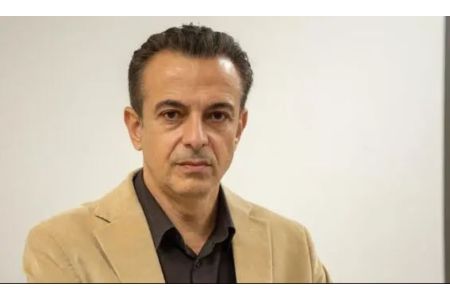
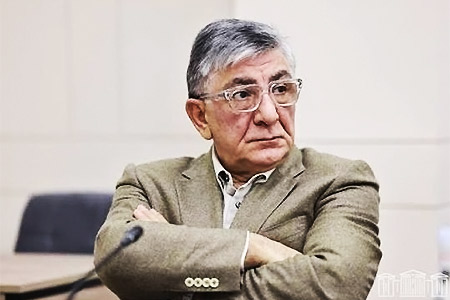
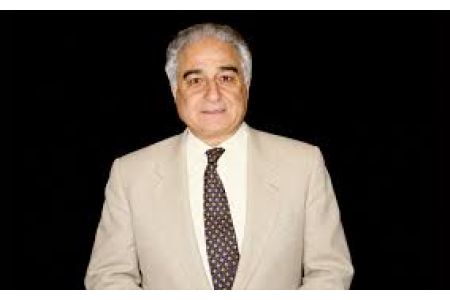
ArmInfo. Azerbaijan is using its program "to settle 300,000 Azerbaijanis in Armenia" as a pretext for further occupying Armenian territories. This viewpoint was expressed by Artur Khachikyan, a political scientist and Stanford University PhD, amidst ongoing conferences in Azerbaijan discussing the "return to Western Azerbaijan, ", i.e Armenia.
Khachikyan noted that Azerbaijani President Ilham Aliyev is demanding that the Armenian regime provide a clear deadline for the "return of 300,000 Azerbaijanis." In this regard, he recalled that there has never been a single directive from Aliyev that his "ambassador" to Armenia (Prime Minister Nikol Pashinyan - ed.) has failed to implement. He also urged the question: where exactly do the Azerbaijanis intend to "return"?
"If we take the figure of 300,000—though some claim the number reaches one million when including descendants—and consider that an average Armenian village houses roughly 1,000 residents, it implies the displacement or evacuation of approximately 300 villages. Even if we consider only one-third of that number, we are talking about 100 villages," he emphasized. He argued that these settlements would likely be established in areas inhabited by Azerbaijanis prior to their departure in 1988, specifically the regions east of Lake Sevan and the Kapan-Gekhi sector of Syunik. According to Khachikyan, these locations are strategically chosen to create "compact zones" of Azerbaijani residence.
In this regard, he noted that these specific villages would effectively bridge the gap between mainland Azerbaijan and the Nakhichevan exclave. "Once established, our neighbors will inevitably raise 'legitimate' questions: Why should these Azerbaijani villages be severed from their compatriots by an Armenian border 'unfairly' drawn by the Bolsheviks? This 'injustice' will then be swiftly corrected," Khachikyan cautioned. "You may not believe me, or anyone else. But look at the map and the facts: there was no order from Aliyev that his 'ambassador' did not carry out. He will definitely do so. And they demand a 'return' to Armenia and have already formed the leadership of the 'Azerbaijani community of Armenia.' Look at the map. Turn off the Public Television of Armenia (PTA), come out of this hypnosis. Think about it, only your mind can save us. We have three weeks (before the parliamentary elections in Armenia – ed.)," Khachikyan concluded.
Concluding his analysis, Khachikyan urged the citizens of Armenia to look beyond official state narratives ahead of the upcoming parliamentary elections. "Do not take my word for it; simply look at the maps and the facts. There hasn't been an order from Aliyev that his " ambassador" has not carried out. He will definitely do so. They are already forming the leadership of the 'Azerbaijani Community of Armenia.' Look at the map. Turn off the state television, come out of this hypnosis, and think. Only your collective reason can save us. We have three weeks left."
It's worth noting that Azerbaijan is currently promoting the "return" of 300,000 Azerbaijanis to their homeland, Armenia. This is happening despite the fact that, according to the 1989 Armenian census, just over 60,000 Azerbaijanis lived in the Armenian SSR, all of whom left Armenia voluntarily and received appropriate compensation from the state. Meanwhile, approximately 500,000 Armenians fled Azerbaijan naked, attempting to save themselves, leaving all their belongings behind. However, no one speaks of them today.
Recall, Nakhichevan, before being transferred to the Azerbaijani SSR in the early 1920s, was part of Armenia and was a region with a predominantly Armenian population. Today, the Azerbaijani authorities have completely erased any trace of Armenian presence in this region. In February 2026, the preamble to the Constitution of the Nakhichevan Autonomous Republic removed references to the fact that the foundations of Nakhichevan's autonomy were laid by international treaties - the Moscow Treaty of March 16, 1921 and the Kars Treaty of October 13, 1921, which are currently in force - replacing it with the wording that this region "is an integral part of the Republic of Azerbaijan."










 Azerbaijani Studies Expert: While Azerbaijan Prepares Its Generation for War, Aliyev’s Aide Calls on Armenia to Prepare Armenian Society for “Peace”
 Turkologist: Azerbaijan will never, under any circumstances, stop pressuring the Armenian people
 Political scientist: We need to move away from the question of "when" and replace it with more important questions
 International Law Specialist: Azerbaijan intends to initiate legal proceedings against Armenia by sentencing Armenian prisoners
 Dmitry Medvedev predicted a Ukrainian-like fate for Armenia amid the country`s shift in foreign policy
 Russian Security Council: In Armenia, they want to force Russian asset owners to dispose of their assets
 Zakharova: Russia ready to discuss with Armenia the prospects for expanding military cooperation as part of a review of bilateral ties
 Tevanyan: Armenia, like Ukraine and Moldova, is being drawn into the EU’s global war
 Yerevan City Hall is considering introducing a valet parking system in the city
 Expert: The circus surrounding the “Albanization” of Armenian culture in the presence of foreign ambassadors in occupied Artsakh is genocide
 Political scientist: If Russian-Armenian relations are destroyed, Turkey will take Russia`s place
 Political scientist: The Armenian public is simply obliged to significantly change the entire content of public discourse and struggle
 Cross tattoos are being removed from the skin of Christian prisoners in Azerbaijan by fire, according to a human rights activist.
 Zakharova: Armenia`s likely introduction of visas with Russia will be a step against Yerevan itself
 Putin: Armenia`s recognition of Karabakh as part of Azerbaijan in Prague has given Russia`s position on this issue an ambivalent character
 Putin: Armenia`s adoption of the law on EU accession means an announcement of its withdrawal from the Eurasian Economic Union
 Aram Vardevanyan: Public demands solutions, not apology scandals in Parliament
 Arrested Armenian oligarch on economy and new jobs