
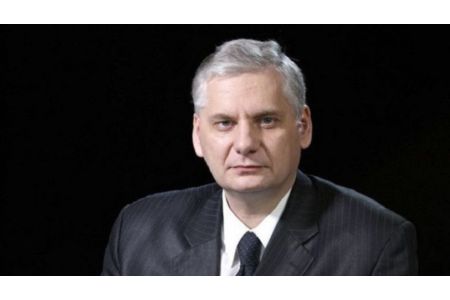
ArmInfo. The collective West is trying to turn Armenia into yet another ideological platform to "contain" Russia in Eurasia, according to Sergei Markedonov, PhD in history and leading research fellow at the Center for Euro-Atlantic Security of the Institute of International Studies at MGIMO University(under the Russian Ministry of Foreign Affairs).
Commenting on the fact that Armenian Prime Minister Nikol Pashinyan will not attend the EAEU summit in Astana on May 28–29 due to the ongoing election campaign—in which his "Civil Contract" party is a participant and a frontrunner—Markedonov noted that "diversification" has become the key term defining the trajectory of Armenia's foreign policy today. The political scientist observed that all top officials in the country, starting with Pashinyan, continuously repeat this word.
"However, it is worth noting an interesting detail! Pashinyan's team's once-popular concept of "Crossroads of Peace" is now less frequently used in public discourse. Armenia, of course, has not removed it from its foreign policy agenda, but today this formula serves more as an umbrella concept rather than the primary public slogan. The explanation for this is not overly complex: official Yerevan has chosen to reformat the country's integration priorities—moving away from closer ties with Russia. While the American vector has somewhat faded in light of recent trends surrounding Iran, the European vector has taken on vibrant new colors," the expert believes.
At the same time, he notes that a reasonable question arises: why doesn't Pashinyan accelerate his geopolitical pivot? Answering his own question, Markedonov pointed out that such acceleration is dangerous, especially on the eve of elections. He drew attention to the fact that those voting for Armenia's ruling power include not only the clients of pro-Western NGOs, but also many ordinary citizens who hold pro-Russian sympathies and are economically tied to the EAEU (even if they do not analytically realize this fact).
"Destroying the customary balance 'here and now' is not in the interest of Pashinyan and Co. 'If we leave the EAEU, we will do so in a planned manner, not abruptly. My assessment is that there is simply no objective necessity for it,' the Prime Minister states. And despite this, he hosts Volodymyr Zelenskyy and top figures of the Brussels Euro-bureaucracy in Yerevan," Markedonov continued.
Furthermore, he suggested looking at what Armenia has actually gained from the outcomes of the European Political Community and EU-Armenia summits in Yerevan. "In May 2026, the EU presented Yerevan as a platform for pan-European dialogue, and Armenia as part of the European political architecture. What is the tangible output? Six non-binding letters of intent, a new draft working agreement between Yerevan and Frontex, and a visa report. This is not a visa-free travel agreement for the Schengen zone, but specifically a report and a set of declarations on continuing the visa liberalization process. The Armenian authorities did not even receive visa-free travel based on the Ukrainian-Georgian-Moldovan scenario as a prize ahead of the June 7 elections," the political scientist pointed out.
According to him, as a result, no functioning integration frameworks have emerged to incorporate Yerevan into the European—and, implicitly, Euro-Atlantic—space with a tangible set of benefits. "For the most part, they are trying to turn Armenia into yet another ideologically driven platform to 'contain' Russia in Eurasia. On one side of the scale, we have a fully functioning EAEU (there are questions regarding the CSTO, but the key here is goal setting: either treating the headache or using the guillotine as a radical remedy), and on the other, the EU-US-NATO axis as a sort of update to 'Wilsonian' Armenia at a new historical stage of development. Maximum declarations, minimum commitments," he continued. However, Markedonov believes that the aforementioned does not mean Russia should seize upon the agenda of Armenia's "Europeanizers" and begin accelerating its own "divorce" from Yerevan. According to him, there are plenty of others willing to do that without Russia's help. The expert is convinced that Russia must not follow the lead of others, but must instead shape and promote its own agenda.
"Armenia is not yet lost for the Russian Federation! And even any electoral success for the Civil Contract party (except triumph) will not mean the complete loss of Russian influence over the country. It will be necessary to fight for it—first and foremost by explaining that there is no real choice between European and Eurasian integration," he said, while acknowledging that there is an attempt to abandon previous, albeit imperfect, priorities in favor of elite, ideologically driven constructs, coupled with domestic socio-political polarization.












 Expert: The arrest of opposition figures in Armenia for social media posts is a systematic attempt to intimidate the public and suppress dissent.
 Azerbaijani Studies Expert: While Azerbaijan Prepares Its Generation for War, Aliyev’s Aide Calls on Armenia to Prepare Armenian Society for “Peace”
 Turkologist: Azerbaijan will never, under any circumstances, stop pressuring the Armenian people
 Political scientist: We need to move away from the question of "when" and replace it with more important questions
 Lukashenko called for Armenia to assume the CIS presidency in 2029
 Dmitry Medvedev predicted a Ukrainian-like fate for Armenia amid the country`s shift in foreign policy
 Russian Security Council: In Armenia, they want to force Russian asset owners to dispose of their assets
 Zakharova: Russia ready to discuss with Armenia the prospects for expanding military cooperation as part of a review of bilateral ties
 Tevanyan: Armenia, like Ukraine and Moldova, is being drawn into the EU’s global war
 Yerevan City Hall is considering introducing a valet parking system in the city
 Expert: The circus surrounding the “Albanization” of Armenian culture in the presence of foreign ambassadors in occupied Artsakh is genocide
 Political scientist: If Russian-Armenian relations are destroyed, Turkey will take Russia`s place
 Political scientist: The Armenian public is simply obliged to significantly change the entire content of public discourse and struggle
 Cross tattoos are being removed from the skin of Christian prisoners in Azerbaijan by fire, according to a human rights activist.
 Zakharova: Armenia`s likely introduction of visas with Russia will be a step against Yerevan itself
 Putin: Armenia`s recognition of Karabakh as part of Azerbaijan in Prague has given Russia`s position on this issue an ambivalent character
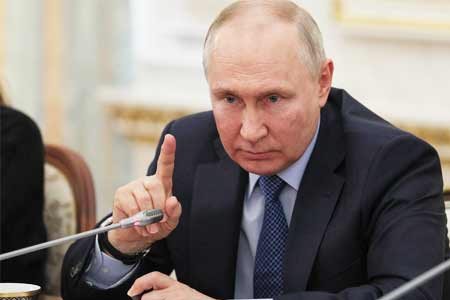 Putin: Armenia`s adoption of the law on EU accession means an announcement of its withdrawal from the Eurasian Economic Union