


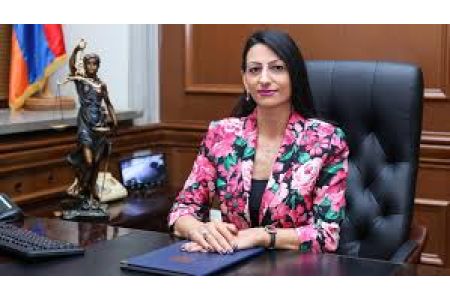
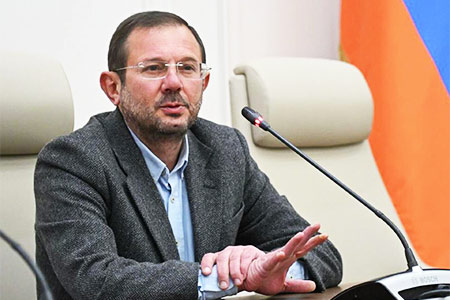
ArmInfo. It is necessary to demand a different model of public communication from Armenian politicians and create a public environment in which it is unacceptable for political forces to use hate speech and incitement to hatred. This was stated by Armenia's Human Rights Defender, Anahit Manasyan, at a training session in Yerevan on "Combating Incitement to Hatred and Sexism Ahead of the Parliamentary Elections in Armenia."
The human rights activist regretted the constant need to remind people that, regardless of the country's political developments, human rights must remain paramount and paramount. She noted that issues of incitement to hatred and discrimination remain particularly pressing in this context. In this regard, she noted that recently, in the run-up to the parliamentary elections, one can increasingly hear politicians using phrases like "act like a man" or "you're a woman, your place is at home with the children, why should you participate in politics?" According to her, such statements may seem insignificant to some, but they are a clear example of entrenched gender stereotypes that continue to manifest themselves actively in Armenian society, including during electoral processes.
"This problem is linked to stereotypical perceptions of social roles and gender differences. For women, this manifests itself not only in assessments of their professional activities but also in discussions of their appearance. This perception needs to be changed, and these issues need to be actively raised in the public space," the Ombudsman emphasized.
As an example, Manasyan noted that gender stereotypes were particularly evident during the municipal elections in Gyumri, where, in her opinion, such instances were systematic. Manasyan called this an extremely dangerous trend, emphasizing that society needs to be clearly informed that such rhetoric is unacceptable.
At the same time, she emphasized that such rhetoric does not always necessarily lead to criminal liability. "It's important to distinguish between cases where rhetoric truly poses a public threat. We're faced with an extremely weak understanding of the rationale for applying criminal law in such cases. Many people believe that if something affects them personally, it should be subject to criminal liability. However, criminal law measures should only be applied when it comes to statements that pose a public danger," Manasyan explained.
Moreover, according to the Ombudsman of Armenia, political forces must demonstrate their position on certain issues, primarily through their own behavior. However, she noted, a serious problem exists today: it is often the leaders of political forces who become the disseminators of hate speech, including discriminatory statements based on gender.
"I don't want to give specific examples now, as we are in the pre-election period. However, after the elections, this issue will be examined more broadly, using the examples of specific political forces. However, this is an extremely dangerous trend, and therefore, it is necessary to demand a different model of public communication from political figures," Manasyan said.
As the human rights activist explained, it is necessary to create a public environment in which it is unacceptable for political forces to use the language of hostility and hatred. "Today, I don't see a consensus or a common understanding of human rights values among public figures in Armenia. And I consider this the most dangerous thing in terms of the country's legal security.
We must work together to establish clear 'red lines' around certain topics so that any processes are viewed primarily through the prism of human rights," Manasyan concluded. It's noteworthy that the Armenian Ombudsman avoided pointing out that it is the current Armenian authorities who are using hate speech, sowing discord, and even displaying disrespect towards women. The images of the Prime Minister of Armenia tugging, yelling, and threatening a woman who dared to express dissatisfaction with his policies during an election campaign on May 18 are still fresh in the minds of Armenian citizens. However, the Armenian Ombudsman made only vague statements on this matter, several hours later and only under public pressure. Let us recall that 19 political forces - 17 parties and 2 blocs - will take part in the upcoming parliamentary elections, scheduled for June 7, 2026.








 Politician: The Moldovan scenario in Armenia will lead to revolution
 American agenda in South Caucasus has two priorities: TRIPP project and increasing pressure on Iran - expert
 Hungary to stop issuing worker visas to citizens of the Philippines, Georgia, and Armenia
 Russia is counting on holding the next "3+3" meeting in Baku or Yerevan
 Robert Kocharyan: Peace treaty with Azerbaijan will include guarantees for peace
 Edmon Marukyan: 1.7mln people must go to polls, and this government will be crushed
 Armenian authorities have turned country into center of a geopolitical struggle - Samvel Karapetyan
  Expert: Pashinyan is finished if most voters go to polls
 It is up to Armenia to decide what kind of jam it will make - RF vice-premier
  Russia again warns Armenia against following Ukraine`s path
 Kocharyan: We go to elections with proven experience and lessons learned
 Europe stands in solidarity with Armenia in the face of the economic coercion by Russia- European Commissioner