

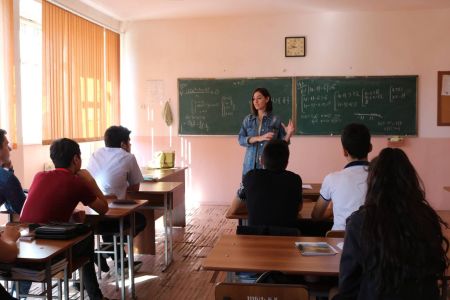
ArmInfo. The RA Government is changing the educational standards in Armenia's general education schools.
At the executive body meeting on May 21, RA Minister of Education, Science, Culture, and Sports Zhanna Andreasyan noted that the state standard for general education has been introduced in all general education schools in the republic for the third academic year, with the exception of grade 12 (introduced only in the Tavush region). During this period, based on monitoring and inspections conducted by the Ministry and its subordinate agencies, and suggestions received from stakeholders in the education sector-principals of general education schools, teachers, students, and parents-the need arose to refine the standard, provide it with clearer regulations, and ensure greater flexibility for general education schools in planning and implementing the educational process.
The standard's core principles have remained largely unchanged. The core requirement and key principle of the standard are formulated as the foundation for the comprehensive development and formation of students' abilities, the goal of which is not only the transfer of knowledge, but above all the development of abilities, a system of values, skills, and attitudes. In other words, the standard is based on the idea that the student is at the center, and education should be aimed at shaping the student's personality, thinking, and value system. The standard emphasizes not simply the reproduction of subject-specific knowledge, but the development of universal and subject-specific abilities essential in the 21st century: critical thinking, communication skills, collaboration, creativity, etc.
Creating equal opportunities for every student in an educational institution is essential, and the principle of inclusive education is emphasized. A key requirement of the standard is the organization of education based on the student's abilities, interests, and individual development, ensuring the development of a system of values, intellectual, social, and practical skills. Starting in the 2025-2026 academic year, the state standard for general education will be implemented in all grades of schools in the Republic of Armenia, with the exception of grade 12, which will be introduced next academic year. The cornerstone of the reforms currently underway in the general education sector is the implementation of the new general education standard, which ensures modern and well-equipped school infrastructure, an inclusive and nurturing environment, high-quality educational content, a highly qualified teaching staff, and transparent and effective school management. The main principle of the standard is the development of life skills and abilities through the active involvement of students in the process of mastering subject material.
The new standard changes approaches to teaching and learning, focusing on students as active, independent thinkers, explorers, and creative and collaborative individuals. The educational process emphasizes the development of natural sciences and mathematics, reading skills, the importance of testing acquired knowledge in practice through project-based learning, and the acceptance of responsibility for learning through collaboration. In addition to knowledge, the new standard emphasizes the development of communication, thinking, analytical, social, civic, and initiative skills across all subjects.
In parallel with improving educational content, starting in 2021, measures are being implemented to improve teacher qualifications, including developing the necessary skills to convey the standard's core principles to students. According to the results of a two-year external independent evaluation of the standard in the Tavush region, student academic performance increased by six months over two years, which is, on average, twice the effectiveness of the standard's implementation in other countries.
According to the results of the International Mathematics and Science Study (TIMSS), fourth-grade students in Armenia improved their mathematics proficiency, showing a 15-point increase compared to the 498 points recorded in 2019. With a score of 513 points, Armenia now belongs to the group of countries demonstrating above-average results. At the same time, the percentage of students failing to meet the minimum threshold in natural sciences has decreased: 82% met the minimum threshold, while 40% met the average threshold. A study conducted among more than 800 children annually showed that 10-year-olds have improved their ability to silently read fiction and non-fiction, as well as to understand, analyze, and draw conclusions from what they read: the number of children with unsatisfactory results decreased from 47% in 2022 to 10% in 2024.
Given that students' academic abilities and skills are primarily developed through project-based learning, the new standards will identify at least two projects with a clear focus on academic performance as an important tool (starting in the 7th grade of elementary school, at least two projects are planned for each semester, one of which is mandatory in the areas of natural sciences, physical education, and biology).
Another area of change concerns the revision of subjects included in the "Physical Education and Health" area. The project envisages expanding the content of the "Basic Military Training" course, with a greater focus on knowledge of emergency procedures and the development of survival skills. The current "Basic Military Training" curriculum primarily develops concepts and practical skills related to military sports training, while only partially developing skills and practical abilities for other emergency situations, creating an imbalance in the full understanding of danger and safety, as well as the ability to overcome them. The current curriculum excludes topics related to national security, information security, and personal and collective security. The course curriculum also does not address the dangers encountered in everyday life or safety issues.
The course taught in 8th grade will be replaced by a new course, "Life Safety," with an expanded scope of study. Students will be able to study this course beginning in 5th grade, exploring various emergency situations, including war, in depth and acquiring the relevant knowledge and response skills. Practical skills development is planned for 11th grade as part of a boot camp. The inclusion of a "Healthy Lifestyle" course in the list of subjects is also a change, further emphasizing the importance of this component in this area. The "Career Guidance" program will continue to function as a mandatory course.
The next area of change concerns the rules for organizing secondary school education using core and targeted programs. Research shows that in advanced education systems, the academic workload of high school students is planned purposefully, allowing students to devote more time to studying their preferred subjects in greater depth, focusing on their interests and preparing for university entrance exams. Given that the structure and content of the standard are organized so that core school provides the opportunity to study the core content of all academic fields, education in high school is organized to deepen acquired knowledge, foster a more systematic understanding and knowledge, and foster interdisciplinary connections. The proposed changes allow high school students to study subjects outside their professional focus within integrated subjects within core programs, as well as study their preferred subjects within targeted programs, deepening their knowledge, skills, and abilities and preparing for university entrance exams. Given the importance of foreign language proficiency, the project stipulates that all high school classes will be required to study two foreign languages.
The teaching of the fundamentals of artificial intelligence will also be expanded. This curriculum is currently being implemented in approximately 40 schools with the support of the Foundation for Armenian Science and Technology (FAST). This school curriculum is a global innovation, and it recently won an award at an industry competition for school curricula in the United States, the minister noted. "We are developing a new initiative with Firebird (the founders of a large data center in Armenia, which will be completed in the coming months - ed.) and OpenAI," the minister stated.
Another change is being made in connection with the recently approved option to take university entrance exams twice - in January and June. Students who successfully pass the January exams will be required to spend the final semester of the school year pursuing research projects or volunteer work. In the future, Andreasyan added, participation in such projects will be taken into account when applying to universities.














 Expert: The arrest of opposition figures in Armenia for social media posts is a systematic attempt to intimidate the public and suppress dissent.
 Azerbaijani Studies Expert: While Azerbaijan Prepares Its Generation for War, Aliyev’s Aide Calls on Armenia to Prepare Armenian Society for “Peace”
 Turkologist: Azerbaijan will never, under any circumstances, stop pressuring the Armenian people
 Political scientist: We need to move away from the question of "when" and replace it with more important questions
 International Law Specialist: Azerbaijan intends to initiate legal proceedings against Armenia by sentencing Armenian prisoners
 Dmitry Medvedev predicted a Ukrainian-like fate for Armenia amid the country`s shift in foreign policy
 Russian Security Council: In Armenia, they want to force Russian asset owners to dispose of their assets
 Zakharova: Russia ready to discuss with Armenia the prospects for expanding military cooperation as part of a review of bilateral ties
 Tevanyan: Armenia, like Ukraine and Moldova, is being drawn into the EU’s global war
 Yerevan City Hall is considering introducing a valet parking system in the city
 Expert: The circus surrounding the “Albanization” of Armenian culture in the presence of foreign ambassadors in occupied Artsakh is genocide
 Political scientist: If Russian-Armenian relations are destroyed, Turkey will take Russia`s place
 Political scientist: The Armenian public is simply obliged to significantly change the entire content of public discourse and struggle
 Cross tattoos are being removed from the skin of Christian prisoners in Azerbaijan by fire, according to a human rights activist.
 Zakharova: Armenia`s likely introduction of visas with Russia will be a step against Yerevan itself
 Putin: Armenia`s recognition of Karabakh as part of Azerbaijan in Prague has given Russia`s position on this issue an ambivalent character
 Putin: Armenia`s adoption of the law on EU accession means an announcement of its withdrawal from the Eurasian Economic Union