
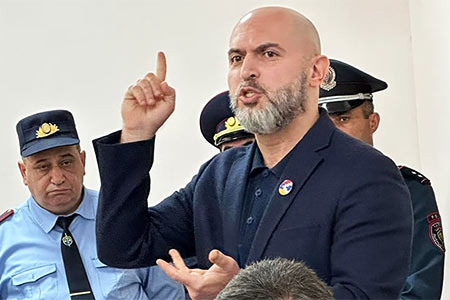
ArmInfo. The Vice Chairman of the Republican Party of Armenia drew the attention of the public, and in particular the opposition, to several problematic aspects of the three documents signed in Yerevan by RA Foreign Minister Ararat Mirzoyan and US Secretary of State Marco Rubio, expressing hope that the opposition will raise these issues in its election campaign.
As a reminder, during the visit, a comprehensive strategic partnership charter, a framework memorandum on the extraction and processing of critical minerals and rare earth elements, and the initialing of a framework agreement on strategic cooperation under the Trump Route for International Peace and Prosperity (TRIPP) project were signed.
In this regard, Ashotyan, in his video address, called for setting aside all geopolitical and diplomatic aspects of the US Secretary of State's unplanned "lightning" visit to Armenia and focusing on the aforementioned documents, which have escaped public attention, especially from the opposition. The RPA Vice Chairman, in particular, pointed to the framework memorandum on the extraction and processing of critical and rare earth minerals, to which the US attaches great importance. In this matter, Washington's goal is not even to displace Moscow and Beijing, but rather the countries of the European Union. It is well known that Armenia's main mineral is molybdenum, which accounts for 7% of the world's total reserves, and the EU countries are its main consumers. Essentially, in accordance with the signed document, Yerevan commits to selling its mineral resources primarily to the US, not the EU. "Thus, Washington wants to take Armenian molybdenum away from the EU. This circumstance, at first glance, is a paradox of this document," the politician said.
He also pointed to the signed charter on the comprehensive strategic partnership, which is an interesting document in itself, as the Biden administration had previously signed a similar agreement with the Armenian side. The new document is comprehensive in nature. A textual analysis reveals some differences between the first and second documents. Specifically, the latter document contains references to the Washington summit on August 8, 2025, nuclear reactors, and other matters, which were not included in the agreement with the Biden administration. This means the new agreement is more specific. "But that's not the point. The point is that the Donald Trump administration likes to tweak the Biden administration's initiatives, turning them into 'unprecedented,' but don't let the word 'comprehensive' mislead you, as in this case, we're talking about merely a cosmetic change in wording. Apart from two or three specific areas, there are no other significant changes," said Armen Ashotyan, adding that the term "comprehensive" implies cooperation in the areas of security and defense. Meanwhile, the document contains no specific hints. Under the term "comprehensive," the United States assumes no obligations to defend Armenia, other than the opportunity to acquire American weapons through a complex scheme. "This document will have virtually no impact on the security and defense of the Armenian state, nor are there any guarantees for its security," the RPA deputy chairman emphasized, adding that there were minor references to cybersecurity. The United States also expressed gratitude to Armenia for its participation in peacekeeping missions in several countries, a process that, according to Ashotyan, began during the presidency of Serzh Sargsyan, the third president of the Republic of Armenia. Ashotyan also noted that American weapons are among the most expensive in the world, if not the most expensive.
Regarding the third document-the agreement on strategic cooperation under the TRIPP project-the politician emphasized that it clearly poses very serious threats to Armenia. First and foremost, it concerns the fact that the Armenian-American project could easily become an Armenian-American-Azerbaijani one. The new document, Armen Ashotyan continued, no longer prohibits the parties from reselling shares in the joint venture being created, where the United States currently owns 74% and Armenia 26%. Moreover, the agreement outlines mechanisms for the sale or transfer of a portion of the shares. "All of this increases our concern that the project will not be solely an Armenian-American one. It is clear that the new document, with the consent of the parties, could transfer some of the shares to a third party, with Turkey and Azerbaijan at the forefront," the RPA vice-chairman noted. He also did not rule out the possibility of Turkish-Azerbaijani firms appearing in Armenia as subcontractors for the project, to whom TRIPP would grant certain powers.
Armen Ashotyan noted that all three documents are nothing more than Washington's support for RA Prime Minister Nikol Pashinyan, who is selling out his homeland to the US for his own PR. The US, however, is not to be blamed; they are simply taking advantage of the opportunities available to them.




















 Expert: Gagik Tsarukyan embodies post-Soviet model of big business-state relations; this model is used in many other post-Soviet countries
 Expert: Azerbaijan promoting aggressive plans against Armenia at state level
 Iranologist: Baku`s propaganda of might masks the country`s inability to provide water to its own population
 Moscow: NATO seeking to "Pull" Armenia away from CSTO Allies
  Political analyst: Russia intends to determine which "Camp" Armenia will choose through a referendum
 Narek Karapetyan will give up his parliamentary salary in favor of charitable contributions.
 Armenia and France discuss further development of strategic partnership and EU cooperation
  To overcome risks Armenia must reduce domestic escalation - expert
  Zatulin: Pashinyan was eager to get back to Russia because he actually lost the elections
 Human rights activist Ruben Melikyan dismissed from YSU
 Pashinyan removed from INNOPROM guest list
 Zakharova: Armenia`s pro-EU pivot poses economic security risks to EAEU member states
 It`s time for South Caucasus countries to think of South Caucasus as single, unified region - RA premier
  Pashinyan: Armenia and Azerbaijan should leave each other alone
 Moscow sees situation with Armenia as attempt to attack Russia-involving integration associations - Russian presidential aid