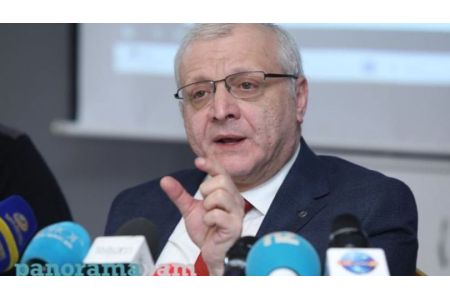
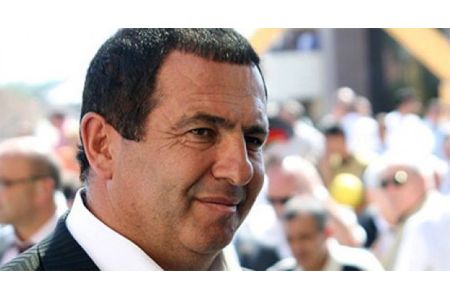
ArmInfo. The "Moldovan scenario" in Armenia could trigger a new political upheaval, according to Suren Surenyants, a politician on the Prosperous Armenia Party (PAP) election list. He made the remarks during a meeting between party leader Gagik Tsarukyan and members of the party.
Surenyants argued that the Armenian authorities have already made a significant misstep during the pre- election period. He criticized the Prime Minister for placing the four main opposition forces in a "single" basket, labeling them a "three-headed war party." "Although it is clear that these forces are very different, with distinct approaches, programs, and rhetoric, when a government whose credibility is waning does something like this, it automatically mobilizes the electorate around the opposition—which is essentially what has happened," Surenyants said. According to the politician, Armenian Prime Minister Nikol Pashinyan is now being pushed toward what he described as another potentially fateful mistake — excluding one or two major opposition forces from the election race.
Surenyants argued that such a move could backfire amid what he described as a sharp shift in public sentiment. He noted that a previously undecided segment of the electorate — estimated at between 40,000 and 50,000 people who did not participate in past elections — is now determined to take part in the upcoming vote and support one of the opposition forces. "It is precisely for this reason that Pashinyan is currently trying to exclude one or two major opposition forces from the race," Surenyants claimed.
Surenyants emphasized that if the authorities implement the first scenario — excluding a single opposition force that crosses the electoral threshold — his party has a plan B. "We are confident that if they specifically target us, a single statement from our leader will be enough to mobilize our electorate, which is among the most active," he said. However, he warned that if a "Moldovan scenario" is applied — referring to the 2020 Moldovan elections, when the Central Election Commission disqualified two political forces at the final stage — it could spark a revolution in Armenia. "Ignoring such a large segment of the electorate is impossible, especially considering that the opposition was far more fragmented in the past than it is today," Surenyants concluded.
It should be noted that ahead of the upcoming parliamentary elections in Armenia, the United States and the European Union have publicly expressed support for Prime Minister Nikol Pashinyan, a development some critics interpret as external involvement in Armenia's domestic political processes. At the same time, there are claims that the EU is not only backing the current government but also promoting the narrative that Russia is engaged in hybrid activities against Armenia. The EU has also deployed a mission aimed at assisting Armenia in "preventing external interference" in the lead-up to the elections. However, some independent analysts argue that, in practice, such assistance could function less as a tool for countering disinformation and more as a mechanism for restricting narratives deemed politically unfavorable to the government.
It should be noted that on March 4, Russian Foreign Ministry spokesperson Maria Zakharova expressed Moscow's readiness to send a mission similar to the European delegation to Armenia, should Yerevan request it. On May 28, 2026, she further announced that Armenia had denied accreditation to several Russian parliamentarians who sought to observe the upcoming parliamentary elections scheduled for June 7. Meanwhile, the Central Election Commission confirmed that delegations from the CIS, OSCE/ODIHR, and PACE will monitor the elections in Armenia.







 Tehran creating security environment in which sustainable shipping in Strait of Hormuz difficult to imagine without its direct participation - expert
  Analyst: The primary issue with Armenia`s new Parliament Speaker`s speech lies is its one-sided interpretation of the causes of the political crisis
 NA Vice Speaker candidate believes his wife`s salary as director of HayPost is the lowest in the company`s history
 RF Permanent Representative: There is no CSTO-Armenia conflict
 Moscow: NATO seeking to "Pull" Armenia away from CSTO Allies
  Political analyst: Russia intends to determine which "Camp" Armenia will choose through a referendum
 Armenia and France discuss further development of strategic partnership and EU cooperation
  To overcome risks Armenia must reduce domestic escalation - expert
  Zatulin: Pashinyan was eager to get back to Russia because he actually lost the elections
 Human rights activist Ruben Melikyan dismissed from YSU
 Zakharova: Armenia`s pro-EU pivot poses economic security risks to EAEU member states
 It`s time for South Caucasus countries to think of South Caucasus as single, unified region - RA premier
  Pashinyan: Armenia and Azerbaijan should leave each other alone