

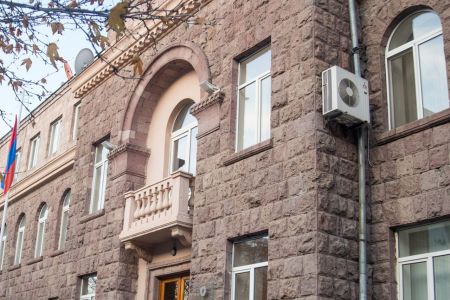
ArmInfo. The Central Electoral Commission (CEC) of Armenia issued a lengthy statement regarding its refusal to schedule re-runs at three polling stations where the parliamentary election results were previously annulled. As a result, Gagik Tsarukyan's Prosperous Armenia party failed to enter parliament by a mere 160 votes. As a result, the picture of the new parliament has taken on a completely different appearance. The CEC of Armenia stated that they should not automatically schedule re-runs after the annulment of the voting results at any polling station.
"When making this decision, the Central Election Commission must consider protecting the true will of voters and ensuring the legitimacy of the election results. Therefore, the CEC must choose a measure that is necessary in the given circumstances, proportionate, and does not cause more distortion than the violation, the consequences of which must be remedied. In the case of a partial repeat vote, the following problem arises. Voters who participated in the main vote cast their ballots when the overall result was not yet known. They did not know who was leading, how many votes there were, which party would pass the threshold, and what impact their vote would have on the final result," the Central Election Commission said in a statement.
The Central Election Commission of Armenia believes that voters participating in the repeat vote will vote in a different situation: for them, the overall picture may be known (in this case, 99.8 percent of voters). The Central Election Commission is confident that, under these circumstances, the will of voters can be formed not on the basis of their initial political preferences or free expression of will, but by calculating the possibility of adjusting the already known result.
"This risk is generally characterized as tactical voting. The Venice Commission also recognized that partial re-votes are not always an appropriate measure. In its 2025 urgent report, it notes that if irregularities affect only a few polling stations, then retaliatory measures could, in principle, be limited to those stations. However, this approach has an important exception: partial re-votes cannot be an appropriate measure if a new vote in those stations, due to the possibility of tactical voting, does not guarantee a fair election result.
From the perspective of equal suffrage, the problem is also obvious. Re-elections can undermine the equality of voters, since one group of voters finds themselves in significantly different starting conditions than others," the Central Election Commission added.
Referring to the Constitutional Court, the CEC of Armenia noted that if the will of voters participating in the main vote has already been legally expressed, then a subsequent re-vote should not have a secondary and deliberate impact on that will.
"Therefore, when calling a repeat vote, the Central Election Commission must also consider whether the same free and equal environment will be ensured during the repeat vote as on the main election day. Does the known result create a risk of tactical voting? Will the rights of voters who have already cast their ballots legally be violated? Have sources of illegal or corrupt influence been neutralized? If the answers to these questions indicate that the repeat vote will not ensure a free, equal, and fair result, then it should not be called. Not calling a repeat vote in such a case does not mean ignoring the violation. It means refusing to pursue measures that could further distort the will of the voters. The Central Election Commission should be guided not by the logic of mechanical re-election, but by the principles of free and equal elections, proportionality, and the protection of the true will of the voters, as guaranteed by the Constitution, as an independent body overseeing the legality of elections in accordance with the Constitution," the institute emphasized.







































 Expert: Economic pressure on Armenia may be virtually painless for other EAEU members, but not for Armenia itself
 Expert on protests in France: Civilizations fade when society loses a vision of the future
 Turkologist: Azerbaijan is not all-powerful—its vulnerabilities should become part of Armenia’s security strategy
 Opinion: The development of the Amulsar mine near the resort town of Jermuk is the beginning of an environmental disaster in Armenia
 Expert: The arrest of opposition figures in Armenia for social media posts is a systematic attempt to intimidate the public and suppress dissent.
 The Armenian Foreign Minister commented on the country`s return to work within the CSTO.
 The Artsakh Public Council expressed outrage at the UN Secretary-General`s behavior
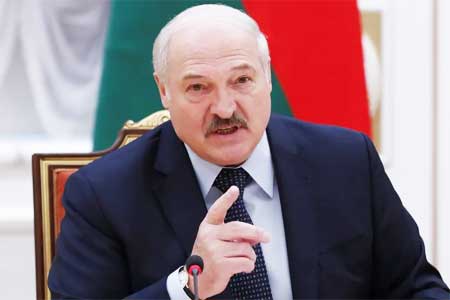 Lukashenko called for Armenia to assume the CIS presidency in 2029
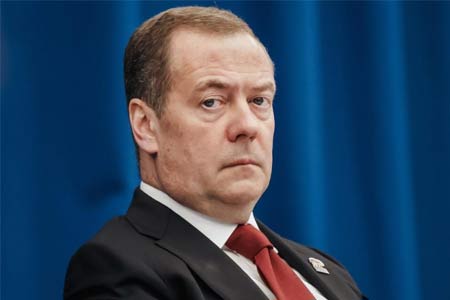 Dmitry Medvedev predicted a Ukrainian-like fate for Armenia amid the country`s shift in foreign policy
 Russian Security Council: In Armenia, they want to force Russian asset owners to dispose of their assets
 Zakharova: Russia ready to discuss with Armenia the prospects for expanding military cooperation as part of a review of bilateral ties
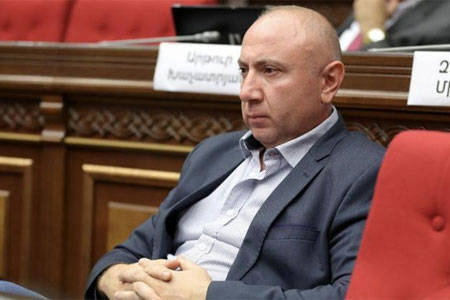 Tevanyan: Armenia, like Ukraine and Moldova, is being drawn into the EU’s global war
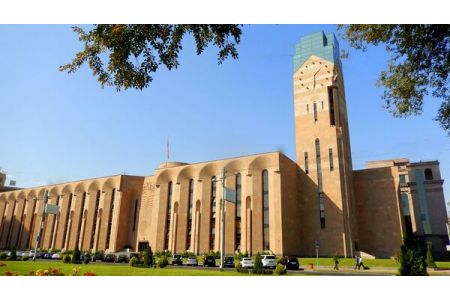 Yerevan City Hall is considering introducing a valet parking system in the city
 Expert: The circus surrounding the “Albanization” of Armenian culture in the presence of foreign ambassadors in occupied Artsakh is genocide
 Political scientist: If Russian-Armenian relations are destroyed, Turkey will take Russia`s place
 Political scientist: The Armenian public is simply obliged to significantly change the entire content of public discourse and struggle
 Cross tattoos are being removed from the skin of Christian prisoners in Azerbaijan by fire, according to a human rights activist.
 Zakharova: Armenia`s likely introduction of visas with Russia will be a step against Yerevan itself
 Putin: Armenia`s recognition of Karabakh as part of Azerbaijan in Prague has given Russia`s position on this issue an ambivalent character
 Putin: Armenia`s adoption of the law on EU accession means an announcement of its withdrawal from the Eurasian Economic Union