

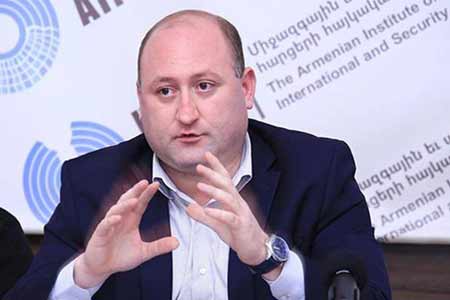
ArmInfo. The resolution of the Armenian-Azerbaijani conflict allows Washington to deprive Russia of key levers of influence in the South Caucasus, according to Americanist Suren Sargsyan.
Regarding the chances of implementing the Trump Route for International Peace and Prosperity (TRIPP) project at this stage, the expert noted that the Trump administration has achieved a level of activity and engagement in the South Caucasus and Central Asia that no American administration has achieved since 1992.
He acknowledged, however, that this is due not only to favorable geopolitical conditions, but also because Russia is focused on the war in Ukraine, as a result of which its involvement and influence in the South Caucasus and Central Asia have significantly weakened. "The same applies to Iran. This circumstance also allowed the Trump administration to play a more active role in the region. However, two key factors that made this process unprecedentedly fast and effective are also crucial here," Sargsyan asserted.
According to him, the first factor is Steve Witkoff. The Americanist noted that, according to available information, Witkoff himself is one of the architects of TRIPP. "The idea of connecting Central Asia with Turkey and Europe through TRIPP is also attributed to his team. This initiative has not only economic and transport significance, but also a significant geopolitical component. It is also important that Witkoff maintains direct contact with Trump, thanks to which, at the initial stage of the project (February 2025), bureaucratic and subordination problems did not arise. In turn, the resolution of the Armenian-Azerbaijani conflict allows Washington to deprive Russia of its most important levers of influence in the South Caucasus - the ability to play a role in the continuation of the conflict," Sargsyan noted. The second important factor in this process, according to the American studies expert, is the Trump administration's management style, which is characterized by a significant reduction in bureaucratic processes, especially in the implementation of key issues, including the use of force (remember how quickly the Panama Canal, Venezuela, and a number of other outstanding issues were resolved).
"Decision-making processes are carried out as quickly as possible, without traditional bureaucratic delays, which allows for the prompt advancement of such large-scale geopolitical projects and their decisions. In this context, President Trump's personal involvement in these processes also plays a crucial role. At the same time, Marco Rubio leads not only the State Department but also the National Security Council, which facilitates closer coordination of foreign policy and national security systems. As a result, competition between various agencies and lengthy interagency agreements are minimized, and decision-making and implementation become faster and more effective," he asserts.
The expert believes that neither Trump nor key members of his team have ever been bureaucrats. Sargsyan added that it is precisely this circumstance that allows them to understand how bureaucracy complicates not only political decision-making but also their implementation, even when it comes to matters of urgent and strategic importance.
"In this regard, the current administration compares favorably with all previous administrations, without exception. These are, of course, key factors, but not all of them.
Of course, there are a number of factors hindering the implementation of TRIPP, even with such serious efforts, but I will discuss them in a separate publication," Sargsyan concluded.
















 Expert: The arrest of opposition figures in Armenia for social media posts is a systematic attempt to intimidate the public and suppress dissent.
 Azerbaijani Studies Expert: While Azerbaijan Prepares Its Generation for War, Aliyev’s Aide Calls on Armenia to Prepare Armenian Society for “Peace”
 Turkologist: Azerbaijan will never, under any circumstances, stop pressuring the Armenian people
 Political scientist: We need to move away from the question of "when" and replace it with more important questions
 International Law Specialist: Azerbaijan intends to initiate legal proceedings against Armenia by sentencing Armenian prisoners
 Lukashenko called for Armenia to assume the CIS presidency in 2029
 Dmitry Medvedev predicted a Ukrainian-like fate for Armenia amid the country`s shift in foreign policy
 Russian Security Council: In Armenia, they want to force Russian asset owners to dispose of their assets
 Zakharova: Russia ready to discuss with Armenia the prospects for expanding military cooperation as part of a review of bilateral ties
 Tevanyan: Armenia, like Ukraine and Moldova, is being drawn into the EU’s global war
 Yerevan City Hall is considering introducing a valet parking system in the city
 Expert: The circus surrounding the “Albanization” of Armenian culture in the presence of foreign ambassadors in occupied Artsakh is genocide
 Political scientist: If Russian-Armenian relations are destroyed, Turkey will take Russia`s place
 Political scientist: The Armenian public is simply obliged to significantly change the entire content of public discourse and struggle
 Cross tattoos are being removed from the skin of Christian prisoners in Azerbaijan by fire, according to a human rights activist.
 Zakharova: Armenia`s likely introduction of visas with Russia will be a step against Yerevan itself
 Putin: Armenia`s recognition of Karabakh as part of Azerbaijan in Prague has given Russia`s position on this issue an ambivalent character
 Putin: Armenia`s adoption of the law on EU accession means an announcement of its withdrawal from the Eurasian Economic Union