

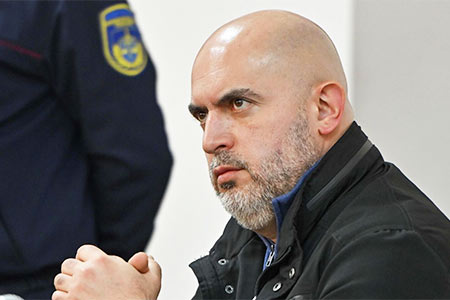
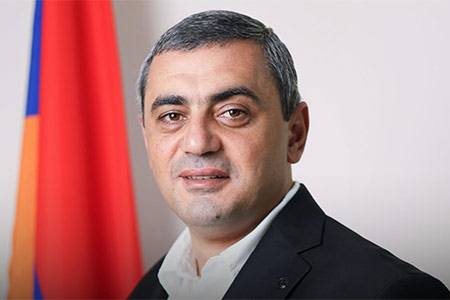
ArmInfo. Armenian universities deserve genuine self- governance, not absolute arbitrary rule by their new political masters, according to Armen Ashotyan, Vice Chairman of the Republican Party of Armenia, who is currently under arrest.
According to him, in 2018, when the "velvet revolution" swept the country, the higher education sector was promised unprecedented development and complete independence. However, nearly a decade later, the latest data from the Academic Freedom Index reveal a shocking reality: the current authorities have not only failed to ensure long-term progress, but have actively contributed to the decline of academic freedom, sinking the country to a lower level than before.
"The comparable index for Armenia has fallen from 0.67 in previous years to 0.58. Nikol Pashinyan's administration has turned what was supposed to be a democratic revival into a classic example of bureaucratic centralization and total control. The tragedy of Armenia's academic trajectory is that the foundations for real progress were once fully available. By 2016, numerous profound reforms had been implemented in line with European best practices, and after the political upheaval of 2018, international organizations provided Pashinyan's government with unique "support." Already in 2019, Armenia's Academic Freedom Index reached a historic high of 0.84. Instead of institutionalizing this newfound opportunity and granting universities real independence, the current government simply squandered it. Instead of protecting the autonomy of universities, the administration introduced legal mechanisms that systematically destroyed the system. The campaign, which began with loud slogans, eventually took a new direction, turning into "This has led to an unprecedented concentration of state control over higher education. The most telling evidence of the current government's policy incompetence is the sharp decline in the institutional autonomy index, which has fallen from 2.1 to a dismal 1.6," Armen Ashotyan said.
He noted that, under a false pretext of modernization and Europeanization, the Ministry of Education, Science, Culture and Sports carried out controversial structural "reforms" that radically changed the composition of university councils. "While universities previously maintained a stable balance, today they are completely constrained by a blind majority appointed directly by the state. By changing the rules of the game and granting the government decisive, exclusive leverage over the appointment of rectors and financial management, the Pashinyan administration has effectively legislated gross state interference. Independent civil society assessments, including CEPA monitoring, have shown that these new administrative obstacles to the formation of councils have simply stifled the de facto independence of leading Armenian universities, turning them into ministerial appendages. The administration's defenders often try to justify this by claiming that individual scholars now have greater freedom to choose their research topics. However, this empty argument brazenly masks the harsh reality: universities are deprived of real academic freedom. The current government has saturated the system with bureaucratic, rigid top- down regulation. As a result, the Campus Integrity score has fallen from a previously stable level of 2.2 to 1.9. The modern Armenian university environment is constrained by a heavy atmosphere of administrative pressure, where state-appointed councils and rectors "They guarantee that institutional decisions invariably reflect the political whims and connivance of the executive branch," the politician emphasized.
He stated that the erosion of university independence is not happening out of nowhere: it is a direct symptom of a general and profound democratic regression that has gripped Armenia in recent years. By early 2018, idealized promises had been completely replaced by completely opaque governance, repression, judicial arbitrariness, and a systemic intolerance of institutional checks and balances. "The numbers don't lie. By allowing the comparable index to decline compared to previous years' levels, the current government has, among other things, sealed a lost decade for the Armenian academic community. Individual freedoms cannot thrive in the long term in the context of structurally vulnerable and repressive institutions. When the government undermines the autonomy of universities to achieve political subordination, it simply limits the intellectual potential of the entire nation. Armenia's universities deserve genuine self-governance, not the absolute arbitrariness of their new political masters," the RPA chairman concluded.










 Expert: Economic pressure on Armenia may be virtually painless for other EAEU members, but not for Armenia itself
 Expert on protests in France: Civilizations fade when society loses a vision of the future
 Turkologist: Azerbaijan is not all-powerful—its vulnerabilities should become part of Armenia’s security strategy
 Opinion: The development of the Amulsar mine near the resort town of Jermuk is the beginning of an environmental disaster in Armenia
 Expert: The arrest of opposition figures in Armenia for social media posts is a systematic attempt to intimidate the public and suppress dissent.
 The Armenian Foreign Minister commented on the country`s return to work within the CSTO.
 The Artsakh Public Council expressed outrage at the UN Secretary-General`s behavior
 Lukashenko called for Armenia to assume the CIS presidency in 2029
 Dmitry Medvedev predicted a Ukrainian-like fate for Armenia amid the country`s shift in foreign policy
 Russian Security Council: In Armenia, they want to force Russian asset owners to dispose of their assets
 Zakharova: Russia ready to discuss with Armenia the prospects for expanding military cooperation as part of a review of bilateral ties
 Tevanyan: Armenia, like Ukraine and Moldova, is being drawn into the EU’s global war
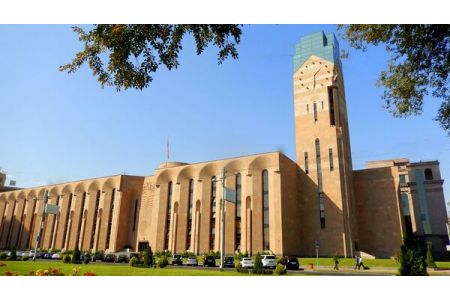 Yerevan City Hall is considering introducing a valet parking system in the city
 Expert: The circus surrounding the “Albanization” of Armenian culture in the presence of foreign ambassadors in occupied Artsakh is genocide
 Political scientist: If Russian-Armenian relations are destroyed, Turkey will take Russia`s place
 Political scientist: The Armenian public is simply obliged to significantly change the entire content of public discourse and struggle
 Cross tattoos are being removed from the skin of Christian prisoners in Azerbaijan by fire, according to a human rights activist.
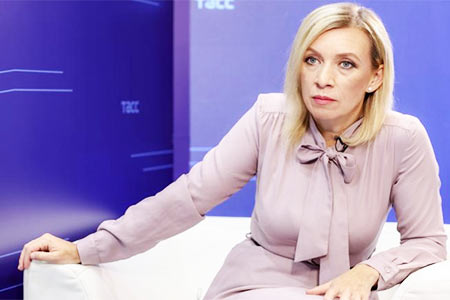 Zakharova: Armenia`s likely introduction of visas with Russia will be a step against Yerevan itself
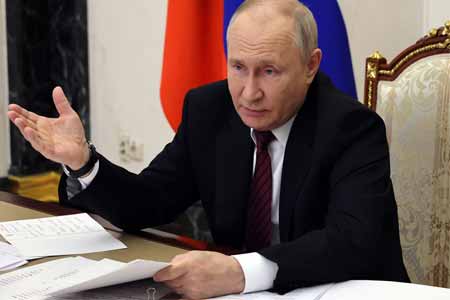 Putin: Armenia`s recognition of Karabakh as part of Azerbaijan in Prague has given Russia`s position on this issue an ambivalent character
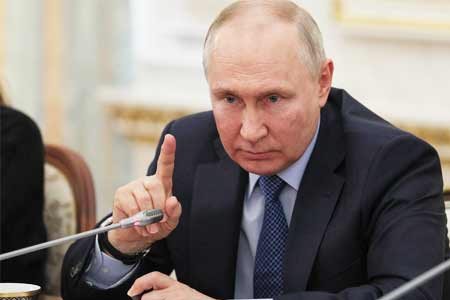 Putin: Armenia`s adoption of the law on EU accession means an announcement of its withdrawal from the Eurasian Economic Union