

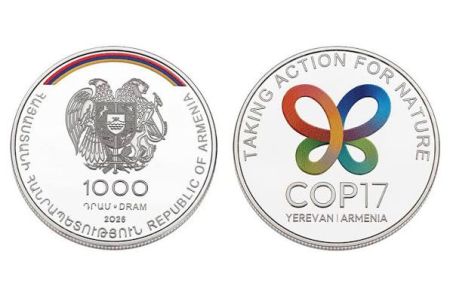
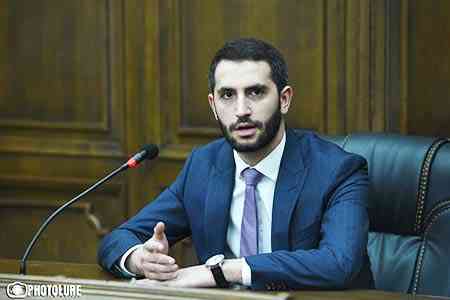
ArmInfo. The Central Bank of Armenia held a ceremony presenting a commemorative coin dedicated to the 17th Conference of the Parties to the Convention on Biological Diversity (COP17). Deputy Minister of Foreign Affairs and International Trade of Armenia Robert Abisogomonyan attended and addressed the event.
According to the press service of the Armenian Foreign Ministry, the diplomat emphasized that the commemorative coin symbolizes not only the upcoming important international event but also the responsibility Armenia assumes by chairing a multilateral process of global significance and contributing to the strengthening of international cooperation. In this context, Armenia's readiness to participate in shaping and advancing global agendas was emphasized.
Abisogomonyan noted that within the framework of COP17, Yerevan will become an important platform for high-level political dialogue and international cooperation, bringing together representatives of states, international organizations, and other stakeholders around global biodiversity conservation issues. It was emphasized that these issues have long gone beyond the environmental agenda and are interconnected with food and water security, healthcare, the economy, and societal sustainability.
Referring to the commemorative coin, Abisogmonyan expressed hope that in the future, it will serve as a reminder not only of Armenia's hosting of COP17 in 2026, but also of Yerevan's role as a platform for dialogue, cooperation, and joint action.
The welcoming remarks at the event were delivered by the Chairman of the Central Bank of Armenia, Martin Galstyan, and the Minister of Environment of Armenia, Ambardtsum Matevosyan.
As a reminder, COP17 will be held in Yerevan this October. The UN Convention on Biological Diversity is one of three key international environmental conventions aimed at guiding the international community's efforts to ensure environmental sustainability, protect biological diversity, restore ecosystems, and sustainably use natural resources.
The Conference of the Parties to the Convention is one of the largest global environmental events, held every two years. During the Conference, participating countries develop mechanisms to implement the provisions of the Convention and adopt new commitments to strengthen the protection of natural resources. Civil society representatives, including representatives of non-governmental organizations, indigenous peoples, the scientific community, women's and youth organizations, and the private sector, actively participate in the work of the Conferences.







 Azerbaijani Studies Expert: While Azerbaijan Prepares Its Generation for War, Aliyev’s Aide Calls on Armenia to Prepare Armenian Society for “Peace”
 Turkologist: Azerbaijan will never, under any circumstances, stop pressuring the Armenian people
 Political scientist: We need to move away from the question of "when" and replace it with more important questions
 International Law Specialist: Azerbaijan intends to initiate legal proceedings against Armenia by sentencing Armenian prisoners
 Dmitry Medvedev predicted a Ukrainian-like fate for Armenia amid the country`s shift in foreign policy
 Russian Security Council: In Armenia, they want to force Russian asset owners to dispose of their assets
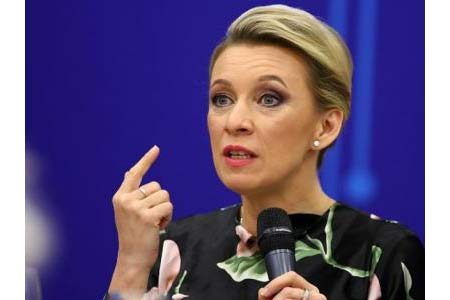 Zakharova: Russia ready to discuss with Armenia the prospects for expanding military cooperation as part of a review of bilateral ties
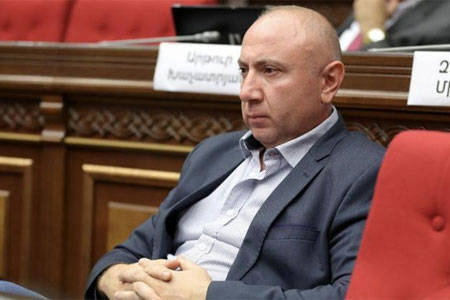 Tevanyan: Armenia, like Ukraine and Moldova, is being drawn into the EU’s global war
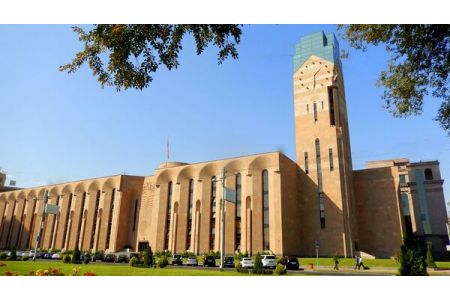 Yerevan City Hall is considering introducing a valet parking system in the city
 Expert: The circus surrounding the “Albanization” of Armenian culture in the presence of foreign ambassadors in occupied Artsakh is genocide
 Political scientist: If Russian-Armenian relations are destroyed, Turkey will take Russia`s place
 Political scientist: The Armenian public is simply obliged to significantly change the entire content of public discourse and struggle
 Cross tattoos are being removed from the skin of Christian prisoners in Azerbaijan by fire, according to a human rights activist.
 Zakharova: Armenia`s likely introduction of visas with Russia will be a step against Yerevan itself
 Putin: Armenia`s recognition of Karabakh as part of Azerbaijan in Prague has given Russia`s position on this issue an ambivalent character
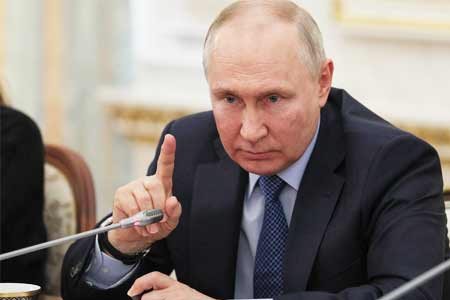 Putin: Armenia`s adoption of the law on EU accession means an announcement of its withdrawal from the Eurasian Economic Union
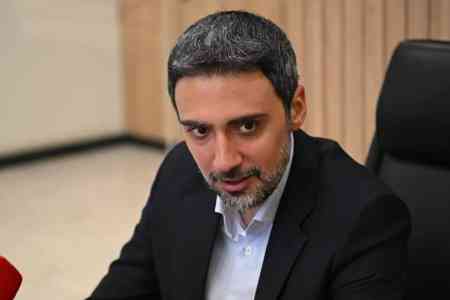 Aram Vardevanyan: Public demands solutions, not apology scandals in Parliament
 Arrested Armenian oligarch on economy and new jobs