
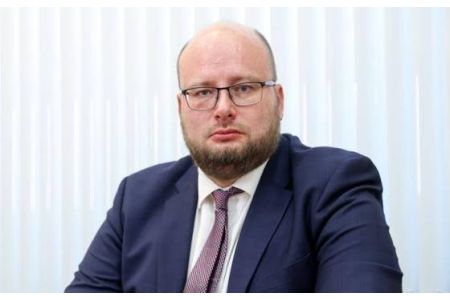
ArmInfo. The South Caucasus is not a chessboard for foreign games, and dividing it into spheres of influence is a dead end. This was stated by Mikhail Kalugin, Director of the Fourth Department of the CIS Countries at the Russian Foreign Ministry.
The diplomat noted that some extra-regional players are seeking to gain a foothold in the South Caucasus, intending to incorporate it into their aggressive, selfish plans.
"We are observing their attempts to curtail interaction between the South Caucasus countries and Iran and China, and to undermine the region's cooperation with one of its key partners—Russia." This cannot be called diversification. However, time has repeatedly shown that the West is incapable of replacing our country in the South Caucasus either as a security guarantor or as an economic partner. We are convinced that the region is not a chessboard for foreign games. Dividing it into spheres of influence is a dead end. "We, as a Caucasian power, have our own national interests in this region, and we will firmly defend them," Kalugin said in an interview with RIA Novosti.
He added that Russia needs the Caucasus as a zone of stability and lasting peace, not for idealistic, but for entirely pragmatic reasons. He said this is a vitally important space for Russia. "Calm and predictability there mean the security of our southern borders, the uninterrupted operation of trade corridors, infrastructure development, and improved well-being for citizens." "We want to have strong and prosperous states next to us, not weak neighbors vulnerable to external pressure," he continued.
According to Kalugin, Russia has much to offer its partners: access to its vast market, transportation connectivity, supplies of a number of critical goods at competitive prices, food and energy security, investment, and cooperation in industry and high technology.
He stated that Russia will continue to promote a constructive agenda in the South Caucasus based on sovereign equality and respect for mutual interests. "We listen and hear our partners, avoiding mentoring and dictatorship. This is our diplomatic culture. These are our principles, which underlie the activities of international formats with Russia's participation, such as the EAEU, CSTO, CIS, BRICS, and SCO. In Western organizations, the situation is different. There, there is bloc discipline. If someone, looking at a map of the South Caucasus, sees a bridgehead against someone, we see human contacts, roads, ports, tourist routes, energy projects, bridges between North and South, East and West. We are ready to work with everyone who shares this logic," he said.
Regarding Armenian-Russian relations, Kalugin noted that Yerevan is saying that our ties are going through a period of "transformation" and that they must now develop "under new conditions."
"We proceed from the premise that if the nature of bilateral relations should somehow change, it should only be with an eye toward positive expansion. We have a comprehensive legal framework with Armenia that enshrines the privileged, allied status of bilateral relations. If the Armenian authorities, as part of "diversification," Foreign policy officials want to revise this status—that's their right. But then they'll also have to give up the preferences that Moscow provides only to its allies," the Russian diplomat said.
He cited the price of gas for Armenia as one example of such preferences. Noting that Russia is not opposed to Armenia purchasing gas from other countries, he called for an alternative to Russian supplies to be considered. "Armenia receives up to 85% of the gas the republic consumes from Russia—about 2.2-2.7 billion cubic meters per year. Supplies are free of export duties, at a fixed price of $177.50 per thousand cubic meters. Armenia also receives petroleum products from Russia duty-free. We've already seen an information campaign spearheaded by Western-funded NGOs and "experts." Its goal was to convince the public that Russian gas is supposedly expensive for the average consumer. True, according to these "analysts," blue fuel from Russia, including all costs, was cheaper than it currently costs, as businessmen say, "at purchase." "The aforementioned conclusions about the 'high cost' of our gas are nothing short of amusing," he noted.
According to him, it's clear that Yerevan will not find the same preferential terms as Russia is currently offering. Kalugin noted that Armenia will have to buy gas at market price, which will lead to new holes in the budget. The diplomat is confident that Armenia should not count on any "subsidies" from Brussels. Since the EU has no money, and if they find something, it will be loans that will increase Armenia's already hefty debt burden.
"Judging by the experience of other countries, Western political strategists will come up with nothing better than calling this the price of independence that Armenia must pay. But ultimately, for its much greater investment, the country will become dependent not on an ally with whom it can negotiate, but on those who will simply dictate their terms and demands without appeal. This is in reference to the political price of gas supplies, which Secretary of the Armenian Security Council Alen Robertovich Simonyan discussed," Kalugin noted.
He also found it difficult to say how actively the republic would have been able to develop its high-tech industry without Russian energy supplies, which provide relatively cheap electricity. In particular, launch an energy-intensive data processing center in Razdan, home to the most powerful thermal power plant operating on Russian natural gas.









 Expert: The arrest of opposition figures in Armenia for social media posts is a systematic attempt to intimidate the public and suppress dissent.
 Azerbaijani Studies Expert: While Azerbaijan Prepares Its Generation for War, Aliyev’s Aide Calls on Armenia to Prepare Armenian Society for “Peace”
 Turkologist: Azerbaijan will never, under any circumstances, stop pressuring the Armenian people
 Political scientist: We need to move away from the question of "when" and replace it with more important questions
 International Law Specialist: Azerbaijan intends to initiate legal proceedings against Armenia by sentencing Armenian prisoners
 Dmitry Medvedev predicted a Ukrainian-like fate for Armenia amid the country`s shift in foreign policy
 Russian Security Council: In Armenia, they want to force Russian asset owners to dispose of their assets
 Zakharova: Russia ready to discuss with Armenia the prospects for expanding military cooperation as part of a review of bilateral ties
 Tevanyan: Armenia, like Ukraine and Moldova, is being drawn into the EU’s global war
 Yerevan City Hall is considering introducing a valet parking system in the city
 Expert: The circus surrounding the “Albanization” of Armenian culture in the presence of foreign ambassadors in occupied Artsakh is genocide
 Political scientist: If Russian-Armenian relations are destroyed, Turkey will take Russia`s place
 Political scientist: The Armenian public is simply obliged to significantly change the entire content of public discourse and struggle
 Cross tattoos are being removed from the skin of Christian prisoners in Azerbaijan by fire, according to a human rights activist.
 Zakharova: Armenia`s likely introduction of visas with Russia will be a step against Yerevan itself
 Putin: Armenia`s recognition of Karabakh as part of Azerbaijan in Prague has given Russia`s position on this issue an ambivalent character
 Putin: Armenia`s adoption of the law on EU accession means an announcement of its withdrawal from the Eurasian Economic Union