

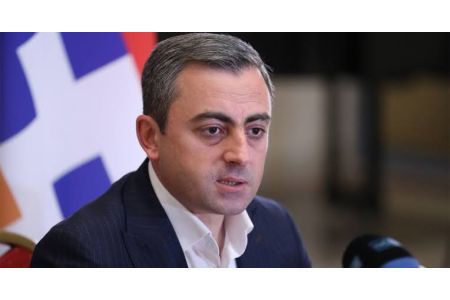
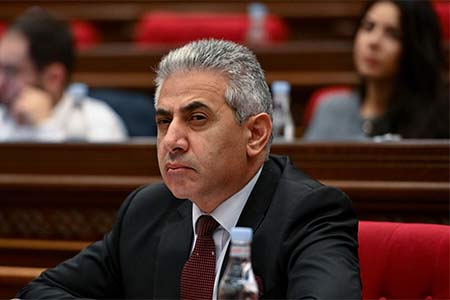
ArmInfo. Ishkhan Saghatelyan, a member of the opposition "Armenia" faction of the National Assembly and a representative of the ARF Supreme Body, answered a question from Armenian Prime Minister Nikol Pashinyan about what was conceded to the enemy during his years in power.
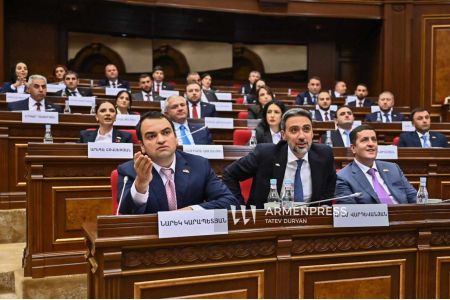
During government hour in parliament on October 7, instead of directly answering specific questions from MPs on a particular topic, the Armenian Prime Minister, in an attempt to avoid answering, began asking various questions himself, including demanding an answer to the question of what he conceded during his years in power.
After parliamentary hour, Saghatelyan listed on his Facebook page, point by point, what Pashinyan surrendered to the enemy.
"Today, from the parliamentary rostrum, Nikol Pashinyan asks in surprise what he I conceded. I presented this list in March 2025. This is an incomplete list of Pashinyan's main concessions. "It would be right if he read this list and shut up every time before asking this question," Saghatelyan wrote, presenting 18 points of concessions from the Armenian prime minister.
The opposition leader recalled that, on Pashinyan's orders (according to his explanation, "by verbal agreement"), the Armenian Armed Forces withdrew from their positions in December 2020, leaving the commanding heights in Syunik under Azerbaijani control, and this concession was later justified by the threat of war.
Furthermore, according to him, on May 12, 2021, the Azerbaijani armed forces invaded Armenia's sovereign territory without resistance—the Black Lake area of the Syunik region, then areas near
the settlements of Verin, Shorzha, and Kut in the Gegharkunik region—and occupied approximately 41 square kilometers. Territory.
"And again, without resistance, you surrendered strategic positions, saying: 'Do we really need these mountains where snow lies for six months?'" Furthermore, in November 2021, a 21-kilometer section of the Goris-Kapan interstate road and part of the village of Shurnukh were handed over to Azerbaijan. Moreover, on November 15, 2021, the Azerbaijani side established a checkpoint on a section of the Kapan-Chakaten highway, thus ceding the road to the enemy, cutting off short and convenient communication between six adjacent villages and Kapan," Saghatelyan continued.
He recalled that in March 2022, Azerbaijani units, without firing a single shot, peacefully intruded approximately one kilometer into the administrative territory of Nerkin Hand in the Syunik region and set up five tents there, consolidating control over new territories.
"In April 2022, Pashinyan announced a lowering of the bar on the Artsakh issue, fulfilling Azerbaijan's precondition that Armenia renounce its defense of Artsakh's right to self-determination. On August 25, 2022, Berdzor, Aghavno, and Sus were handed over to Azerbaijan. The transfer of the Lachin corridor, connecting Artsakh with Armenia, along with adjacent settlements, to Azerbaijan was not envisaged in the trilateral statement of November 9, 2020. With the transfer of settlements, the gas pipeline and power line supplying Artsakh also came under Azerbaijani control, which had devastating consequences during the Artsakh blockade. Moreover, as a result of all this, the enemy reached the approaches to the village of Tekh in the Goris region, seizing the village's lands and pastures," the Dashnaktsakan further noted. Saghatelyan noted that on September 13-14, 2022, Azerbaijani armed forces invaded the sovereign territory of Armenia in the directions of Gegharkunik, Syunik, and Vayots Dzor, increasing the scale of the occupation to 220 square kilometers. He noted that the Armenian side had more than 200 casualties at the time, and the main reason for this was the previous surrender of strategic positions in this direction.
"In 2022, in Prague, Pashinyan verbally agreed, and then in 2023, in Granada, with written consent, to fulfill Azerbaijan's latest demand by recognizing Artsakh as part of Azerbaijan. In Granada, Pashinyan even signed a unilateral document recognizing Azerbaijan's territorial integrity to the nearest 86,600 square kilometers. In return, Aliyev has still not recognized the territorial integrity of the Republic of Armenia, with its clearly defined territory and borders. Later, citing these very statements, Azerbaijan blocked the Lachin corridor, besieging Artsakh. And in September 2023—during the attack on Artsakh and the ethnic cleansing in Artsakh—Pashinyan fulfilled Azerbaijan's demand: he left the Artsakh Armenians alone, publicly refusing to ensure the safety of approximately 120,000 Armenian citizens," he continued.
According to the Dashnak, on February 28, 2024, the Armenian side, as a gesture of goodwill, returned Ruslan Penakhov, who had crossed the line of contact in the Tekh community, to Azerbaijan without obtaining the return of the prisoners in return. The same thing happened with the Azerbaijanis who invaded Armenian territory from the Sisian area and killed an Armenian citizen in Kapan. They were also returned to Azerbaijan without exchange.
"In 2024, another unilateral concession under the threat of war occurred in Tavush, where Armenian troops withdrew from their occupied positions, transferring the territory of four villages to Azerbaijani control. Moreover, at Azerbaijan's request, Pashinyan refused to discuss the protection of the rights of Artsakh Armenians and their return during the negotiations, considering the Artsakh issue closed and thereby attempting to legitimize the genocide committed by Azerbaijan in Artsakh," the oppositionist continued.
The MP noted that during the negotiation process, Azerbaijan put forward the precondition of amending the Armenian Constitution, and several months later, Pashinyan declared that Armenia needed a new Constitution, setting a specific timeline for a referendum.
"During the negotiation process, Ilham Aliyev also put forward a demand for a joint statement on the dissolution of the OSCE Minsk Group." In his post, Nikol Pashinyan agreed to fulfill this demand as well. The long-discussed document left unresolved Azerbaijan's demands to withdraw claims from international courts and not to deploy forces along the border. In March 2025, Azerbaijan declared that Armenia had agreed to these points as well. Thus, Azerbaijan's demand for Armenia's demilitarization has partially become a reality," he noted.
According to Saghatelyan, at Azerbaijan's request, the agreement with Armenia included a clause committing the parties to combat forces operating within the country that are "against the peace agenda," thereby giving Azerbaijan the opportunity to interfere in Armenia's internal affairs.
"On June 12, July 3, October 19, November 1, and November 29, 2021, Nikol Pashinyan, without preconditions, handed over to Azerbaijan 972 minefield logs located in Artsakh. In January 2024, he handed over eight more new minefield logs to Baku. These maps were of exceptional importance, since without them, demining the mined areas would have taken 10-15 years. This list of concessions does not include the results of the 44-day war, as a result of which we lost our victory, the second Armenian statehood – Artsakh – with a territory of 12,000 square kilometers, a thousand-year-old historical and cultural heritage, monuments, mines, and all its wealth," Saghatelyan emphasized.
Dashnaktsakan emphasized that these are the main concessions that were made unilaterally within the framework of written or verbal agreements with Aliyev.
"However, Baku's demands do not end there: Azerbaijan is effectively demanding amendments to the Armenian Constitution, as well as the provision of a "corridor" (of course, this will be called providing a road), the resettlement of Azerbaijanis in Armenia, the transfer of "enclaves." Consequently, all attempts by the capitulator to falsify facts, lie, distort reality, and hide his destructive role for the nation have already been exhausted," wrote Saghatelyan.













 Expert: The arrest of opposition figures in Armenia for social media posts is a systematic attempt to intimidate the public and suppress dissent.
 Azerbaijani Studies Expert: While Azerbaijan Prepares Its Generation for War, Aliyev’s Aide Calls on Armenia to Prepare Armenian Society for “Peace”
 Turkologist: Azerbaijan will never, under any circumstances, stop pressuring the Armenian people
 Political scientist: We need to move away from the question of "when" and replace it with more important questions
 International Law Specialist: Azerbaijan intends to initiate legal proceedings against Armenia by sentencing Armenian prisoners
 Dmitry Medvedev predicted a Ukrainian-like fate for Armenia amid the country`s shift in foreign policy
 Russian Security Council: In Armenia, they want to force Russian asset owners to dispose of their assets
 Zakharova: Russia ready to discuss with Armenia the prospects for expanding military cooperation as part of a review of bilateral ties
 Tevanyan: Armenia, like Ukraine and Moldova, is being drawn into the EU’s global war
 Yerevan City Hall is considering introducing a valet parking system in the city
 Expert: The circus surrounding the “Albanization” of Armenian culture in the presence of foreign ambassadors in occupied Artsakh is genocide
 Political scientist: If Russian-Armenian relations are destroyed, Turkey will take Russia`s place
 Political scientist: The Armenian public is simply obliged to significantly change the entire content of public discourse and struggle
 Cross tattoos are being removed from the skin of Christian prisoners in Azerbaijan by fire, according to a human rights activist.
 Zakharova: Armenia`s likely introduction of visas with Russia will be a step against Yerevan itself
 Putin: Armenia`s recognition of Karabakh as part of Azerbaijan in Prague has given Russia`s position on this issue an ambivalent character
 Putin: Armenia`s adoption of the law on EU accession means an announcement of its withdrawal from the Eurasian Economic Union