

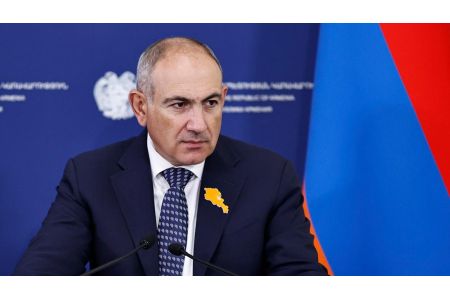
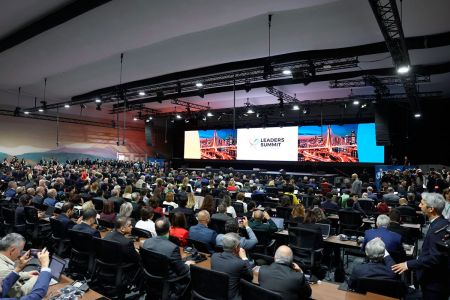
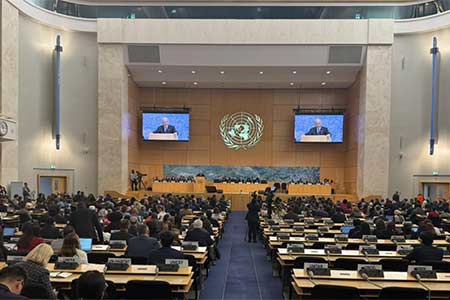
ArmInfo. The international community has already formulated the concept of "living in harmony with nature" and, in 2022, adopted the Kunming-Montreal Global Biodiversity Framework, setting goals and clear benchmarks until 2030. Armenia, however, is halfway to achieving these benchmarks. This was stated by Armenian Prime Minister Nikol Pashinyan at the opening plenary session of the "Leaders for Nature" summit, held as part of COP17 (the 17th Conference of the Parties to the Convention on Biological Diversity) at the Meridian Expo Center.
As a result of consistent work, Pashinyan explained, over the past 10 years, the total stock (biomass) of whitefish in Lake Sevan has grown more than tenfold: from several hundred tons during the crisis period of the mid-2010s, when the stock was essentially on the brink of extinction, to over 4,500 tons as of July 2026.
He noted that the government is also implementing a program to restore Sevan trout stocks and develop fish farming in Lake Sevan. Before 2025, Sevan trout stocks in the lake were insignificant, amounting to no more than 20 tons. In 2025, they were estimated at approximately 138 tons, and as of July 2026, they reached 374 tons. Today, trout are once again being caught in Sevan fishermen's nets. They say they only remember seeing them so often from stories told by their grandfathers.
According to him, a program to restore and develop the brook trout population is also being successfully implemented in Armenia's high-mountain rivers. A broodstock has already been established, and the resulting fry are planned to be regularly released into Armenia's high-mountain rivers. This year alone, approximately 50,000 fry are planned to be released.
Program "This is another success story for us. This species was also considered extinct in Armenia. However, between 2022 and 2025, a total of 22 individuals were released into their natural habitat. Eight cubs have already been born in the wild, indicating that the relocated animals have begun to reproduce successfully in the wild," he said.
Despite these successes, as the Prime Minister noted, unfortunately, illegal logging and poaching continue in Armenia, as well as examples of the illegal exploitation of natural resources. To address these problems, just two years ago, the authorities began creating the Ecopatrol Service in the Republic of Armenia, essentially an environmental police force, which now operates in four of the country's ten regions.
We will consistently implement it in the remaining regions. The service's goal is to ensure round-the-clock environmental protection. We intend to develop it both technically and substantively, as well as enhance the professionalism and integrity of our employees. Our forests have a very high capacity for restoration. At the same time, we are implementing and must continue to implement reforestation programs. However, it is important to understand that without forest protection and the development of environmentally responsible behavior among people, it will be very difficult to achieve significant results," the head of government said. The prime minister identified bringing the mining industry into compliance with modern environmental standards as a particular challenge for our country. Despite the difficulties, he noted that Armenia is moving in this direction.













 Opinion: The development of the Amulsar mine near the resort town of Jermuk is the beginning of an environmental disaster in Armenia
 Expert: The arrest of opposition figures in Armenia for social media posts is a systematic attempt to intimidate the public and suppress dissent.
 Azerbaijani Studies Expert: While Azerbaijan Prepares Its Generation for War, Aliyev’s Aide Calls on Armenia to Prepare Armenian Society for “Peace”
 Lukashenko called for Armenia to assume the CIS presidency in 2029
 Dmitry Medvedev predicted a Ukrainian-like fate for Armenia amid the country`s shift in foreign policy
 Russian Security Council: In Armenia, they want to force Russian asset owners to dispose of their assets
 Zakharova: Russia ready to discuss with Armenia the prospects for expanding military cooperation as part of a review of bilateral ties
 Tevanyan: Armenia, like Ukraine and Moldova, is being drawn into the EU’s global war
 Yerevan City Hall is considering introducing a valet parking system in the city
 Expert: The circus surrounding the “Albanization” of Armenian culture in the presence of foreign ambassadors in occupied Artsakh is genocide
 Political scientist: If Russian-Armenian relations are destroyed, Turkey will take Russia`s place
 Political scientist: The Armenian public is simply obliged to significantly change the entire content of public discourse and struggle
 Cross tattoos are being removed from the skin of Christian prisoners in Azerbaijan by fire, according to a human rights activist.
 Zakharova: Armenia`s likely introduction of visas with Russia will be a step against Yerevan itself
 Putin: Armenia`s recognition of Karabakh as part of Azerbaijan in Prague has given Russia`s position on this issue an ambivalent character
 Putin: Armenia`s adoption of the law on EU accession means an announcement of its withdrawal from the Eurasian Economic Union