


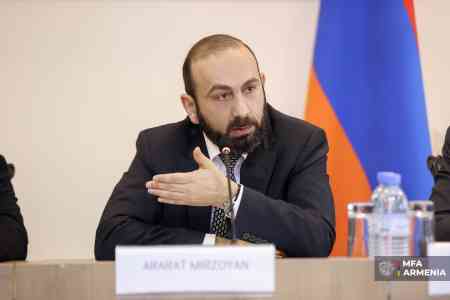
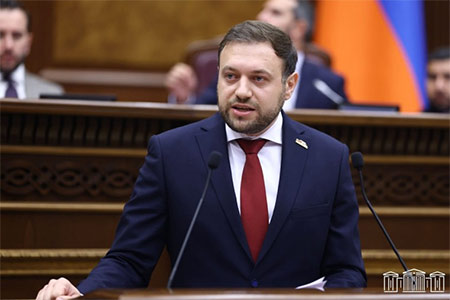
ArmInfo. The draft law "On Ratification of the Framework Agreement on Strategic Partnership between Armenia and the United States of America within the Trump Route for International Peace and Prosperity (TRIPP) Project" was discussed at a meeting of the Armenian Parliament's Standing Committee on Foreign Affairs on October 21. Armenian Foreign Minister Ararat Mirzoyan will be the keynote speaker on the draft law at the parliamentary committee.
At the beginning of his speech, the minister mentioned the declaration adopted at the Washington Peace Summit on August 8, 2025, which formalized the establishment of peace between Armenia and Azerbaijan. The importance of opening transport infrastructure between Armenia and Azerbaijan was also noted, with the understanding that these links will be opened based on the sovereignty, jurisdiction, and territorial integrity of Armenia and Azerbaijan and will become an important hub for passenger and freight transport from east to west.
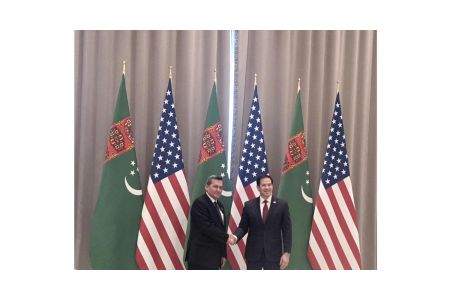
"On January 13, 2026, Ararat Mirzoyan and US Secretary of State Marco Rubio signed a document entitled the 'TRIPP Implementation Framework Agreement.'" There had been considerable speculation surrounding the project. This document on the project's implementation eloquently and decisively dispelled many concerns. Following this document, negotiations continued, and this agreement was signed by Armenia and the United States," the diplomat noted, adding that the agreement had completed all necessary procedures.
Referring to several provisions of the document, Mirzoyan spoke about its geopolitical and direct benefits, emphasizing the lifting of the blockade against Armenia, unprecedented economic opportunities it had never experienced, Armenia's ties with both the East and the West, the strengthening of peace, and other important circumstances.
"Any infrastructure that will function, any relations that will be established, will be implemented fully and in detail based on or within the framework of several fundamental principles. These principles are familiar to all of you: sovereignty, territorial integrity, jurisdiction." "As for the infrastructure located on our territory, naturally, the absolute jurisdiction, sovereignty, and territorial integrity of the Republic of Armenia will be preserved," Mirzoyan emphasized, reiterating that the Republic of Armenia's sovereignty over infrastructure and processes is preserved.
He presented the provisions of the document, according to which the Republic of Armenia retains full sovereignty and jurisdiction over its borders and customs operations, undertakes to ensure effective border management, and has the right to maintain a physical presence at all its border control points.
According to him, Armenia, in accordance with its domestic legislation and international agreements, continues to be responsible for the following: activities in the field of security and law enforcement; border control and border security; customs and migration control; transfer of taxes and duties to the state budget; Information systems and public administration and oversight.
Mirzoyan also raised a number of questions regarding the management of TRIPP, the distribution of its shares, and clarified a number of circumstances.
"The distribution of shares will be carried out as follows: the United States will own 74% of the company's shares, and Armenia will own 26%. This agreement will be in effect for 49 years. The parties can extend their legal relationship, in which case Armenia's share will immediately reach 49%, while the US share will reach 51%," he recalled.
During the question-and-answer session, as well as presentations, numerous substantive and technical issues were discussed, including the possibility of legislative amendments to implement the agreement, economic benefits in the event of transit, infrastructure security, Armenia's rights in emergency situations, the progress of TRIPP construction, the issue of the simultaneity of the peace process and TRIPP implementation, the organization of border crossings, military-political, geopolitical, and other issues.
"Azerbaijan will receive the right of passage through the territory of the Republic of Armenia to Nakhichevan, and Azerbaijan will connect with third countries through our territory. The Republic of Armenia will receive mutual benefits from using Azerbaijani territory for connections, for example, by rail, from Yeraskh to Meghri and from north to south, and for connecting with third countries via infrastructure through Azerbaijani territory. "This is reciprocity," he assured, without providing clear answers to a number of questions raised by the opposition.
At the end of the discussions, Committee Chairman Sargis Khandanyan called the draft fundamental in terms of strategic relations between the Republic of Armenia and the United States, as there is no such cooperation between the two countries. "The world's leading superpower is preparing for large-scale investments, and a century-long future is opening up for Armenia," the Committee Chairman noted.
Following the discussions, the Committee gave a positive opinion on the draft law. It will be included on the agenda of the upcoming plenary session of Parliament, scheduled for next week.












 Expert on protests in France: Civilizations fade when society loses a vision of the future
 Turkologist: Azerbaijan is not all-powerful—its vulnerabilities should become part of Armenia’s security strategy
 Opinion: The development of the Amulsar mine near the resort town of Jermuk is the beginning of an environmental disaster in Armenia
 Expert: The arrest of opposition figures in Armenia for social media posts is a systematic attempt to intimidate the public and suppress dissent.
 The Artsakh Public Council expressed outrage at the UN Secretary-General`s behavior
 Lukashenko called for Armenia to assume the CIS presidency in 2029
 Dmitry Medvedev predicted a Ukrainian-like fate for Armenia amid the country`s shift in foreign policy
 Russian Security Council: In Armenia, they want to force Russian asset owners to dispose of their assets
 Zakharova: Russia ready to discuss with Armenia the prospects for expanding military cooperation as part of a review of bilateral ties
 Tevanyan: Armenia, like Ukraine and Moldova, is being drawn into the EU’s global war
 Yerevan City Hall is considering introducing a valet parking system in the city
 Expert: The circus surrounding the “Albanization” of Armenian culture in the presence of foreign ambassadors in occupied Artsakh is genocide
 Political scientist: If Russian-Armenian relations are destroyed, Turkey will take Russia`s place
 Political scientist: The Armenian public is simply obliged to significantly change the entire content of public discourse and struggle
 Cross tattoos are being removed from the skin of Christian prisoners in Azerbaijan by fire, according to a human rights activist.
 Zakharova: Armenia`s likely introduction of visas with Russia will be a step against Yerevan itself
 Putin: Armenia`s recognition of Karabakh as part of Azerbaijan in Prague has given Russia`s position on this issue an ambivalent character
 Putin: Armenia`s adoption of the law on EU accession means an announcement of its withdrawal from the Eurasian Economic Union