
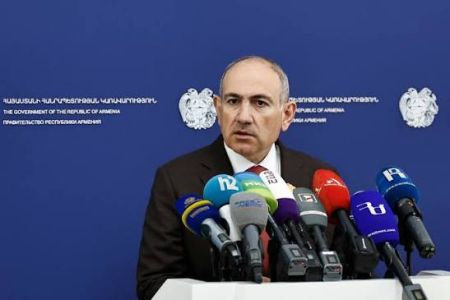
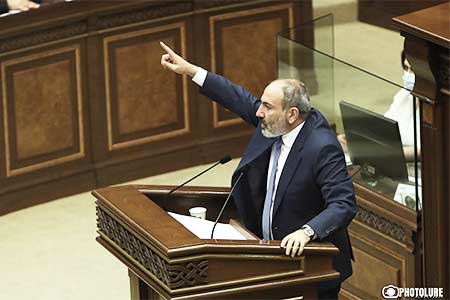
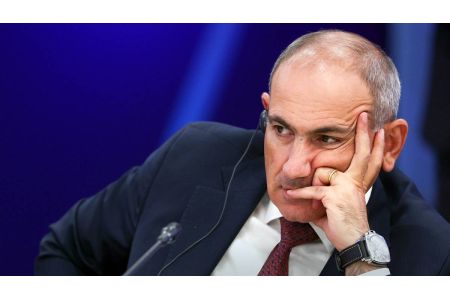
ArmInfo. In the period preceding the sanctions, the restrictions imposed on Armenia did not lead to the economic or political consequences expected by certain circles in Armenia and abroad. Armenian Prime Minister Nikol Pashinyan stated this during a briefing on October 22, answering journalists' questions.
He noted that this is the third attempt in the last three years to achieve a similar outcome, including destabilizing Armenia's domestic political situation, with the very specific goal of de facto eliminating Armenia's independence.
The Prime Minister recalled that the first instance was the events of 2023, when, in Nagorno-Karabakh, in the presence of Russian peacekeepers, a stream of people was essentially diverted to Armenia, while calls for a change of political power were simultaneously heard from prominent sources. "This attempt failed," Pashinyan emphasized. He cited the June 2026 parliamentary elections as a second attempt, which, he said, also failed. "Now, essentially, a third attempt is being made. And, of course, this is undoubtedly part of the widely discussed "secret plan,"" he said.
In this vein, the prime minister expressed the opinion that it is more than obvious that there are no economic motives here, but rather, in essence, we are dealing with a political component. "The goal is to provoke domestic political instability in Armenia and, as a result, establish control over the state. That is, first de facto, and then de jure, to deprive Armenia of independence. In essence, the processes of recent decades have had precisely this purpose. "But I am convinced that Armenia's statehood is quite resilient and will overcome this situation," he emphasized.
Referring to the report "On the possible consequences of suspending the Treaty on the Eurasian Economic Union of May 29, 2014, with respect to the Republic of Armenia," the head of government noted that even this document stipulates that member states do not have the right to expel a country from the Organization. He noted, somewhat humorously, that for the first time in Armenia's history, the mother country is not pulling it closer, but is indirectly saying that it will expel us.
This has never happened before in the history of the Armenian people, and this is also a very remarkable fact that needs to be recorded. "We will continue to work on the rest," Pashinyan noted.
It should be noted that a few days earlier, the Russian government's website published a report "On the Possible Consequences of Suspension of the Treaty on the Eurasian Economic Union of May 29, 2014, in Relation to the Republic of Armenia," in which experts touched on both the political and economic consequences for Armenia in the event of its withdrawal from the EAEU. The report is available at the following link: http://static.government.ru/media/files/BrqMDtjpIH9d9amtYn6CmKXEJcZQrCUG. pdf
Recall that relations between Moscow and Yerevan have worsened against the backdrop of Armenia's integration course toward the EU.















 Expert: Economic pressure on Armenia may be virtually painless for other EAEU members, but not for Armenia itself
 Expert on protests in France: Civilizations fade when society loses a vision of the future
 Turkologist: Azerbaijan is not all-powerful—its vulnerabilities should become part of Armenia’s security strategy
 Opinion: The development of the Amulsar mine near the resort town of Jermuk is the beginning of an environmental disaster in Armenia
 Expert: The arrest of opposition figures in Armenia for social media posts is a systematic attempt to intimidate the public and suppress dissent.
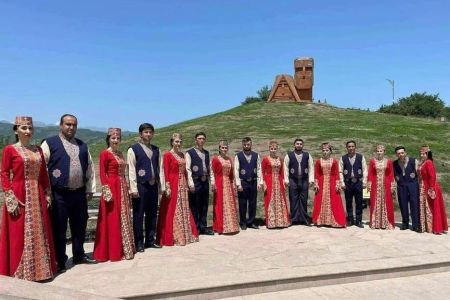 The participation of Artsakh ensembles in an international festival in Vienna was cancelled following the intervention of several foreign embassies
 Expert: It`s time for Armenia to move away from uncertainty and choose between West and East
 The Armenian Foreign Minister commented on the country`s return to work within the CSTO.
 The Artsakh Public Council expressed outrage at the UN Secretary-General`s behavior
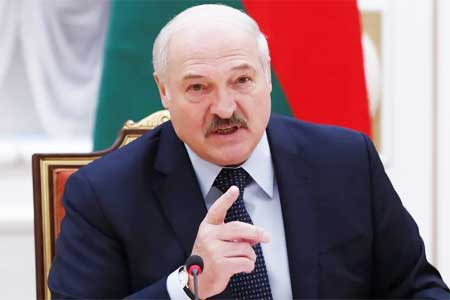 Lukashenko called for Armenia to assume the CIS presidency in 2029
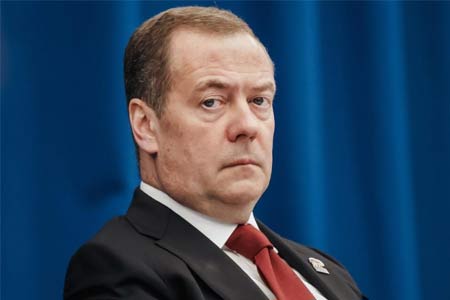 Dmitry Medvedev predicted a Ukrainian-like fate for Armenia amid the country`s shift in foreign policy
 Russian Security Council: In Armenia, they want to force Russian asset owners to dispose of their assets
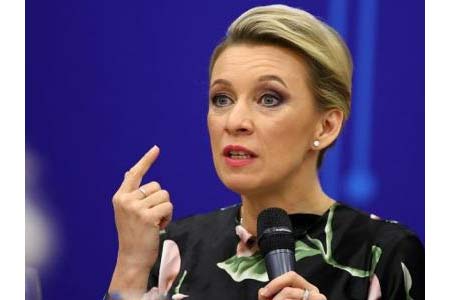 Zakharova: Russia ready to discuss with Armenia the prospects for expanding military cooperation as part of a review of bilateral ties
 Tevanyan: Armenia, like Ukraine and Moldova, is being drawn into the EU’s global war
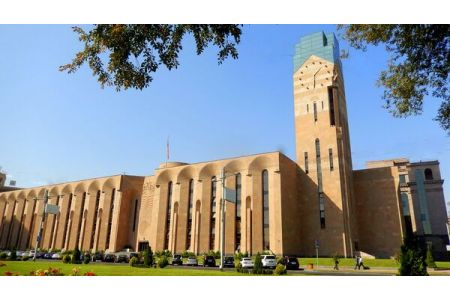 Yerevan City Hall is considering introducing a valet parking system in the city
 Expert: The circus surrounding the “Albanization” of Armenian culture in the presence of foreign ambassadors in occupied Artsakh is genocide
 Political scientist: If Russian-Armenian relations are destroyed, Turkey will take Russia`s place
 Political scientist: The Armenian public is simply obliged to significantly change the entire content of public discourse and struggle
 Cross tattoos are being removed from the skin of Christian prisoners in Azerbaijan by fire, according to a human rights activist.