
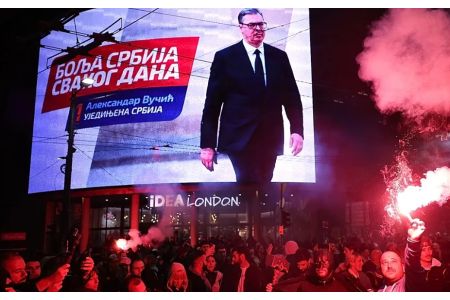
Arminfo. The “Student List” is leading in Serbia’s elections, Vučić has conceded defeat. The “Student List” won the parliamentary elections in the country, marking a dramatic breakthrough for the movement that emerged from months of student protests and quickly transformed into a key political force in the country. euro.news reports.
In a brief address to the nation, outgoing Serbian President Aleksandar Vučić conceded defeat and said that the “Student List” had won a majority in parliament.
Vučić said that “based on a representative sample, it is clear that we lost the election,” adding: “The ‘Student List’ won and will receive between 135 and 140 seats, while we will have around 105.”
According to Vučić, the Serbian Progressive Party received around 1.72 million votes. The “Student List” received 2.2 million, giving it a majority of 52% against 32.3%.
It is still too early to draw final conclusions and say whether any of the smaller parties crossed the 3-percent electoral threshold, but it is clear that this will no longer affect the overall outcome of the vote or who emerged as the winner.
The result means more than simply a change in the distribution of seats in parliament. It represents a profound rejection of the political model that shaped Serbia’s development for more than a decade.
Analysts believe that transitioning from a protest movement to governing the country could prove a significantly more difficult task for the “Student List” than winning the election.
Running the state means making decisions on the economy, foreign policy, relations with the European Union, Kosovo, security issues, energy, public finances, and Serbia’s ties with Russia and China. The student movement will now have to prove that its political legitimacy can be transformed into effective governance of the state.
There may be several consequences.
First, this is a generational shift in Serbian politics. The movement, dominated by young people, managed to challenge the political elite that had determined the country’s course for many years.
Second, a large-scale institutional reset is possible. The new government will be expected to take serious steps to ensure the independence of institutions and the judiciary, combat corruption, reform public media, and improve the conditions for holding elections.
Third, Serbia’s foreign policy may enter a new phase. The new leadership will immediately have to answer questions about the process of joining the EU, relations with Brussels and Washington, as well as traditionally close ties with Moscow and Beijing. Whether the “Student List” chooses an unequivocally pro-European course or tries to maintain a more balanced approach will be closely watched.














 Expert: Economic pressure on Armenia may be virtually painless for other EAEU members, but not for Armenia itself
 Expert on protests in France: Civilizations fade when society loses a vision of the future
 Turkologist: Azerbaijan is not all-powerful—its vulnerabilities should become part of Armenia’s security strategy
 Opinion: The development of the Amulsar mine near the resort town of Jermuk is the beginning of an environmental disaster in Armenia
 Expert: The arrest of opposition figures in Armenia for social media posts is a systematic attempt to intimidate the public and suppress dissent.
 The participation of Artsakh ensembles in an international festival in Vienna was cancelled following the intervention of several foreign embassies
 Expert: It`s time for Armenia to move away from uncertainty and choose between West and East
 The Armenian Foreign Minister commented on the country`s return to work within the CSTO.
 The Artsakh Public Council expressed outrage at the UN Secretary-General`s behavior
 Lukashenko called for Armenia to assume the CIS presidency in 2029
 Dmitry Medvedev predicted a Ukrainian-like fate for Armenia amid the country`s shift in foreign policy
 Russian Security Council: In Armenia, they want to force Russian asset owners to dispose of their assets
 Zakharova: Russia ready to discuss with Armenia the prospects for expanding military cooperation as part of a review of bilateral ties
 Tevanyan: Armenia, like Ukraine and Moldova, is being drawn into the EU’s global war
 Yerevan City Hall is considering introducing a valet parking system in the city
 Expert: The circus surrounding the “Albanization” of Armenian culture in the presence of foreign ambassadors in occupied Artsakh is genocide
 Political scientist: If Russian-Armenian relations are destroyed, Turkey will take Russia`s place
 Political scientist: The Armenian public is simply obliged to significantly change the entire content of public discourse and struggle
 Cross tattoos are being removed from the skin of Christian prisoners in Azerbaijan by fire, according to a human rights activist.