
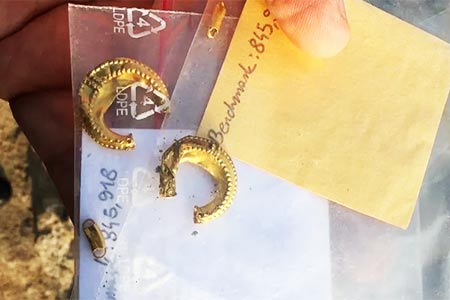
ArmInfo. Unique and exceptional finds, including items from the Late Bronze, Iron, and Classical Ages, were discovered in an ancient settlement adjacent to the Metsamor Historical and Archaeological Museum-Reserve.
According to the press service of the State Non-Commercial Organization "Service for the Protection of the Historical Environment and Historical and Cultural Museum-Reserves," excavations at the ancient settlement of Metsamor, which began two years ago, were resumed in 2026 on land owned by private owners. "The archaeological structure being studied is a stone tomb surrounded by a cromlech. The cromlech is approximately 20 meters in diameter. The structure is made of tuff and basalt." In its central section is a fairly large stone tomb, constructed from the same type of stone. The tomb's interior dimensions are approximately 6 by 4 meters. During excavations in recent years, a burial from the classical period with rich grave goods was discovered in the tomb's upper layer. Among the items found were gold jewelry, a coin, and other finds typical of the classical period, dating to the 1st century AD," the organization noted.
According to the source, the layers uncovered during the 2026 excavations are distinguished by the presence of archaeological materials from various periods. "Particularly noteworthy is the burial layer dating to the Iron Age, where the burial of one individual was discovered along with accompanying grave goods and a significant quantity of ceramics. The main burial was discovered in the lower, bottom-level section of the tomb. According to preliminary dating of the materials found, it belongs to the Late Bronze Age, dating to the 14th-13th centuries BC. This layer yielded significant concentrations of horse bones, a large number of ceramic fragments, a Lchashen-type dagger, belt fragments, as well as fragments of various bronze objects and bell-shaped pendants. The diversity of the materials found and their stratigraphic sequence indicate long-term use and reuse of the burial structure in different periods," the organization concluded.




















 Expert: Economic pressure on Armenia may be virtually painless for other EAEU members, but not for Armenia itself
 Expert on protests in France: Civilizations fade when society loses a vision of the future
 Turkologist: Azerbaijan is not all-powerful—its vulnerabilities should become part of Armenia’s security strategy
 Opinion: The development of the Amulsar mine near the resort town of Jermuk is the beginning of an environmental disaster in Armenia
 Expert: The arrest of opposition figures in Armenia for social media posts is a systematic attempt to intimidate the public and suppress dissent.
 Nikolai Bordyuzha proposed excluding Armenia from the CSTO.
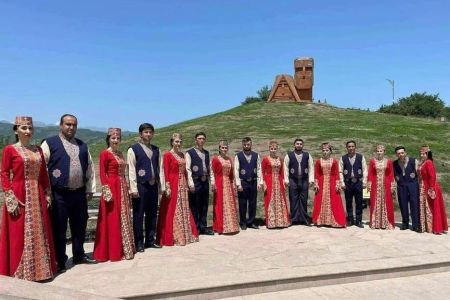 The participation of Artsakh ensembles in an international festival in Vienna was cancelled following the intervention of several foreign embassies
 Expert: It`s time for Armenia to move away from uncertainty and choose between West and East
 The Armenian Foreign Minister commented on the country`s return to work within the CSTO.
 The Artsakh Public Council expressed outrage at the UN Secretary-General`s behavior
 Lukashenko called for Armenia to assume the CIS presidency in 2029
 Dmitry Medvedev predicted a Ukrainian-like fate for Armenia amid the country`s shift in foreign policy
 Russian Security Council: In Armenia, they want to force Russian asset owners to dispose of their assets
 Zakharova: Russia ready to discuss with Armenia the prospects for expanding military cooperation as part of a review of bilateral ties
 Tevanyan: Armenia, like Ukraine and Moldova, is being drawn into the EU’s global war
 Yerevan City Hall is considering introducing a valet parking system in the city
 Expert: The circus surrounding the “Albanization” of Armenian culture in the presence of foreign ambassadors in occupied Artsakh is genocide
 Political scientist: If Russian-Armenian relations are destroyed, Turkey will take Russia`s place