
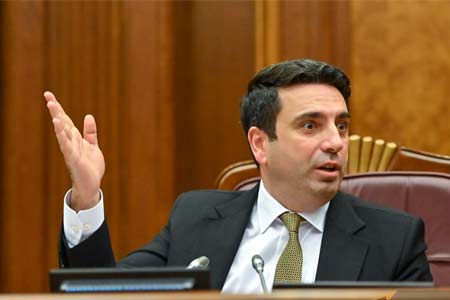
ArmInfo. Armenian Security Council Secretary Alen Simonyan has gone on a quest to find dark spots in Armenian history in an attempt to justify the current authorities' inability to reach an agreement with the enemy. And in these fabrications, he even went so far as to claim that the Tsitsernakaberd Armenian Genocide Memorial was built not thanks to the efforts of prominent Armenian figures, but because the USSR wanted the Armenian people to see Russians as saviors.
"Who said we're good neighbors for Turkey and Azerbaijan, and they'll sit and wait for us to grow stronger, become a big Hayk, attack, and devour them?" "," Simonyan said in response to the remark that today Armenia cannot sit at the negotiating table with the wolf, since it is unable to fight it due to its weakness.
Simonyan assured that if Turkey or Azerbaijan decide to attack, Armenia "will not have time to grow stronger." "This misconception we've been fed—that we must stick with the Russians or the Turks will devour us—has nothing to do with reality. How are we supposed to strengthen ourselves? After the collapse of the USSR, our population has not increased, unlike Azerbaijan's, which has reached 10 million," he noted during discussions at the Second Armenian World Summit.
Then the Secretary of the Armenian Security Council launched into a discussion related to the Armenian Genocide in the Ottoman Empire and expressed his thoughts at length. "How did it happen that the Soviet Union's leadership allowed us to build the Tsitsernakaberd memorial to the victims of the Armenian Genocide in the Ottoman Empire in the 1960s? The purpose was so that we would always look at this memorial, go there every year, and remember that without a Russian brother, the Turks would come and commit another genocide," Simonyan said ironically.
He also hinted that the "wolf in sheep's clothing" was not Turkey or Azerbaijan, but Russia, thus continuing to fuel anti-Russian sentiment in Armenian society.
"If they want, neither the Russian base nor anything of ours will save us. We shouldn't be fed fairy tales." "We must not give a pretext for war; this is the most important guarantor of our security," the Secretary of the Armenian Security Council said.
He also shifted all responsibility for the developments around Artsakh to Russia, including the outbreak of hostilities. He forgot, however, that it was the Armenian Prime Minister who declared that "Artsakh is Armenia, period," provoking the 2020 war, and then, on October 6, 2022, in Prague, recognized Artsakh as part of Azerbaijan.
It should be noted that, at a meeting with representatives of the Armenian community in Switzerland, the Armenian Prime Minister questioned the fact of the Armenian Genocide in the Ottoman Empire. "We must understand what happened and why it happened. And how did we perceive it, through whom did we perceive it: how did it happen that in 1939 there was no agenda for the Armenian Genocide, but in 1950 it appeared? "How this happened, we must understand, or we must not understand," the Armenian prime minister noted. Independent experts are inclined to believe that he is either unaware that the term "genocide" was coined by genocide scholar Raphael Lemkin only in 1944, or that he is deliberately trying to create a narrative that "this issue was artificially raised by the Soviet Union to put pressure on Turkey."
Earlier, in October of last year, Armenian Foreign Minister Ararat Mirzoyan stated in parliament that promoting the agenda of international recognition of the Armenian Genocide in the Ottoman Empire is not the prerogative of the Armenian Foreign Ministry. He then repeated narratives promoted by Ankara for decades that this issue should be addressed by historians. With this statement, Mirzoyan essentially confirmed the concerns previously expressed by experts that the current Armenian authorities would do anything to normalize relations with Turkey, while trampling on their own national interests, including the international recognition of the Armenian Genocide.
It should be noted that the Armenian Genocide in the Ottoman Empire was the first genocide of the 20th century. Armenians commemorate the victims of the tragedy every year on April 24. Turkey traditionally denies accusations of the mass extermination of more than 1.5 million Armenians. The Armenian Genocide has been recognized by many countries and a number of authoritative international organizations. Uruguay was the first country to recognize the Genocide in 1965. This fact was then recognized by Cyprus, Russia, Greece, Canada, Lebanon, Belgium, France, Paraguay, Argentina, Sweden, Bolivia, Great Britain, Holland, Slovakia, Germany, Lithuania, Venezuela, Poland, Chile, Switzerland, Brazil, Luxembourg, Austria, the Vatican, the Czech Republic, Denmark, Portugal, as well as the interim government of Libya, the USA, Syria, the European Parliament, and the World Council of Churches.















 Orientalist: In 2026, Baku made special efforts to achieve greater diplomatic effect on the issue of victory over Artsakh
 Expert: Official Yerevan should not base its calculations in relations with Ankara on the "crack" in the Turkish-Azerbaijani alliance
 International expert: Trump is entering a "lame duck" period of rule
 Political scientist: The failure of the mission to adopt a new Armenian Constitution could raise the question of Pashinyan`s resignation.
 Opinion: Russia`s involvement in the Organization of Turkic States may increase its international weight, but will force a redistribution of political influence within it
 Drmeyan: The ECHR rejected Azerbaijan`s appeal in the case of Artsakh Defense Army Major Hayk Toroyan
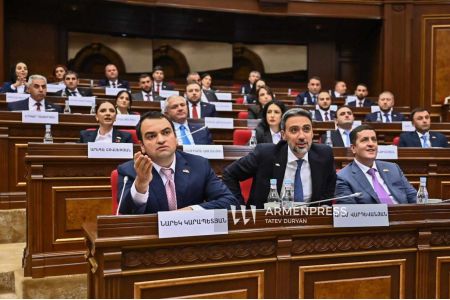 "Strong Armenia": The brawl in parliament was staged to distract public attention from Pashinyan`s failed foreign policy
 Zakharova commented on the scandalous epithets of the governor of Armenia`s Shirak region about "Ivanov"
 Nikolai Bordyuzha proposed excluding Armenia from the CSTO.
 The participation of Artsakh ensembles in an international festival in Vienna was cancelled following the intervention of several foreign embassies
 Expert: It`s time for Armenia to move away from uncertainty and choose between West and East
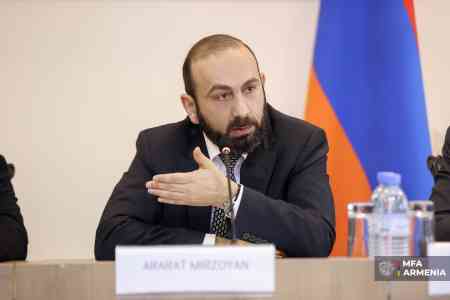 The Armenian Foreign Minister commented on the country`s return to work within the CSTO.
 The Artsakh Public Council expressed outrage at the UN Secretary-General`s behavior
 Lukashenko called for Armenia to assume the CIS presidency in 2029
 Dmitry Medvedev predicted a Ukrainian-like fate for Armenia amid the country`s shift in foreign policy
 Russian Security Council: In Armenia, they want to force Russian asset owners to dispose of their assets
 Zakharova: Russia ready to discuss with Armenia the prospects for expanding military cooperation as part of a review of bilateral ties
 Tevanyan: Armenia, like Ukraine and Moldova, is being drawn into the EU’s global war
 Yerevan City Hall is considering introducing a valet parking system in the city