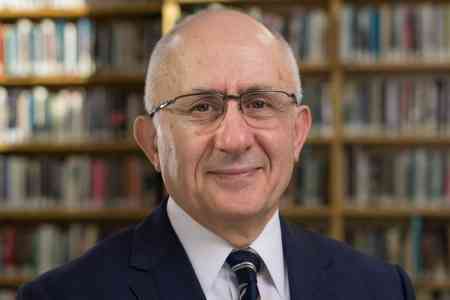
ArmInfo. Turkey's recognition of the Armenian Genocide is possible only through active political struggle, because we live in a world where not only historical tragedies are forgotten, but also modern acts of violence go unnoticed, as stated by Taner Akcam, a Turkish historian, genocide scholar, and head of the genocide studies program at the Armenian Institute "Promise" at the University of California, Los Angeles (UCLA) on April 29 at the Center for Western Armenian Studies in Yerevan. He was presenting his new monograph "The Origins of the Genocidal State" in Armenian.
In his work, Akcam examines historical events from the Ottoman Empire to the present day, offering a new perspective on the history of Turkey. In particular, he analyzes how the country applies apartheid policies towards ethnic minorities, and draws parallels with practices that existed in the Republic of South Africa. In this vein, Akcam recalled that laws limiting the rights of minorities have been adopted in Turkey since 1923. He then drew parallels between the apartheid policy in South Africa and in Turkey. In particular, according to the historian, in Turkey, Armenians were forced to convert to Islam and change their names to Turkish ones in order to remain in the country. He believes that there should be a struggle in Turkey to dismantle this apartheid regime, which could eventually lead to the recognition of the Armenian Genocide. Speaking about the normalization of Armenian-Turkish relations and the willingness of the current Armenian government to normalize relations with Ankara, without addressing the issue of recognizing the Armenian Genocide, the Turkish historian assured that this policy has been consistent across all political forces in Armenia, and not just under Nikol Pashinyan.
Meanwhile, Taner Akcam believes that each generation has the right to choose how the country should address the recognition of the genocide and present its vision of history. In conclusion, the author of the monograph also touched upon the forced displacement of the entire Armenian population of Artsakh, labeling it a crime against humanity. He also mentioned his involvement in collecting signatures to condemn the aggression during the war in Artsakh. Additionally, Akcam noted that he does not have high expectations regarding the restoration of the rights of the people of Artsakh, likening it to effortd to restore the rights of Armenians who survived the genocide or Palestinians.



















 Opinion: Following Berlin talks, Baku gains expanded influence within EU and strengthens cooperation ties with main European powerhouse
 Armenian expert: Could modern Azerbaijan even exist without Russian and Soviet modernization?
 Zatulin: Pashinyan was eager to get back to Russia because he actually lost the elections
 Human rights activist Ruben Melikyan dismissed from YSU
 Pashinyan removed from INNOPROM guest list
 Zakharova: Armenia`s pro-EU pivot poses economic security risks to EAEU member states
 It`s time for South Caucasus countries to think of South Caucasus as single, unified region - RA premier
  Pashinyan: Armenia and Azerbaijan should leave each other alone
 Moscow sees situation with Armenia as attempt to attack Russia-involving integration associations - Russian presidential aid
 Zakharova: Armenia views relations with Russia as tool for financially securing reorientation toward EU
 The Armenian Minister of Justice and the EU Ambassador discussed visa liberalization issues for Yerevan.
 Azerbaijan`s aggressive plans against Armenia became possible in wake of Pashinyan`s decisions on Artsakh - expert
  Zakharova: Russia sent a note of protest to Armenia over the act of vandalism at the "Mother Armenia" memorial in Gyumri
 Samvel Karapetyan proposes creating a post-election opposition coalition