
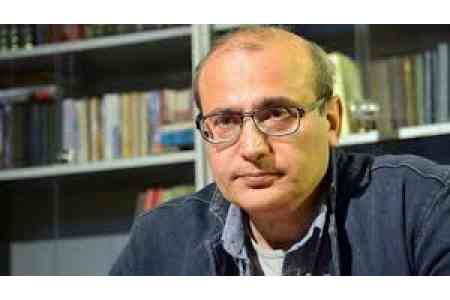
ArmInfo. The elimination of the Armenian Apostolic Church (AAC) may result in Armenian communities becoming a so-called "fifth column," according to Armenian expert and political scientist Stepan Danielyan, when addressing the ongoing conflict between the authorities and the Armenian Church.
The expert expressed the opinion that the ongoing developments should be viewed within a broader context that goes beyond Armenia. "There is a possibility of external interference. Specifically, Turkish and Azerbaijani 'think tanks' are working on scenarios that may change the geopolitical situation. Specifically, these centers are spreading the message that the Church and the diaspora are the foundation of Armenian nationalism," Danielyan pointed out.
In this vein, the political scientist mentioned the unbreakable connection between the diaspora and the Church, calrifying that without the Armenian Apostolic Church, any Armenian community loses its foundation. In this regard, he urged consideration of what would happen if the Armenian Apostolic Church were to submit to any geopolitical centers. According to Danielyan, this would raise the question of the advisability of maintaining Armenian dioceses in other countries. As an example, he noted that the Iranian Church is subordinate to the Church of Antelias (a city in Lebanon, home to the Catholicosate of the Great House of Cilicia, headed by Catholicos Aram I - ed.) and urged the question of whether Iran would allow a "fifth column" to operate on its territory. "That is, serious processes are currently underway, where Turkish think tanks are aiming to eliminate the Armenian Church. This is due to the Church's important role in the political life and national identity of Armenians, which hinders the implementation of Turkish geopolitical programs. These programs are aimed at creating a greater Turkish world, which could subsequently come into conflict with Russia, Iran, and China," Danelyan noted.
The expert also touched on the prayer breakfast organized by Armenian Prime Minister Nikol Pashinyan. He noted that this event goes against the traditions of the Armenian Church and is more aligned with Zionist evangelicals. Danielyan recalled that the latter advocate for the belief that all of Israel should be controlled by Jewish people. "This, in turn, creates distrust among Orthodox Arabs and Christians living in those areas, including Armenians. Essentially, the Evangelicals seek to return these territories to the Jews, indicating their desire to divide the Armenian Church as well," the expert noted.
In conclusion, Danielyan expressed his conviction that the current processes are driven by an external agenda, which includes the reinstating the current government in 2026. In this regard, he emphasized that the Armenian people are now at a crossroads: either reform the Armenian Apostolic Church or risk its destruction. "We must understand that problems exist in other churches as well, often even more serious. However, any changes within the Church should not lead to its destruction. In other words, the issue at hand is not simply about replacing Catholicos Karekin II of All Armenians, but about preserving our identity. Discussions about necessary changes in the Church will only be possible after a change in leadership. Until then, the country will face pressing challenges unrelated to the Church," the political scientist concluded.































 Political analyst: Pashinyan- Putin phone call confirms deepening strategic rift between Yerevan and Moscow
 Opinion: Resolving conflict between Yerevan and Baku allows Washington to deprive Russia of key levers of influence in South Caucasus
 Narek Karapetyan will give up his parliamentary salary in favor of charitable contributions.
 Armenia and France discuss further development of strategic partnership and EU cooperation
  To overcome risks Armenia must reduce domestic escalation - expert
  Zatulin: Pashinyan was eager to get back to Russia because he actually lost the elections
 Pashinyan removed from INNOPROM guest list
 Zakharova: Armenia`s pro-EU pivot poses economic security risks to EAEU member states
 It`s time for South Caucasus countries to think of South Caucasus as single, unified region - RA premier
  Pashinyan: Armenia and Azerbaijan should leave each other alone
 Moscow sees situation with Armenia as attempt to attack Russia-involving integration associations - Russian presidential aid
 Zakharova: Armenia views relations with Russia as tool for financially securing reorientation toward EU
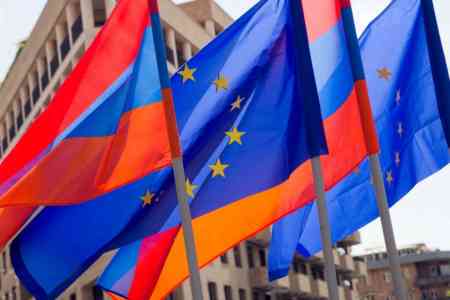 The Armenian Minister of Justice and the EU Ambassador discussed visa liberalization issues for Yerevan.
 Azerbaijan`s aggressive plans against Armenia became possible in wake of Pashinyan`s decisions on Artsakh - expert
  Zakharova: Russia sent a note of protest to Armenia over the act of vandalism at the "Mother Armenia" memorial in Gyumri