
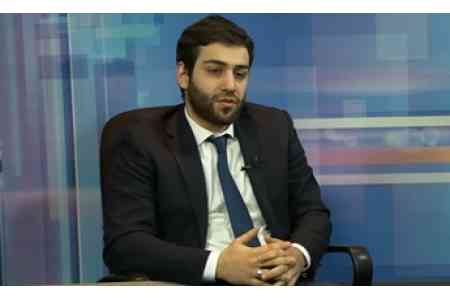
ArmInfo. From the perspective of the Donald Trump administration and his allies, the South Caucasus is not a priority region for the United States: even national security documents barely mention it. Georgy Asatryan, deputy director of the Institute of World Military Economy and Strategy at the Higher School of Economics and associate professor at the Plekhanov Russian University of Economics, made this statement during a Yerevan-Moscow videoconference on "US Strategy in and Around the South Caucasus," commenting on US Vice President J.D. Vance's visit to Baku and Yerevan.
According to the expert, President Trump does not view the South Caucasus as an important region for advancing his interests. Moreover, Asatryan emphasized that the US's attitude toward Armenia in this context is perceived by the ruling class as a second- or third-tier country.
According to Asatryan, there are several factors influencing US interests in the region. "This set of factors, of course, includes attempts to contain Russia and Iran-these are classic geopolitical aspects that remain, although their significance may vary. Secondly, it is important for Trump to advance Israel's interests, which also include containing Iran. Some countries in the South Caucasus are already involved in these processes, while others are trying to counteract them," the expert clarified.
Asatryan noted that Trump is interested in business and energy. "He values regions where he can capitalize on US political influence-where he can get paid or where he can strike lucrative deals. From this perspective, Azerbaijan appears to be a more serious political actor today," the expert believes. The expert further acknowledged that during J.D. Vance's regional tour, the seriousness and businesslike nature of Vance's visit to Baku was significantly higher. "People there were more reserved and talked about matters involving serious American business representatives," he noted. Asatryan pointed out that the Trump administration's strategy in the South Caucasus is to find partners from whom they can profit. In this regard, he noted that the reconnaissance drones supplied to Armenia are technology from 2010 and are nothing special. "These drones haven't proven themselves in combat and are standard reconnaissance devices. Many military experts believe their high cost is unjustified. That is, it's no shame that the Americans sold them for a high price. This is obvious. Drones are something that should be produced domestically. Even third-world countries are already doing this themselves. I know that Armenia has had some experience in drone production, and purchasing 2010 technology for that kind of money will hinder this development," the expert noted.
Asatryan also considered it important to note that the Trump administration's interests in the Caucasus include energy and economic deals, where, of course, wealthy Azerbaijan, with its working business contacts, is a priority. "However, there are no and never have been any deep geopolitical projects in this context, as there are adequate restrictions in the interests of American policy in the region, given its location and limitations in terms of economy and infrastructure," the expert concluded.



















 RA Government guarantees high salaries for CC justices, Syunik families deprived of family benefits - politician
  Armenian experts, leading Turkish think tanks discuss prospects for expanding cooperation
  Political Scientist: As long as the opposition remains silent, Pashinyan can use Plan B and secure a constitutional majority
 US-Iranian memorandum more beneficial for Iran from political and economic perspective - expert
  Zakharova: Armenia`s pro-EU pivot poses economic security risks to EAEU member states
 It`s time for South Caucasus countries to think of South Caucasus as single, unified region - RA premier
  Pashinyan: Armenia and Azerbaijan should leave each other alone
 Moscow sees situation with Armenia as attempt to attack Russia-involving integration associations - Russian presidential aid
 Zakharova: Armenia views relations with Russia as tool for financially securing reorientation toward EU
 The Armenian Minister of Justice and the EU Ambassador discussed visa liberalization issues for Yerevan.
 Azerbaijan`s aggressive plans against Armenia became possible in wake of Pashinyan`s decisions on Artsakh - expert
  Zakharova: Russia sent a note of protest to Armenia over the act of vandalism at the "Mother Armenia" memorial in Gyumri
 Samvel Karapetyan proposes creating a post-election opposition coalition
 Artsakh`s Cultural Heritage Ombudsman called on Moscow to respond to destruction of WWII monuments by Azerbaijan in occupied NKR
 Prosecutor General`s Office petitions Central Electoral Commission for criminal prosecution of Robert Kocharyan
 Dutch Prime Minister expresses his support for Armenia`s democratic reform and economic diversification agenda
 Heritage: It`s time for Armenia`s opposition to present people with legitimate alternative to power
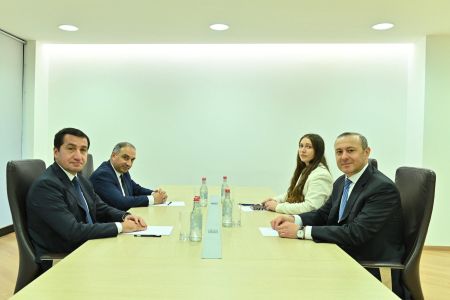 RA Security Council Sec, Assistant to President of Azerbaijan hold negotiations in Dilijan