
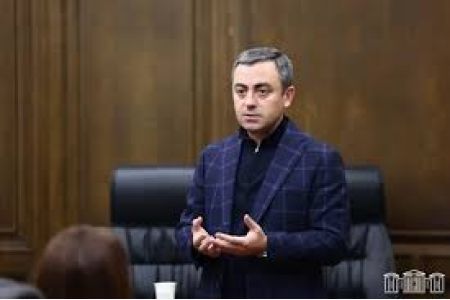
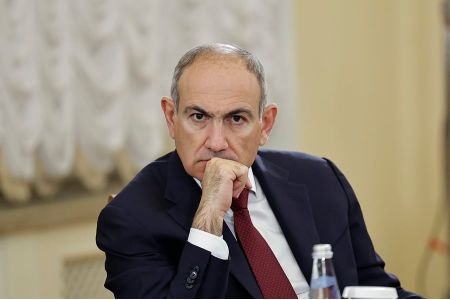
ArmInfo. Armenian Prime Minister Nikol Pashinyan, a symbol of defeat, war, and betrayal, has no right to call the opposition forces intending to participate in the country's upcoming parliamentary elections harbingers of war. Thus, Ishkhan Saghatelyan, a representative of the Supreme Body of the Armenian Revolutionary Federation (ARF Dashnaktsutyun) and a member of parliament from the opposition "Armenia" faction, commented on Pashinyan's statement that the rise to power of other political forces could lead to war and the loss of not only territory but also sovereignty.
Saghatelyan, in a video message published on his Facebook page, noted that the Armenian prime minister even specified a specific timeframe for this to occur. According to the MP, such statements merely indicate that Pashinyan hopes to repeat the 2021 scenario and maintain his power by deceiving and intimidating the Armenian people with threats of Azerbaijan resuming the war. In this regard, Saghatelyan recalled that Pashinyan made similar claims before the 2021 snap parliamentary elections, declaring that if elected, he would ensure peace. Therefore, the MP called for an examination of the reality. "Since Pashinyan's restoration to power in 2021, two wars have erupted. In 2022, Azerbaijan launched a large-scale attack on Armenia, resulting in over 200 deaths and the occupancy of over 240 square kilometers of territory. Heights and positions of strategic importance fell under Azerbaijani control. A year later, in September 2023, ethnic cleansing and forced displacement of the Artsakh population occurred in Artsakh, resulting in hundreds of casualties. In 2024, Pashinyan, with the same threats, told our people that if Armenia did not make concessions in the Tavush region, there would be war. As a result, strategic territories were surrendered to Azerbaijan, and today it continues to intimidate the Armenian people with Aliyev and war," Saghatelyan recalled.
As the MP explained, Pashinyan is trying to portray himself as a guarantor of peace, but in reality, he is a guarantor of war and defeat. All his actions, the opposition leader noted, are aimed at intimidating the people and regaining power. "However, you personally are the symbol of defeat, war, betrayal, surrender of the homeland, humiliation, sacrifice, and tragedy, and you have no right to blame other forces participating in the parliamentary elections for this, or to pretend that you have achieved peace while we have come to bring war. You personally are the symbol of war and defeat, and to ensure Armenia's territorial integrity, restore its sovereignty, and ensure the security of Armenian citizens, it is necessary to prevent your re- emergence in the upcoming parliamentary elections, as you personally pose a threat to our national security," the ARF Supreme Body representative emphasized.
Ivetta Tonoyan, press secretary for Prosperous Armenia Party leader Gagik Tsarukyan, also responded to Pashinyan's statements. She recalled that the overwhelming majority of members of the political team that came to power in 2018 (the ruling Civil Contract party) did not even have employment records, and their first task was to occupy ministerial, deputy, or other high-ranking government positions. "We are all still facing the painful consequences of leading the country with those who have neither a biography nor experience. Perhaps this is why the head of today's political force feels a pronounced hostility toward those figures who, throughout their lives, built rather than destroyed, created good rather than destroyed values in Armenia and Artsakh," Tonoyan concluded.
As a reminder, on March 19, Armenian Prime Minister Nikol Pashinyan stated at a briefing with journalists that if other forces come to power, the peace agenda will be revised, which would risk war-with the risk of losing not only territory but also sovereignty. In other words, as the Armenian prime minister explained, they are allegedly "preparing for a new September war with grave consequences." The prime minister even specified a timeframe: he estimated that this could happen soon after the elections-by the fall at the latest. When asked further, "Why would the opposition want a war?" the prime minister noted that this would allow these forces to become leaders of an outpost, not a state, which would be financially advantageous for them, as it would allow them to preserve their assets abroad.










 Expert: The arrest of opposition figures in Armenia for social media posts is a systematic attempt to intimidate the public and suppress dissent.
 Azerbaijani Studies Expert: While Azerbaijan Prepares Its Generation for War, Aliyev’s Aide Calls on Armenia to Prepare Armenian Society for “Peace”
 Turkologist: Azerbaijan will never, under any circumstances, stop pressuring the Armenian people
 Political scientist: We need to move away from the question of "when" and replace it with more important questions
 Lukashenko called for Armenia to assume the CIS presidency in 2029
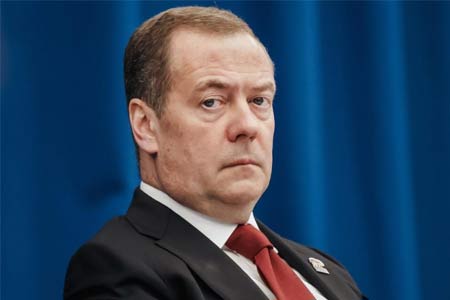 Dmitry Medvedev predicted a Ukrainian-like fate for Armenia amid the country`s shift in foreign policy
 Russian Security Council: In Armenia, they want to force Russian asset owners to dispose of their assets
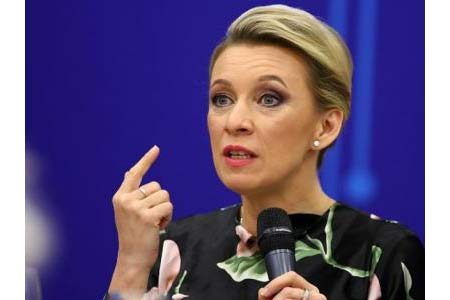 Zakharova: Russia ready to discuss with Armenia the prospects for expanding military cooperation as part of a review of bilateral ties
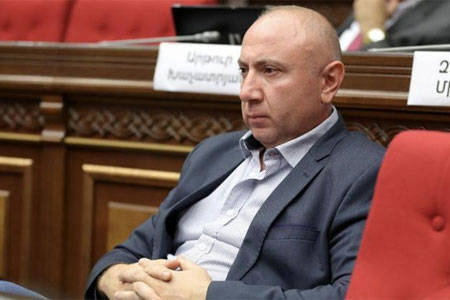 Tevanyan: Armenia, like Ukraine and Moldova, is being drawn into the EU’s global war
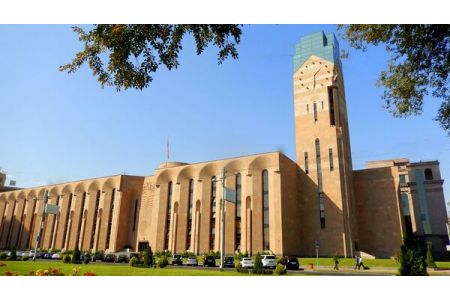 Yerevan City Hall is considering introducing a valet parking system in the city
 Expert: The circus surrounding the “Albanization” of Armenian culture in the presence of foreign ambassadors in occupied Artsakh is genocide
 Political scientist: If Russian-Armenian relations are destroyed, Turkey will take Russia`s place
 Political scientist: The Armenian public is simply obliged to significantly change the entire content of public discourse and struggle
 Cross tattoos are being removed from the skin of Christian prisoners in Azerbaijan by fire, according to a human rights activist.
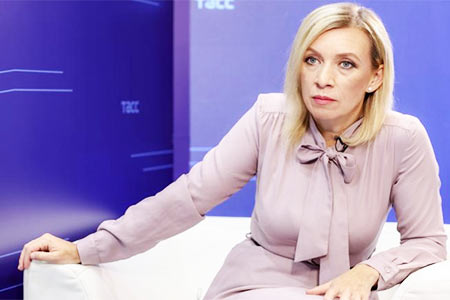 Zakharova: Armenia`s likely introduction of visas with Russia will be a step against Yerevan itself
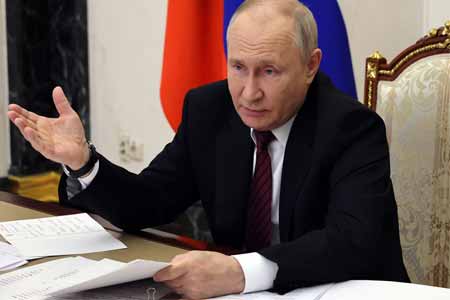 Putin: Armenia`s recognition of Karabakh as part of Azerbaijan in Prague has given Russia`s position on this issue an ambivalent character
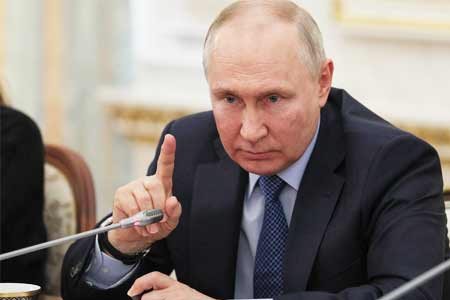 Putin: Armenia`s adoption of the law on EU accession means an announcement of its withdrawal from the Eurasian Economic Union