
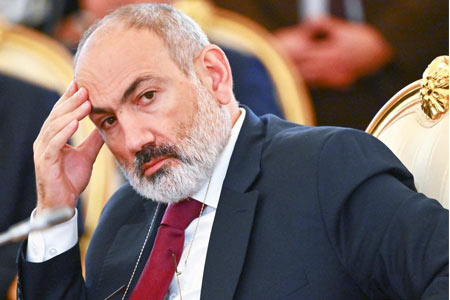
ArmInfo. The theme of "war and peace" is becoming a key focus for Armenian Prime Minister Nikol Pashinyan in his election campaign for the ruling "Civil Contract" party he leads. "The forces led by Kocharyan, Tsarukyan, and Karapetyan have adopted a policy of revising the peace agreement between Armenia and Azerbaijan, which means they are pursuing the path of opening the door to war," as stated by Pashinyan on Facebook live stream regarding his political rivals' positions.
According to Pashinyan, Robert Kocharyan, Armenia's second president, Gagik Tsarukyan leader of the "Prosperous Armenia" party, and Samvel Karapetyan, chairman of the "Strong Armenia" party, have recently been talking about revising this peace, including imposing by force, thereby making the war inevitable.
Meanwhile, according to Pashinyan, resuming peace talks means creating conditions for transforming the content they (the ruling Civil Contract Party - ed.) have achieved through the negotiation process.
Pashinyan stated that when these forces say that a peace guarantor is necessary to achieve real peace, they are effectively opening the door to the peacekeepers into the region and the country itself. " And what consequences the activities of peacekeepers have brought before our eyes, we have all seen it, and the forces leading to stand on the same rake twice must be unequivocally and irrevocably rejected (Pashinyan did not specify which peacekeepers he was referring to, but apparently meant peacekeepers in Artsakh - ed.)." He reminded that Armenia had a security guarantor (Russia - ed.), whose obligations were de jure clearly defined in documents. However, that mechanism failed to work. Moreover, according to the Armenian Prime Minister, such mechanisms are completely non-functional. "History, including the history of the Armenian people, has confirmed this. Peace between Azerbaijan and Armenia was only established because we relied not on guarantees, but on ourselves. We considered it to be our problem. When we relied on security guarantors and believed that they would solve our problems, this invariably led to escalation, aggravation, war, and losses," Pashinyan noted.
Summing up, he emphasized that peace between Armenia and Azerbaijan was achieved at the cost of heavy losses, but despite this, the country has reached a new historical milestone. "The survival agenda has been replaced by the development agenda. And all those who seek to revise the peace agenda are trying to push us from a period of development to the survival period. However, as history shows, when we are guided by this principle, we survive not in our homeland, not in our state, but in foreign states," Pashinyan concluded.
Recall, during a briefing with journalists on March 19, Armenian Prime Minister Nikol Pashinyan stated that if other forces come to power, the peace agenda will be revised, which would risk war-with the risk of losing not only territory but also sovereignty. In other words, as the Armenian prime minister clarified, they are allegedly "preparing for a new September war with grave consequences." The prime minister even specified a timeframe: according to his estimates, this could happen soon after the elections-by the fall at the latest. To the clarifying question "why does the opposition need war?", the Prime Minister noted that in this way these forces will become the leaders of the outpost (of Russia - Ed.), and not the state, which is financially beneficial for them, since it will allow them to preserve their assets abroad."




















 Expert: Current process is not about peace, but implementing Azerbaijan`s wishlist
 Expert: Real peace unattainable until Armenia-Azerbaijan agreement is signed and ratified
 TRIPP`s proximity to Iranian border could slow its implementation - expert
  Who and why is sacrificing RA National Security Service`s reputation? - expert
  Tehran creating security environment in which sustainable shipping in Strait of Hormuz difficult to imagine without its direct participation - expert
  Arrested Armenian oligarch on economy and new jobs
  NA Vice Speaker candidate believes his wife`s salary as director of HayPost is the lowest in the company`s history
 RF Permanent Representative: There is no CSTO-Armenia conflict
 Moscow: NATO seeking to "Pull" Armenia away from CSTO Allies
  Political analyst: Russia intends to determine which "Camp" Armenia will choose through a referendum
 Narek Karapetyan will give up his parliamentary salary in favor of charitable contributions.
 Armenian analyst: Developing relations with Europe and the U.S. must not jeopardize relations with regional powers
 Armenia and France discuss further development of strategic partnership and EU cooperation
  To overcome risks Armenia must reduce domestic escalation - expert
  Zatulin: Pashinyan was eager to get back to Russia because he actually lost the elections
 Human rights activist Ruben Melikyan dismissed from YSU
 Pashinyan removed from INNOPROM guest list
 Zakharova: Armenia`s pro-EU pivot poses economic security risks to EAEU member states
 It`s time for South Caucasus countries to think of South Caucasus as single, unified region - RA premier
  Pashinyan: Armenia and Azerbaijan should leave each other alone