
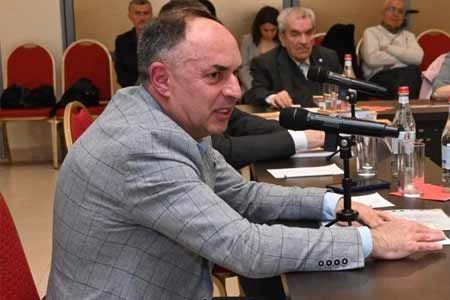
ArmInfo.The presentation of a new book by writer, publicist, and war writer Ashot Beglaryan, "In the Womb of War," was held in Yerevan, published as part of the Dialogue book series.
According to the Dialogue press center, the presentation was attended by those for whom this book is not just literature, but a part of their personal history: Artsakh residents, fellow soldiers, colleagues, teachers - the people with whom the author shared the most difficult and tragic periods of his life. The audience heard not only words about the book, but also living memories united by the shared fate of Artsakh.
Ashot Beglaryan has been a participant in all the wars that Artsakh has endured. His creative work is inseparable from the reality he has personally experienced. It's no wonder that the writer and his friend Viktor Konoplyov said of him: "Ashot is a man who has declared war on war itself." This phrase accurately captures the essence of his works-the desire to understand, stop, and overcome tragedy through words.
In his opening remarks, Yuri Navoyan, chairman of the Moscow organization "Dialogue" and founder of the Book Series, noted that this is the author's second book published within the organization's series. He emphasized the importance of so-called "book diplomacy" today-as a form of public dialogue capable of transcending the boundaries of formal politics and becoming a living instrument for preserving memory, speech, and the right to a homeland.
According to him, in such circumstances, a book ceases to be simply a literary work. It becomes a testimony, a document, a voice of the people that cannot be ignored. Through texts, through personal stories and destinies, a space is formed in which identity is preserved and truth is conveyed-especially when the very possibility of speaking is threatened. Reflecting on Artsakh, the meeting participants discussed how culture, words, and memory are the pillars that sustain a connection with the homeland today. When people are deprived of physical space, they continue to exist in cultural space-in language, in literature, in memories.
In this sense, "book diplomacy" acts as an important social phenomenon. It unites people, creates a common field of meaning, and allows them to discuss complex and painful topics through human stories. And perhaps it is through books like "In the Womb of War" that not only the past but also the future is preserved-the right to return, to memory, to the continuation of life.










 Expert: The arrest of opposition figures in Armenia for social media posts is a systematic attempt to intimidate the public and suppress dissent.
 Azerbaijani Studies Expert: While Azerbaijan Prepares Its Generation for War, Aliyev’s Aide Calls on Armenia to Prepare Armenian Society for “Peace”
 Turkologist: Azerbaijan will never, under any circumstances, stop pressuring the Armenian people
 Political scientist: We need to move away from the question of "when" and replace it with more important questions
 Lukashenko called for Armenia to assume the CIS presidency in 2029
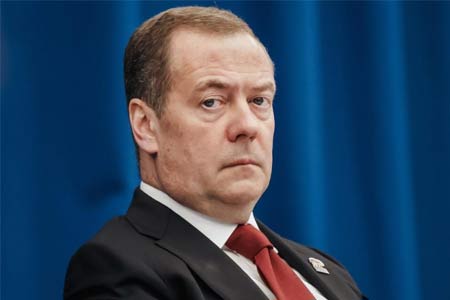 Dmitry Medvedev predicted a Ukrainian-like fate for Armenia amid the country`s shift in foreign policy
 Russian Security Council: In Armenia, they want to force Russian asset owners to dispose of their assets
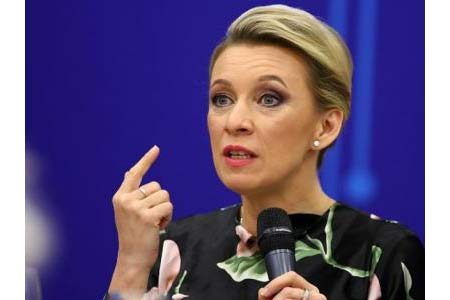 Zakharova: Russia ready to discuss with Armenia the prospects for expanding military cooperation as part of a review of bilateral ties
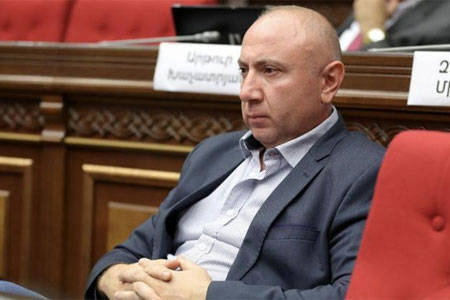 Tevanyan: Armenia, like Ukraine and Moldova, is being drawn into the EU’s global war
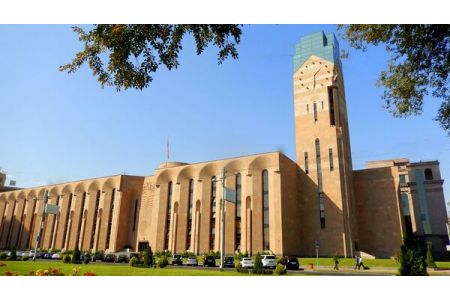 Yerevan City Hall is considering introducing a valet parking system in the city
 Expert: The circus surrounding the “Albanization” of Armenian culture in the presence of foreign ambassadors in occupied Artsakh is genocide
 Political scientist: If Russian-Armenian relations are destroyed, Turkey will take Russia`s place
 Political scientist: The Armenian public is simply obliged to significantly change the entire content of public discourse and struggle
 Cross tattoos are being removed from the skin of Christian prisoners in Azerbaijan by fire, according to a human rights activist.
 Zakharova: Armenia`s likely introduction of visas with Russia will be a step against Yerevan itself
 Putin: Armenia`s recognition of Karabakh as part of Azerbaijan in Prague has given Russia`s position on this issue an ambivalent character
 Putin: Armenia`s adoption of the law on EU accession means an announcement of its withdrawal from the Eurasian Economic Union