
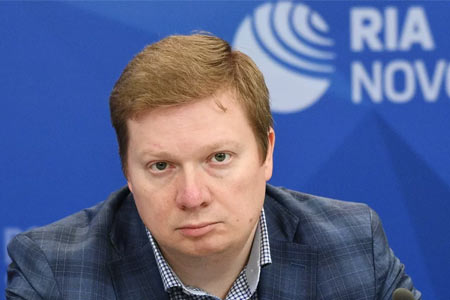
ArmInfo. From a Russian perspective, Armenia's current course makes a final rupture of relations with Russia a matter of time. This was stated on April 3 in Yerevan by Dmitry Suslov, political scientist and deputy director and research fellow at the Center for Comprehensive European and International Studies at the Faculty of World Economy and International Affairs at the National Research University Higher School of Economics. The conference was organized by the Analytical Center for Strategic Studies and Initiatives (ACSSI).
According to him, the military and economic weakening of Iran contributes to the strengthening of Turkey and Azerbaijan's influence in the Transcaucasus, which is not in the interests of either Russia or Armenia. "With Iran weakening, Yerevan should be interested in stabilizing and even improving relations with Russia. However, this is not currently the case. Armenian Prime Minister Nikol Pashinyan's recent visit to Moscow is perceived not as an attempt to improve ties with Russia, but as an attempt to hedge risks in the Russian direction amid the country's continuing pro-Western course. This also serves to mitigate domestic criticism of Pashinyan as an anti-Russian candidate before the upcoming elections, thereby weakening the opposition," the political scientist believes.
At the same time, he acknowledged that the weakening of Russia's position and the change in the geopolitical situation in the Transcaucasus occurred after the liquidation of the Nagorno-Karabakh Republic. According to him, the previous status quo no longer exists and cannot be restored, since it relied on Russia as a mediator between Yerevan and Baku. "Currently, there is neither a status quo nor an acute military conflict. There is no Nagorno-Karabakh Republic, nor even a need for Russia as a mediator. This is unfair, given Russia's role in resolving the 2020 conflict and the presence of Russian peacekeepers until Azerbaijan's final conquest of the NKR. Nevertheless, this is a reality that can no longer be changed. At the same time, geographic factors cannot be ignored: Russia's physical presence in the Caucasus, economic ties, and Russia's interest in preventing the emergence of overtly hostile countries and proxy rivals are immutable constants. In the new geopolitical conditions, Russia's interest lies not necessarily in a central role, but in ensuring that no external player can occupy that position. This means maintaining a balance of power in the Transcaucasus and preventing the dominance of any other great power, especially an adversary of Russia, and preventing the transformation of countries in the region into anti-Russian proxies, as in the Moldovan scenario," Suslov explained.
In this regard, the political scientist noted that, from a Russian perspective, the current Armenian government is pursuing a systemic policy of reorientation toward the West, while hedging against the Russian factor and maintaining cooperation with Russia. According to him, Russia understands that even this cooperation is being implemented out of necessity and to the extent necessary for Armenia in terms of economy and security. However, Suslov noted that such cooperation is gradually waning, and the current course inevitably leads to Armenia's withdrawal from the Eurasian Economic Union, the withdrawal of the Russian military base from Gyumri, and a general deterioration in Russian-Armenian relations. "This is happening as Armenia's relations with Turkey and Azerbaijan, as well as with the EU and the US, are improving. Thus, from a Russian perspective, Armenia's current course makes a final rupture with Russia a matter of time-not a question of 'if,' but 'when,'" the expert emphasized.
He noted that Russia perceives this not as diversification, but as a gradual shift to the side of an adversary that is open about its plans and preparing for war with Russia. He expressed the opinion that this development is comfortable for the current Armenian authorities. "However, Pashinyan's visit to Moscow showed that Russia's patience is running out. While Russia is not interested in a sharp escalation of the situation, it is not going to simply watch Armenia drift westward, gradually reducing cooperation with Russia. Therefore, Russia is asking Armenia to make a decision: it is not opposed to deepening Yerevan's relations with the EU and the US, but this should not be accompanied by the exclusion of Russia. "This applies in particular to areas such as railways, nuclear energy, and the attitude toward those political forces that position themselves as Russia's friends," the political scientist noted.
Suslov believes that in the current geopolitical situation, Armenia should be interested not in exacerbating relations, but ideally in rapprochement with Russia, while continuing dialogue with the US and the EU. Summing up, he noted that the guarantee of peace for Armenia lies not in recognizing the new territorial status quo and erasing the Nagorno-Karabakh Republic from national memory, but in maintaining friendly relations with Russia. "Russia remains the main deterrent for Armenia's geopolitical adversaries in the region, and its absence will make a new war inevitable," Suslov concluded.
READ ALL COMMENTS














 Expert: Economic pressure on Armenia may be virtually painless for other EAEU members, but not for Armenia itself
 Expert on protests in France: Civilizations fade when society loses a vision of the future
 Turkologist: Azerbaijan is not all-powerful—its vulnerabilities should become part of Armenia’s security strategy
 Opinion: The development of the Amulsar mine near the resort town of Jermuk is the beginning of an environmental disaster in Armenia
 Expert: The arrest of opposition figures in Armenia for social media posts is a systematic attempt to intimidate the public and suppress dissent.
 Expert: It`s time for Armenia to move away from uncertainty and choose between West and East
 The Armenian Foreign Minister commented on the country`s return to work within the CSTO.
 The Artsakh Public Council expressed outrage at the UN Secretary-General`s behavior
 Lukashenko called for Armenia to assume the CIS presidency in 2029
 Dmitry Medvedev predicted a Ukrainian-like fate for Armenia amid the country`s shift in foreign policy
 Russian Security Council: In Armenia, they want to force Russian asset owners to dispose of their assets
 Zakharova: Russia ready to discuss with Armenia the prospects for expanding military cooperation as part of a review of bilateral ties
 Tevanyan: Armenia, like Ukraine and Moldova, is being drawn into the EU’s global war
 Yerevan City Hall is considering introducing a valet parking system in the city
 Expert: The circus surrounding the “Albanization” of Armenian culture in the presence of foreign ambassadors in occupied Artsakh is genocide
 Political scientist: If Russian-Armenian relations are destroyed, Turkey will take Russia`s place
 Political scientist: The Armenian public is simply obliged to significantly change the entire content of public discourse and struggle
 Cross tattoos are being removed from the skin of Christian prisoners in Azerbaijan by fire, according to a human rights activist.
 Zakharova: Armenia`s likely introduction of visas with Russia will be a step against Yerevan itself