
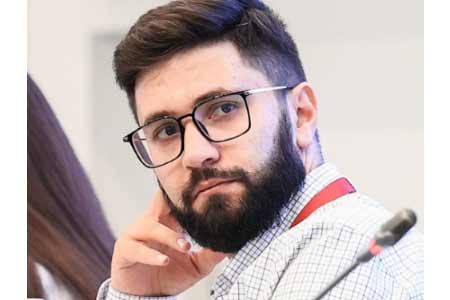
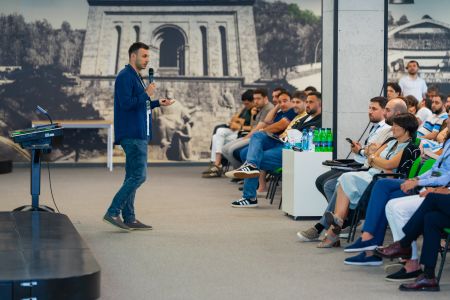
ArmInfo. Armenian Prime Minister Nikol Pashinyan's recent visit to Moscow was necessary to legitimize Armenia's shift in foreign policy, as stated by Benjamin Matevosyan, a political analyst at the Political Economy Research Institute, during a conference "The Impact of Regional and Electoral Processes on Russian-Armenian Relations" in Yerevan on April 3. The conference was organized by the Analytical Center for Strategic Studies and Initiatives (ACSSI).
According to the expert, this visit demonstrated that the traditional model of cooperation between Yerevan and Moscow has officially reached its limit. " The Moscow visit revealed a total lack of consensus on everything from the fall of Nagorno-Karabakh to Armenia's future Eurasian vs. European trajectory," Matevosyan noted.
He also noted that in recent years, statements about a crisis in Armenian-Russian relations have mostly come from the analytical community and journalists, but at the highest political level, an attempt has been made to maintain a certain diplomatic etiquette. "However, the information surrounding the Armenian Prime Minister's visit to Moscow and the subsequent analysis of what was presented by government- affiliated media and experts demonstrates that this visit was, among other things, necessary to legitimize a shift in Armenia's foreign policy vector. After all, by accusing your strategic ally on live television of having caused the fall of the Nagorno-Karabakh Republic, you are at the very least making a bid for a change in Armenia's foreign policy vector," the political scientist emphasized.
Speaking about the Russian side's position, Matevosyan recalled that several days before the Armenian Prime Minister's visit, Russian Transport Minister Andrei Nikitin, and subsequently Russian Foreign Ministry spokesperson Maria Zakharova, stated that Russia was not negotiating with Armenia regarding the sale of the Armenian railways concession management. "After Pashinyan's visit, an interview with Russian Deputy Prime Minister Alexei Overchuk, the architect of the current system of interaction between the Armenian and Russian governments, was published. His statements also demonstrated that the current level of Russian-Armenian relations is indeed plagued by serious problems. These problems have accumulated, and the Russian side believes that the time has passed when it was possible to convey through other channels, primarily to Armenian society, the existence of problems in the relations between the two states," the expert noted.
According to Matevosyan, Overchuk's statements were a clear message that things could no longer continue as they are. "Overchuk essentially stated that Russian businesses lack confidence in Armenia's political course. This, incidentally, has already led to a $5 billion decline in trade between the two countries, and there is also a serious issue with Armenia's energy security," Matevosyan noted.
In this vein, the expert pointed to the "coincidental" shutdown of the Armenian Nuclear Power Plant for repairs during the Moscow visit, as a sign of deepening friction in essential sectors. According to him, such coincidences are rare in big politics.
Summing up, the expert expressed his conviction that the reality of Armenian-Russian relations will change definitively on June 8, 2026, the day after the country's parliamentary elections. " Regardless of who wins, the old level of relations is gone. But if the current government stays, the entire framework will be dismantled. Everything happening now concludes on June 8. This will lead to Russian state capital and the Russian military presence being simply withdrawn from Armenian territory in the near future. The main beneficiary of this is, of course, Turkey. And let everyone draw their own conclusions. If political change occurs in Armenia through electoral processes, then, at least based on the public statements currently being made by opposition political forces, it is clear that they are more committed to building a dialogue with Russia as a predictable and reliable partner. Whether this will be successful or not, time will tell. But everything that is currently happening in Armenian-Russian relations will end on June 8," Matevosyan concluded.
Recall, Putin-Pashinyan talks took place in Moscow on April 1. The meeting took place in a rather tense atmosphere, with the parties exchanging accusations. The Russian leader emphasized Moscow's position on Yerevan's claims against the CSTO, the Nagorno-Karabakh issue, Yerevan's integration into the EU, and further cooperation with the Eurasian Economic Union. The parties also discussed the construction of a nuclear power plant and the persecution of Russian businessman Samvel Karapetyan in Armenia. In turn, Pashinyan assured of the friendly nature of bilateral relations, recalled the claims against the CSTO, attempted to shift responsibility for the surrender of Artsakh to Russia, and declared that Russian citizens would not be able to participate in political processes in Armenia.














 Analyst: The primary issue with Armenia`s new Parliament Speaker`s speech lies is its one-sided interpretation of the causes of the political crisis
 Expert: Gagik Tsarukyan embodies post-Soviet model of big business-state relations; this model is used in many other post-Soviet countries
 Expert: Azerbaijan promoting aggressive plans against Armenia at state level
 Iranologist: Baku`s propaganda of might masks the country`s inability to provide water to its own population
 NA Vice Speaker candidate believes his wife`s salary as director of HayPost is the lowest in the company`s history
 RF Permanent Representative: There is no CSTO-Armenia conflict
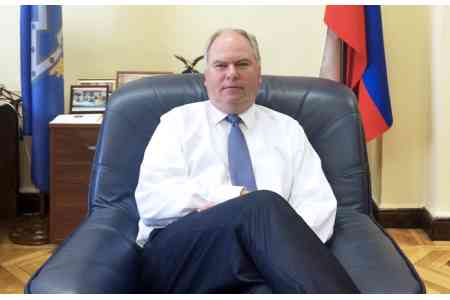 Moscow: NATO seeking to "Pull" Armenia away from CSTO Allies
  Political analyst: Russia intends to determine which "Camp" Armenia will choose through a referendum
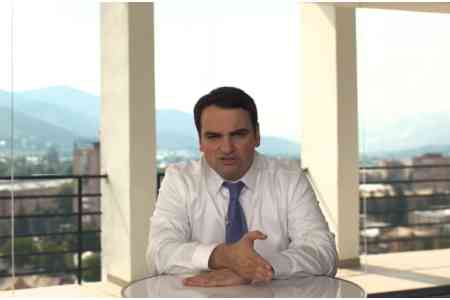 Narek Karapetyan will give up his parliamentary salary in favor of charitable contributions.
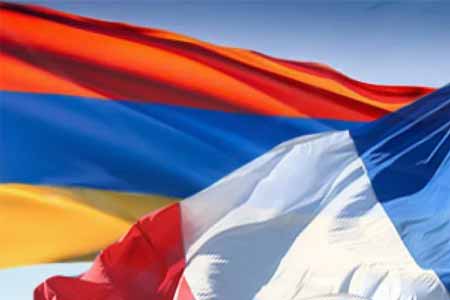 Armenia and France discuss further development of strategic partnership and EU cooperation
 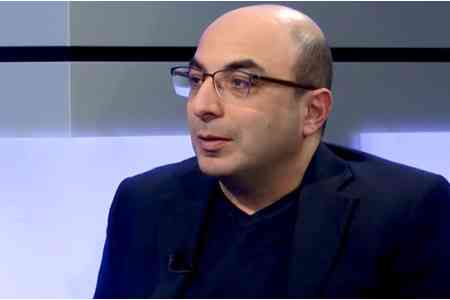 To overcome risks Armenia must reduce domestic escalation - expert
 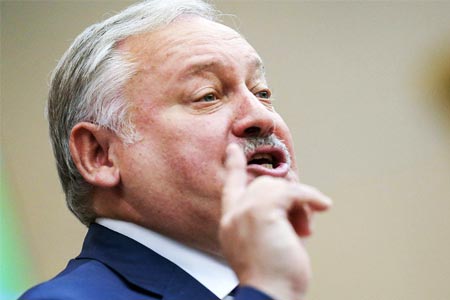 Zatulin: Pashinyan was eager to get back to Russia because he actually lost the elections
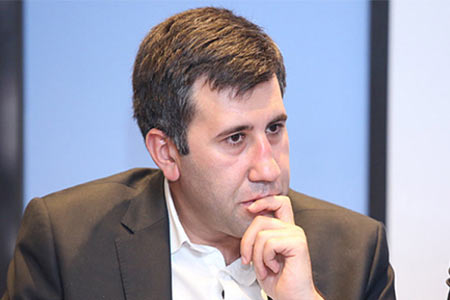 Human rights activist Ruben Melikyan dismissed from YSU
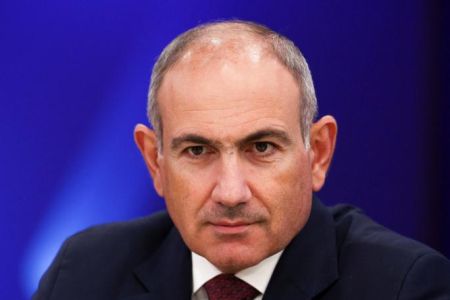 Pashinyan removed from INNOPROM guest list
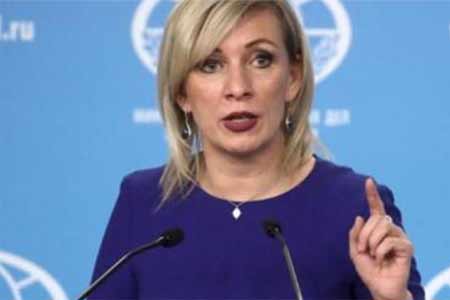 Zakharova: Armenia`s pro-EU pivot poses economic security risks to EAEU member states
 It`s time for South Caucasus countries to think of South Caucasus as single, unified region - RA premier
  Pashinyan: Armenia and Azerbaijan should leave each other alone
 Moscow sees situation with Armenia as attempt to attack Russia-involving integration associations - Russian presidential aid