
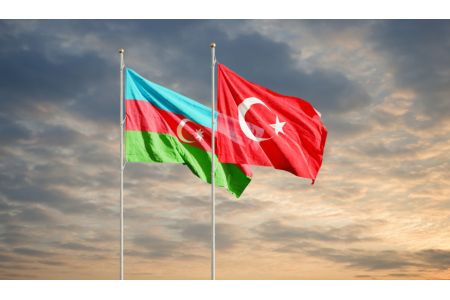
ArmInfo. Turkologist and researcher of the Turkish military- industrial complex, Anzhela Simonyan, spoke about the role of Turkish intelligence, MIT, in the 44-day war of 2020 around Artsakh.
The expert noted that when discussing the 44-day war in Artsakh, public attention is usually focused on visible military factors: drones, armored vehicles, or personnel. However, according to her, the recently published official book "National Intelligence Organization 1826-2023" reveals the "shadow" side of the war, where Turkish intelligence, MIT, played a key role. "Furthermore, the book publishes archival documents from the National Intelligence Organization (MIT) for the first time. Author Polat Safi argues that this conflict became a testing ground for MIT's 'game-changing' strategy, which involved transferring all operational methods accumulated in Syria, Iraq, and Libya to the Caucasus. This transfer of experience entailed MIT's direct and dual support for Azerbaijan, which was carried out at both the intelligence and special operations levels," Simonyan writes.
According to her, MIT effectively assumed the role of "intellectual center" for the Bayraktar TB2: although UAVs are a type of air force weapon, their devastating effectiveness was ensured precisely by the critical data provided by intelligence. Simonyan noted that, using Turkish Gokturk satellite systems, intelligence analysis centers processed geospatial data (GEOINT), allowing them to detect Armenian hideouts and mobile targets before a strike.
"However, MIT's presence was not limited to technological support. As part of covert operations, Turkish Special Ops units directly participated in combat operations, particularly in the Shusha direction, where they served as operational advisers and coordinators. At the same time, military success was reinforced by active behind-the-scenes intelligence diplomacy. The then head of MIT, Hakan Fidan, was in constant contact with the heads of the Russian intelligence services (FSB and SVR) to prevent direct Russian intervention," the Turkologist continued. Simonyan emphasized that the Turkish side is already officially proud of this fact, emphasizing that without the special operations on the ground and the provision of critical data by MIT, the outcome of the war could have been completely different. "We are dealing with a reality in which intelligence services are becoming the primary instrument for delineating state borders. For MIT, the 44-day war was merely a prelude to expanding its zones of influence in the Caucasus and changing the regional status quo on the path to creating a 'Turkic world,'" the Turkologist concluded.
As a reminder, on September 27, 2020, Azerbaijan, with the support of Turkey and the involvement of mercenaries from the Middle East, committed aggression against Artsakh. The 44-day war was concluded by a trilateral statement on November 9, 2020, between the leaders of Russia, Armenia, and Azerbaijan. This war marked the beginning of the loss of Artsakh and the occupation of Armenian territories on several fronts.
READ ALL COMMENTS







 Opinion: The development of the Amulsar mine near the resort town of Jermuk is the beginning of an environmental disaster in Armenia
 Expert: The arrest of opposition figures in Armenia for social media posts is a systematic attempt to intimidate the public and suppress dissent.
 Azerbaijani Studies Expert: While Azerbaijan Prepares Its Generation for War, Aliyev’s Aide Calls on Armenia to Prepare Armenian Society for “Peace”
 Turkologist: Azerbaijan will never, under any circumstances, stop pressuring the Armenian people
 Political scientist: We need to move away from the question of "when" and replace it with more important questions
 Lukashenko called for Armenia to assume the CIS presidency in 2029
 Dmitry Medvedev predicted a Ukrainian-like fate for Armenia amid the country`s shift in foreign policy
 Russian Security Council: In Armenia, they want to force Russian asset owners to dispose of their assets
 Zakharova: Russia ready to discuss with Armenia the prospects for expanding military cooperation as part of a review of bilateral ties
 Tevanyan: Armenia, like Ukraine and Moldova, is being drawn into the EU’s global war
 Yerevan City Hall is considering introducing a valet parking system in the city
 Expert: The circus surrounding the “Albanization” of Armenian culture in the presence of foreign ambassadors in occupied Artsakh is genocide
 Political scientist: If Russian-Armenian relations are destroyed, Turkey will take Russia`s place
 Political scientist: The Armenian public is simply obliged to significantly change the entire content of public discourse and struggle
 Cross tattoos are being removed from the skin of Christian prisoners in Azerbaijan by fire, according to a human rights activist.
 Zakharova: Armenia`s likely introduction of visas with Russia will be a step against Yerevan itself
 Putin: Armenia`s recognition of Karabakh as part of Azerbaijan in Prague has given Russia`s position on this issue an ambivalent character
 Putin: Armenia`s adoption of the law on EU accession means an announcement of its withdrawal from the Eurasian Economic Union
 Aram Vardevanyan: Public demands solutions, not apology scandals in Parliament