
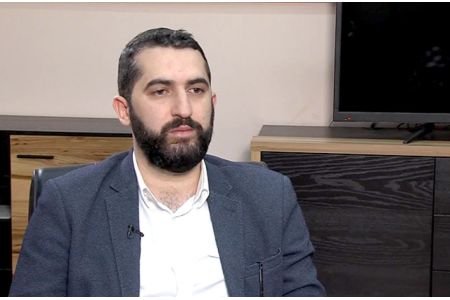
ArmInfo. Turkey is not only closely monitoring but also exerting influence on internal processes in Armenia, at least at the level of rhetoric and information policy. Turkologist Varuzhan Geghamyan wrote about this in his analytical article, explaining how three Turkish diplomats are providing support to Armenian Prime Minister Nikol Pashinyan.
He pointed out that the parliamentary elections in Armenia, scheduled for June 7, have already attracted the attention of not only the Armenian public but also various international players, and are widely characterized as "geopolitical elections" between different poles. "There is nothing surprising in this context. The geopolitical importance of the South Caucasus, stemming primarily from its geographical location and relief, constantly makes it an object of competition not only between regional but also global powers," the expert explained.
According to the Turkologist, neighboring Turkey is no exception, where the progress of the June parliamentary elections will be followed with great attention. In confirmation of these words, Geghamyan recalled the statement made by Turkish Foreign Minister Fidan in January 2026, stating that "the elections in Armenia will be of great importance in the Armenian-Turkish and Armenian-Azerbaijani negotiation process. Armenian Prime Minister Nikol Pashinyan is currently leading in public opinion polls. Turkey sincerely supports the constructive role he plays in this matter. This approach, this will must continue."
Geghamyan noted that the Turkish Foreign Minister's statement is not the only example demonstrating interest in Armenia's electoral and political processes in general. According to him, numerous examples of this can be found periodically in the Turkish media, and he suggested that their number would increase in the coming weeks. At the same time, he called for an examination of three articles published in recent days in well-known Turkish media outlets, authored by three Turkish diplomats who visited Armenia on a private visit in late April. In this regard, Geghamyan recalled that on April 26, former ambassadors Omer Onhon, Hasan Gogus, and Hasan Servet Oktem arrived in Yerevan. The expert pointed out that Oktem's biography, besides mentioning his work as Turkey's ambassador to various countries, also notes that he was wounded in 1984 during a "punitive operation organized by ASALA against the Turkish Embassy in Tehran." Moreover, as Geghamyan observed, all three diplomats currently perform expert activities and are specialists at the Ankara Policy Center (APM) analytical center.
"Despite the 'private' nature of the visit, according to the diplomats themselves, it provided an opportunity to 'follow the situation in the country firsthand before the elections' and 'meet with important persons in Armenia, as well as understand the pre-election atmosphere.' In their articles published as a result of the trip to Yerevan, the Turkish diplomats, in addition to tourist-type observations and assessments containing what has already become classic anti-Armenian propaganda, also touch upon the political situation. In this sense, they put forward two main theses," Geghamyan emphasized.
The first thesis, according to the expert, is that the policy pursued by the current authorities of Armenia is correct. In support of his words, he drew attention to how Ambassador Gogus describes the political situation in Armenia and Turkey's position: "Having made the right choice and having abandoned claims of genocide in the international arena, Pashinyan is moving towards normalization of relations with Turkey without preconditions. In a country where hostility toward Turks has been incited for 100 years, this is a very bold step for a leader who lost a war three years ago."
The Turkologist emphasized that Gogus also addresses the demand for changes to the Armenian Constitution, specifically noting: "Now the biggest obstacle to the normalization of relations is the Armenian Constitution of 1991 (the Turkish diplomat likely means the 1990 Declaration of Independence). Noting that these problematic articles in the Constitution must be changed, Pashinyan took another bold step, but there is no possibility of doing anything like that before the elections."
According to the expert, Ambassador Oktem shares a similar assessment, noting: "The political situation in Armenia can be briefly described as follows. We have been following Armenia's progress toward peace and regional cooperation with satisfaction in recent years. By moving away from Russia and choosing the West, Armenia is taking steps in the right direction. Together we see that Prime Minister Pashinyan is trying to pull the country out of the mud. For the signing of a peace treaty, it is expected that the reference to the Declaration of Independence will be removed from the preamble of the Armenian Constitution. There is confidence that Pashinyan will eliminate this last obstacle after the elections." The second thesis, according to Geghamyan, concerns the elections in Armenia themselves. In them, as the Turkologist explained, undisguised support for the force currently ruling in Armenia is manifested. As the expert noted, Ambassador Oktem, asserting that Pashinyan will most likely win the elections, notes the following: "The Armenian voter will go to the polls on June 7 and determine the country's future of their own free will. If they want peace, prosperity, and democracy, the right choice is Pashinyan's party. Those who want Armenia to remain in Russia's 'backyard' should vote for Samvel Karapetyan. Turkey is ready to wait and extend a hand of friendship to Armenia, which has 'signed' a peace treaty with Azerbaijan, is ready to open borders, start diplomatic relations—in a word, normalize relations. Led by Pashinyan... Armenia will have good relations with its neighbors... Agreement with this is in the hands of the Armenian voter. Let's hope it will be so."
At the same time, the Turkologist pointed out that the author labels other political forces, characterizing the ARF Dashnaktsutyun as "Armenian nationalists leading Armenia to disaster," the Armenian Apostolic Church (AAC) as "opponents of the peace policy," and linking the force led by Samvel Karapetyan with Russia. Onhon also, as Geghamyan noted, calls Armenian opposition political forces "extreme nationalists," applying the formula "Russia - Church - Allies" to those fighting the ruling power.
"Furthermore, the latter qualifies the actions of opposition forces as an 'omen of a future that generates conflict with neighboring countries and leads to a rapprochement with Russia,' while describing Pashinyan as 'opposing the introduction of Armenia under Russian hegemony' and a 'supporter of normalizing relations with Turkey.' It is worth noting that the ambassador who wrote the article also mentions the 'Middle Corridor' route in the context of the elections as a project contributing to the implementation of the so-called 'Zangezur Corridor,' which has always been important for Turkey," Geghamyan pointed out.
These articles, as the Turkologist observed, are effectively a manifestation of indirect and direct support directed toward one of the political forces operating in Armenia. The expert called it interesting that a reputable and independent publication in Turkey, the newspaper Oksijen, reached a similar conclusion. In this regard, he drew attention to the fact that the editorial article dedicated to the columns of the three diplomats in the newspaper is titled "Full Support for Pashinyan from Retired Turkish Ambassadors," and the preface to the article notes that the diplomats "checked the pulse of the country before the elections" and in their articles "sent a message of support to Pashinyan."
In connection with the above, the expert questioned whether these articles published during the pre-election period would receive the same sharp and critical reaction from the Armenian authorities and their supporting circles as they receive with similar content in another country, such as Russia. "Moreover, in this case, we are dealing not only with journalists but also with former statesmen who still have a certain influence in Turkey's political circles today," Geghamyan added. The Turkologist noted that a similar situation was observed during the 2021 pre-election period. For example, one of Turkey's leading newspapers, Yeni Şafak, published an analytical article in February 2021 titled "Which scenario for Turkey and Azerbaijan in Armenia is better?" The author of the article, as Geghamyan noted, wrote the following: "Compared to the 'Karabakh clan,' Pashinyan is an ideal [choice]. He is the most naive of Armenian politicians. It is better for Turkey and Azerbaijan to support Western-oriented authorities rather than Russia, both in Armenia and Georgia. These lines, of course, do not justify Pashinyan. But if one must choose from the worst, he is better than the rest."
Geghamyan also touched upon an article in the English version of the daily newspaper Daily Sabah, considered the main pro-government Turkish mouthpiece, titled "Does Turkey support Pashinyan?". The article, as the Turkologist noted, stated: "Turkey fears that Pashinyan's successor, supported by the army, might pursue a tougher and more uncompromising foreign policy. It seems that Ankara's policymakers believe that the pro-Western political leadership in Yerevan will contribute more to regional peace."
Summarizing, the expert expressed conviction that all the aforementioned statements can easily be classified as external interference, indicating not only Turkey's increased attention but also its involvement in internal Armenian processes, at least at the level of rhetoric and information policy.











 Expert: Economic pressure on Armenia may be virtually painless for other EAEU members, but not for Armenia itself
 Expert on protests in France: Civilizations fade when society loses a vision of the future
 Turkologist: Azerbaijan is not all-powerful—its vulnerabilities should become part of Armenia’s security strategy
 Opinion: The development of the Amulsar mine near the resort town of Jermuk is the beginning of an environmental disaster in Armenia
 Expert: The arrest of opposition figures in Armenia for social media posts is a systematic attempt to intimidate the public and suppress dissent.
 The Armenian Foreign Minister commented on the country`s return to work within the CSTO.
 The Artsakh Public Council expressed outrage at the UN Secretary-General`s behavior
 Lukashenko called for Armenia to assume the CIS presidency in 2029
 Dmitry Medvedev predicted a Ukrainian-like fate for Armenia amid the country`s shift in foreign policy
 Russian Security Council: In Armenia, they want to force Russian asset owners to dispose of their assets
 Zakharova: Russia ready to discuss with Armenia the prospects for expanding military cooperation as part of a review of bilateral ties
 Tevanyan: Armenia, like Ukraine and Moldova, is being drawn into the EU’s global war
 Yerevan City Hall is considering introducing a valet parking system in the city
 Expert: The circus surrounding the “Albanization” of Armenian culture in the presence of foreign ambassadors in occupied Artsakh is genocide
 Political scientist: If Russian-Armenian relations are destroyed, Turkey will take Russia`s place
 Political scientist: The Armenian public is simply obliged to significantly change the entire content of public discourse and struggle
 Cross tattoos are being removed from the skin of Christian prisoners in Azerbaijan by fire, according to a human rights activist.
 Zakharova: Armenia`s likely introduction of visas with Russia will be a step against Yerevan itself
 Putin: Armenia`s recognition of Karabakh as part of Azerbaijan in Prague has given Russia`s position on this issue an ambivalent character
 Putin: Armenia`s adoption of the law on EU accession means an announcement of its withdrawal from the Eurasian Economic Union