
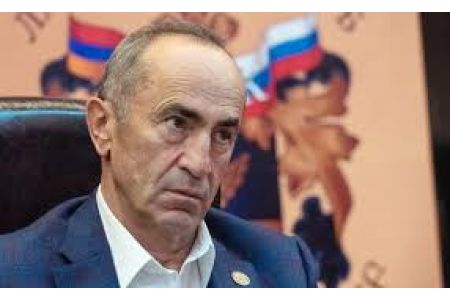
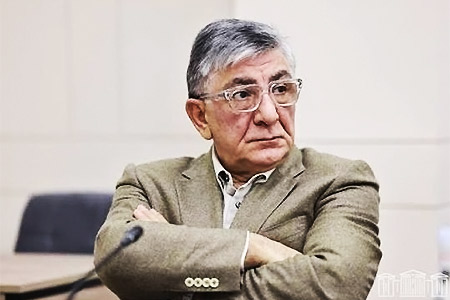
ArmInfo. The November 9, 2020, ceasefire agreement did not grant the Russian peacekeepers any mandate, and the Armenian Prime Minister's actions on the Artsakh issue have relegated these peacekeepers to the status of outside observers. This was stated by Robert Kocharyan, the second president of Armenia and leader of the "Armenia" bloc, on the Public Television of Armenia.
"There's a misconception about the contents of the November 9, 2020, statement regarding the powers of Russian peacekeepers-they can and can't use weapons, what they can and can't do. There was no UN Security Council decision, and none of this was implemented in accordance with Chapter 7 of the UN Security Council Charter, which concerns the model for the use of force, so-called peace enforcement. I get the impression that you either don't understand what happened after the 44-day war, or you wouldn't have bothered to delve into this issue," Kocharyan said, addressing the presenter's accusations against Russia for failing to fulfill its mediation mission.
The politician stated that Azerbaijan, under pressure from Russia, signed the statement, which was not about peace enforcement, but about the deployment of peacekeepers between the parties with the consent of Yerevan and Baku.
"But as soon as one of the parties withdraws from this statement, the peacekeepers' functions simply cease. That was the model. This wasn't documented anywhere in the UN," the former Armenian president said.
In response to the comment that Azerbaijan violated the agreements and Russia did nothing, despite Russian leader Vladimir Putin signing the statement, Kocharyan pointed out that the Azerbaijani side violated the agreements only after Armenian Prime Minister Nikol Pashinyan recognized Artsakh as part of Azerbaijan on October 6, 2022, in Prague.
In response to the pro-government claim that Putin had allegedly done this earlier, the former Armenian president retorted that Putin had never spoken out against Azerbaijan's territorial integrity. According to him, there was no need to do so. "So, the US didn't recognize Azerbaijan's territorial integrity? Russia, the US, and France (the co-chairs of the OSCE Minsk Group on the Nagorno-Karabakh conflict - ed.) all recognized Azerbaijan's territorial integrity. Artsakh was a self-determined people, whose right to recognition of self-determination was in the process. This was the Minsk process, and this was the Madrid principles. When Armenia unilaterally, without notifying its partners, for example, Russia, recognizes Artsakh as part of Azerbaijan, this entire structure falls apart. The entire Karabakh movement immediately turns into a separatist movement, and the Artsakh Defense Army becomes an illegal armed group. Azerbaijan has already labeled it a terrorist group, and the entire structure collapsed. The signature of one official brought the entire structure down," Kocharyan emphasized.
Responding to the presenter's attempts to shift the blame for the loss of Artsakh entirely onto the Russian side, whitewashing Pashinyan, the former Armenian president once again emphasized that Artsakh was on the path to international recognition of its self-determination. According to him, this could have happened in a year, or in five years, but Armenia's decision destroyed this entire construct. "That's the problem. Everyone recognized Azerbaijan's territorial integrity, but everyone also said that the self-determination process was ongoing.
This is a classic example of self-determination after a conflict. We were in that process," Kocharyan said, adding that Russian peacekeepers had no mandate to use force. He added that when one side withdraws from the process, the peacekeepers become mere bystanders in armored personnel carriers and armed with machine guns.
"They essentially had no mandate to use weapons. They had no other authority, since Armenia had turned them into such a bystander. He (Pashinyan - ed.) destroyed the entire structure that had maintained this fragile situation, with just his signature," he said.
Responding to the comment that Russia and the CSTO failed to defend Armenia when it was attacked in 2022, Kocharyan suggested looking into the situation and asked whether Armenia itself had fought. According to him, what does that mean when you declare you won't fight for a mountain covered in snow for nine months? "When you spoil relations within the CSTO, it means you're becoming an unreliable, suspicious partner among the bloc's partners. It would be very good if the CSTO were protected, but that's not the point. You did everything to arouse suspicion among your partners," the politician said.
To illustrate, he cited the example of US President Donald Trump attacking Iran without notifying his NATO partners. Then, when he found himself stuck, he asked the North Atlantic Alliance for help, only to be refused, citing Trump's own disrespectful attitude. He emphasized the unacceptability of making such documents absolute, noting that states like Armenia must ensure that a superpower has no reason to refuse to fulfill its obligations. The second president of Armenia emphasized that he himself would have resolved the current situation with a single phone call. Moreover, he emphasized that the 44-day war would not have occurred under his leadership, since it was Armenia, led by Nikol Pashinyan, that provoked it.









 Azerbaijani Studies Expert: While Azerbaijan Prepares Its Generation for War, Aliyev’s Aide Calls on Armenia to Prepare Armenian Society for “Peace”
 Turkologist: Azerbaijan will never, under any circumstances, stop pressuring the Armenian people
 Political scientist: We need to move away from the question of "when" and replace it with more important questions
 International Law Specialist: Azerbaijan intends to initiate legal proceedings against Armenia by sentencing Armenian prisoners
 Dmitry Medvedev predicted a Ukrainian-like fate for Armenia amid the country`s shift in foreign policy
 Russian Security Council: In Armenia, they want to force Russian asset owners to dispose of their assets
 Zakharova: Russia ready to discuss with Armenia the prospects for expanding military cooperation as part of a review of bilateral ties
 Tevanyan: Armenia, like Ukraine and Moldova, is being drawn into the EU’s global war
 Yerevan City Hall is considering introducing a valet parking system in the city
 Expert: The circus surrounding the “Albanization” of Armenian culture in the presence of foreign ambassadors in occupied Artsakh is genocide
 Political scientist: If Russian-Armenian relations are destroyed, Turkey will take Russia`s place
 Political scientist: The Armenian public is simply obliged to significantly change the entire content of public discourse and struggle
 Cross tattoos are being removed from the skin of Christian prisoners in Azerbaijan by fire, according to a human rights activist.
 Zakharova: Armenia`s likely introduction of visas with Russia will be a step against Yerevan itself
 Putin: Armenia`s recognition of Karabakh as part of Azerbaijan in Prague has given Russia`s position on this issue an ambivalent character
 Putin: Armenia`s adoption of the law on EU accession means an announcement of its withdrawal from the Eurasian Economic Union
 Aram Vardevanyan: Public demands solutions, not apology scandals in Parliament
 Arrested Armenian oligarch on economy and new jobs