


ArmInfo. Armenia, led by Nikol Pashinyan, is trying to present itself to the world with a "green" agenda, while the opening of the Amulsar mine near the resort town of Jermuk just days earlier is literally the beginning of an environmental disaster. This was written by Lilit Galstyan, a member of the Armenian parliament from the opposition "Armenia" faction, on her Facebook page.
She recalled that the 17th United Nations Conference on Biological Diversity (COP17) will begin in Yerevan on October 15 under Armenia's presidency.
"Under Nikol Pashinyan's leadership, Armenia is trying to present itself to the world with a "green" agenda, while the opening of the Amulsar mine in Jermuk is literally the beginning of an environmental disaster. The Armenian government recently officially announced the opening of the Amulsar mine. Nearly 500 NGOs condemn the Amulsar gold mine development project because: "[It] has not offered a realistic and comprehensive solution to the environmental and socio-economic problems that have been raised for years; and it flagrantly violates obligations under international conventions," the MP wrote, sharing a statement published on the Transparency International website on the matter.
The international organization's statement on the launch of Amulsar, signed by several dozen NGOs and public figures, condemns the start of the mine. The operation of the Amulsar gold mine in the absence of any realistic and justified response to the important environmental and socio-economic concerns that have been raised for many years.
"The official announcement and inauguration of the Amulsar mine by the Armenian government on October 10, 2026, just a few days before the 17th Conference of the Parties to the UN Convention on Biological Diversity (COP17), scheduled to take place in Yerevan, is an extremely bold and irresponsible step. The ceremony, attended by Armenian Prime Minister Nikol Pashinyan, was accompanied by the demonstration of a gold bar, the result of an entire industrial cycle. This demonstration directly affected the entire COP17 process and Armenia's reputation as the country holding the COP17 Presidency. Armenia, which holds the COP17 Presidency, is trying to present itself to the international community as a "green" "The Armenian government is unleashing an environmental disaster domestically, grossly violating its obligations under international conventions and calling into question the sincerity of the government's environmental goals and statements," the statement reads.
The signatories of the statement note that for many years they have been attempting to bring to the attention of the Armenian government and various funding organizations the main legal and environmental risks associated with the Amulsar mining project.
The statement emphasizes that the Standing Committee and the Bureau of the European (Bern) Convention on the Conservation of Wildlife and Natural Habitats have, by numerous decisions, demanded that the Armenian government cease all activities at Amulsar and conduct a new environmental impact assessment (EIA) for the development of the mine, review and approve the list of areas of special conservation value in the Emerald ecological network, and approve the designation of the Jermuk National Park. as a biodiversity conservation area.
"The Committee's position clearly states that this can be done as long as no mining is underway. During communication with the Bern Convention Secretariat, the Armenian Ministry of Environment reported that work is underway to improve the Amulsar project and emphasized that the results of the expert assessment by ELARD and TRC have been provided to the relevant government agencies for professional evaluation." "The commencement of mine development negates any dialogue with the Armenian government under the Berne Convention and damages our country's international reputation," the NGO representatives emphasize.
The authors of the statement note that the Armenian government is deliberately ignoring a crucial official document developed on its own initiative: the 2019 ELARD and TRC report on the impacts of the Amulsar gold mine on water resources and geology, biodiversity, and air quality. This report systematically identified dozens of serious omissions, calculation errors, and inaccuracies in the current environmental impact assessment documents for Amulsar, including inaccurate water resource modeling, acid runoff calculations, neglect of seismic risks, biodiversity assessments, and other important issues.
"Furthermore, this study and all documents related to the criminal case related to it have been removed from official websites." Meanwhile, many Armenian and foreign experts believe that the cyanide method used for gold mining at Amulsar is one of the most dangerous chemical processes, and that an accident or other leak would put the ecology of the Arpa River at risk. They have also convincingly demonstrated that the development of the Amulsar mine would create an extremely high and long-term risk of acid rock drainage, threatening the Arpa and Vorotan rivers, the entire ecosystem of Lake Sevan through the Vorotan-Arpa-Sevan tunnel, as well as the mineral waters of Jermuk and other groundwater in the region," the statement continues.
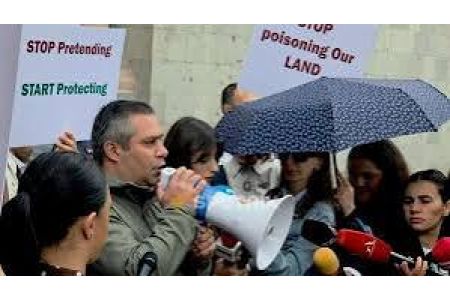
Public activists believe that Jermuk will transform from a sustainable resort center into a temporary mining wasteland. "The city's ecology is already deteriorating due to construction and blasting operations carried out during the mine's development. With the mine's reserves depleted and short-term profits fading, we face the fate of yet another abandoned and empty settlement (like Dastakert and Sotk). The Armenian government is gradually losing touch with the public and its awareness of public interests. Since 2019, when Prime Minister Pashinyan first attempted to persuade the public to accept the opening of the Amulsar mine, the public reaction has been unequivocal. Civil society has subsequently repeatedly protested, including the fact that 12.5% of Lydian Armenia's shares were "gifted" to the Armenian government, the statement continues.
The authors of the statement demanded the immediate cessation of the mine's operation and related activities, maintaining the necessary safety and pollution prevention measures, and a review of the decisions that allowed the operation.
Ensure the proper implementation of the recommendations of the Berne Convention Bureau. End state involvement in this catastrophic project and reconsider Armenia's mining policy, basing future decisions on proper public participation and a quality environmental impact assessment process, ensuring water security, preserving biodiversity, and the long-term well-being of local communities.
It should be noted that the Amulsar mine was launched on October 10. At the launch, Pashinyan stated that the Amulsar gold mine would produce approximately 210,000 ounces of gold per year. It is noted that as a result of the mine's operation, annual taxes and royalties paid by Lydian Armenia to the state budget will amount to approximately $130 million, which will have a positive impact on Armenia's GDP of 1.5-2%.
The Amulsar project is expected to create over 4,000 direct and indirect jobs. According to the community development agreement signed between the government, Lydian Armenia, and the communities of Jermuk, Vayk, and Sisian, $7-9 million is planned to be allocated annually for community socioeconomic development programs throughout the mine's lifespan.
The project is being implemented as part of a strategic partnership between Lydian Armenia and the Armenian government. The company has invested approximately $750 million in the project, $150 million of which is secured by a state guarantee issued by the Armenian government.
Environmentalists have criticized the Armenian authorities' decision, emphasizing that the mine's operations will cause irreparable damage to the Jermuk resort and Lake Sevan.































 Expert: The arrest of opposition figures in Armenia for social media posts is a systematic attempt to intimidate the public and suppress dissent.
 Azerbaijani Studies Expert: While Azerbaijan Prepares Its Generation for War, Aliyev’s Aide Calls on Armenia to Prepare Armenian Society for “Peace”
 Turkologist: Azerbaijan will never, under any circumstances, stop pressuring the Armenian people
 Political scientist: We need to move away from the question of "when" and replace it with more important questions
 Lukashenko called for Armenia to assume the CIS presidency in 2029
 Dmitry Medvedev predicted a Ukrainian-like fate for Armenia amid the country`s shift in foreign policy
 Russian Security Council: In Armenia, they want to force Russian asset owners to dispose of their assets
 Zakharova: Russia ready to discuss with Armenia the prospects for expanding military cooperation as part of a review of bilateral ties
 Tevanyan: Armenia, like Ukraine and Moldova, is being drawn into the EU’s global war
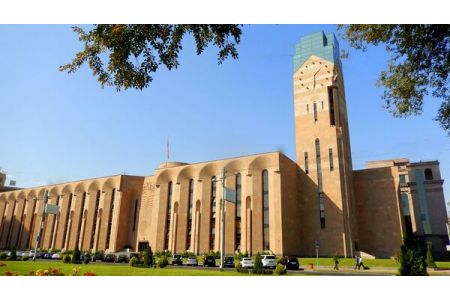 Yerevan City Hall is considering introducing a valet parking system in the city
 Expert: The circus surrounding the “Albanization” of Armenian culture in the presence of foreign ambassadors in occupied Artsakh is genocide
 Political scientist: If Russian-Armenian relations are destroyed, Turkey will take Russia`s place
 Political scientist: The Armenian public is simply obliged to significantly change the entire content of public discourse and struggle
 Cross tattoos are being removed from the skin of Christian prisoners in Azerbaijan by fire, according to a human rights activist.
 Zakharova: Armenia`s likely introduction of visas with Russia will be a step against Yerevan itself
 Putin: Armenia`s recognition of Karabakh as part of Azerbaijan in Prague has given Russia`s position on this issue an ambivalent character
 Putin: Armenia`s adoption of the law on EU accession means an announcement of its withdrawal from the Eurasian Economic Union