


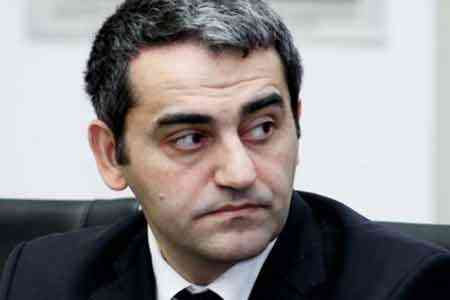
ArmInfo. Preliminary results of the local government elections have shown that Nikol Pashinyan and the Civil Contract party's rule is based solely on force, administrative resources, and a climate of fear among citizens, which is nothing new. Former Deputy Defense Minister of the Republic of Armenia Artak Zakaryan wrote about this on his Facebook page.
According to him, in all the settlements where the elections were held, votes cast for the ruling party through violent means averaged no more than 32% of the total number of voters in the settlements, which can be considered the maximum "rating" for the Civil Contract party. It should be noted that both voluntary and "incompetent and forced" voters "participated" in the elections. In this case, the average turnout of 32% indicates that the Civil Contract "team" faction lacks sufficient public support at the local government level. Further clear evidence of the authorities' administrative resources and influence over the local elections is the fact that the preliminary results were presented as a victory. "From the content and form of the information flow, it is clear that high-ranking officials of the executive branch (the minister, the regional governor) reported to their prime minister on the instructions received and carried out," noted Artak Zakaryan.
He also noted that if the main opposition forces had been able to nominate a single candidate in each locality properly, without concealment or bribes to their opposition partners, Nikol Pashinyan and the political force he leads would not have had a chance to continue to undermine Armenian statehood. "I'll give a short example specifically for the Civil Contract. In the April 2017 parliamentary elections, the Republican Party received 770,441 votes. That is, more than the ruling party in the country received in June 2026. In November 2017, in the city of Goris, our party's then candidate received approximately 99% of the vote. A similar picture was observed in other communities. However, my party, which had achieved an absolute victory in parliament and local government bodies and was guided by the vital interests of the Republic of Armenia and the national agenda, was forced to leave power bloodlessly shortly after the elections, in April 2018. Therefore, I advise the "Goris Duma" not to rejoice too much over the election results. World events are no longer favorable to their catastrophic rule," noted the former Deputy Minister of Defense of the Republic of Armenia.



















 Expert: Economic pressure on Armenia may be virtually painless for other EAEU members, but not for Armenia itself
 Expert on protests in France: Civilizations fade when society loses a vision of the future
 Turkologist: Azerbaijan is not all-powerful—its vulnerabilities should become part of Armenia’s security strategy
 Opinion: The development of the Amulsar mine near the resort town of Jermuk is the beginning of an environmental disaster in Armenia
 Expert: The arrest of opposition figures in Armenia for social media posts is a systematic attempt to intimidate the public and suppress dissent.
 Zakharova commented on the scandalous epithets of the governor of Armenia`s Shirak region about "Ivanov"
 Nikolai Bordyuzha proposed excluding Armenia from the CSTO.
 The participation of Artsakh ensembles in an international festival in Vienna was cancelled following the intervention of several foreign embassies
 Expert: It`s time for Armenia to move away from uncertainty and choose between West and East
 The Armenian Foreign Minister commented on the country`s return to work within the CSTO.
 The Artsakh Public Council expressed outrage at the UN Secretary-General`s behavior
 Lukashenko called for Armenia to assume the CIS presidency in 2029
 Dmitry Medvedev predicted a Ukrainian-like fate for Armenia amid the country`s shift in foreign policy
 Russian Security Council: In Armenia, they want to force Russian asset owners to dispose of their assets
 Zakharova: Russia ready to discuss with Armenia the prospects for expanding military cooperation as part of a review of bilateral ties
 Tevanyan: Armenia, like Ukraine and Moldova, is being drawn into the EU’s global war
 Yerevan City Hall is considering introducing a valet parking system in the city
 Expert: The circus surrounding the “Albanization” of Armenian culture in the presence of foreign ambassadors in occupied Artsakh is genocide
 Political scientist: If Russian-Armenian relations are destroyed, Turkey will take Russia`s place