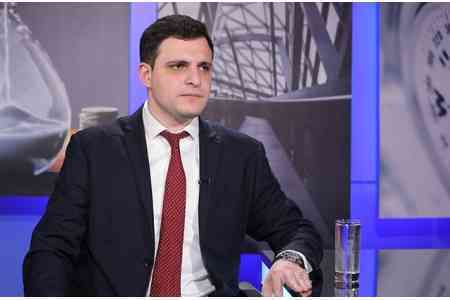
ArmInfo. It is impossible to talk about an era of peace as of today. This is how orientalist Sergey Melkonyan commented on the results of the Armenian-Azerbaijani summit in Washington.
Speaking about what Armenia received from the August 8 summit in Washington, the expert stated that the initialing of the peace treaty allows postponing a potential escalation, but not canceling it. According to him, the prospect of opening the border with Turkey has also been outlined, although there may be more problems than benefits here.
Touching on what Azerbaijan received, Melkonyan noted that first of all, this is the dissolution of the OSCE Minsk Group - the legalization of the closure of the "Karabakh issue". "Yerevan and Baku have already sent a joint statement to the OSCE. However, the procedure remains unclear: should the co-chairs (Russia, the United States and France) send a corresponding appeal.
In addition, the cancellation of Section 907 of the Freedom Support Act is a de facto opening of the door to military-technical cooperation between the United States and Azerbaijan. Exclusive conditions for the road to Nakhichevan: Baku received another document, which outlines "unhindered" access to its exclave"
Based on this, we can conclude that Azerbaijan has already received specific benefits, while Armenia can only be content with prospects (reduced risk of escalation in the near future and possible opening of communications)," Melkonyan emphasized.
Speaking about the consequences for Russia, the expert noted that the creation of a new status quo continues in the South Caucasus without Russia's participation and without taking into account its interests. However, he is sure that it is too early to say that Moscow has completely left the region - options for possible participation in the future configuration remain.
"At the same time, it is possible talk about the loss of Russia's monopoly in the processes, which means the need to find a new model of competition and cooperation with regional and extra-regional actors," the orientalist added.
The expert also outlined the consequences for Iran, noting that the concluded deal is a challenge to the interests of the Islamic Republic. "The potential placement of American companies in close proximity to the northern borders will lead to more active involvement of Tehran to mitigate potential risks. In this case, Iran, like Russia, was left out of the formation of new contours of the region," he is sure.
Melkonyan believes that the growth of Turkey's influence after these agreements, taking into account the current dynamics, is obvious. "Ankara is getting prospects to become a key regional actor in the South Caucasus. Whether it will be able to realize the advantage will depend on many factors (how TRIPP will be implemented and whether it will be implemented at all; whether the agreement in Washington will lead to a partial or complete opening of the border with Armenia, etc.)," the orientalist added.
At the same time, he noted that Armenia had actually made two more concessions. "Firstly, Armenia's position was previously based on the fact that it was ready to provide a road for Azerbaijan to Nakhichevan on the same terms that Iran provided within the framework of the "Araz Corridor". However, now we see that the conditions are completely different: Azerbaijan has unhindered access through Iran and there will definitely be no American companies on this communication line, as envisaged in the TRIPP framework. Secondly, Armenia had previously stated that it was ready to submit a statement on the dissolution of the Minsk Group in parallel with the signing of a peace treaty. As a result, Yerevan did not receive a signed peace treaty, but has already submitted a statement on the dissolution of the MG," the expert noted.
According to him, Armenia will additionally need to review the actions of the EU observation mission, which must leave the Armenian-Azerbaijani border, in accordance with the initialed agreement. He suggested that the mission may remain in a different format.
"In this case, Armenia will become the most internationalized country in the region, since European observers, Russian border guards, a Russian military base and an American company will be located on its territory. Yerevan will also be obliged to change the Constitution (which already violates Article 4 of the initialed agreement on non-interference in each other's internal affairs). Considering that, according to various polls, 600,000 votes in support of changing the Constitution at the request of Azerbaijan are not collected, the signing of the peace treaty will be postponed for a long time," Melkonyan noted.
At the same time, the orientalist noted that the only concession for Baku can be considered the initialing of the document, since there is no additional benefit for Azerbaijan (except for creating an opportunity for qualitative growth in relations with the United States).
"However, given that the statement itself and the initialed document are a declaration of intent and do not oblige Azerbaijan to anything in fact, Baku is free to act within the framework of the existing "modus operandi" - to demand new concessions from Armenia. The issue of the so-called "enclaves" may be on the agenda in the future.
In addition, as was said, in addition to the 2020 Statement, Baku receives another document providing for unhindered access to Nakhchivan. Thus, in the event of a change in the regional and international situation that leads to the disruption of this project, Azerbaijan will receive additional legitimacy to open the road by force," the expert believes.
"It is impossible to talk about an era of peace as of today. Until Azerbaijan decides to implement the following points, which are an important element of the conflict, it is impossible to talk about the peaceful intentions of the Azerbaijani side or the approach of peace: the return of Armenian prisoners held in Baku; de-occupation of the territory of Armenia (more than 200 km2 captured in 2021-2022); the realization of the rights of the forcibly expelled residents of Nagorno-Karabakh; maintaining on Baku's agenda expansionist projects such as the so-called "Western Azerbaijan", which pose a threat to the sovereignty and territorial integrity of Armenia," the orientalist concluded.



















 RA Government guarantees high salaries for CC justices, Syunik families deprived of family benefits - politician
  Armenian experts, leading Turkish think tanks discuss prospects for expanding cooperation
  Political Scientist: As long as the opposition remains silent, Pashinyan can use Plan B and secure a constitutional majority
 US-Iranian memorandum more beneficial for Iran from political and economic perspective - expert
  Political analyst: While Pashinyan pledges peace with Azerbaijan, Baku continues promoting the "Western Azerbaijan" project
 Zakharova: Armenia`s pro-EU pivot poses economic security risks to EAEU member states
 It`s time for South Caucasus countries to think of South Caucasus as single, unified region - RA premier
  Pashinyan: Armenia and Azerbaijan should leave each other alone
 Moscow sees situation with Armenia as attempt to attack Russia-involving integration associations - Russian presidential aid
 Zakharova: Armenia views relations with Russia as tool for financially securing reorientation toward EU
 The Armenian Minister of Justice and the EU Ambassador discussed visa liberalization issues for Yerevan.
 Azerbaijan`s aggressive plans against Armenia became possible in wake of Pashinyan`s decisions on Artsakh - expert
  Zakharova: Russia sent a note of protest to Armenia over the act of vandalism at the "Mother Armenia" memorial in Gyumri
 Samvel Karapetyan proposes creating a post-election opposition coalition
 Artsakh`s Cultural Heritage Ombudsman called on Moscow to respond to destruction of WWII monuments by Azerbaijan in occupied NKR
 Prosecutor General`s Office petitions Central Electoral Commission for criminal prosecution of Robert Kocharyan
 Dutch Prime Minister expresses his support for Armenia`s democratic reform and economic diversification agenda
 Heritage: It`s time for Armenia`s opposition to present people with legitimate alternative to power
 RA Security Council Sec, Assistant to President of Azerbaijan hold negotiations in Dilijan
  CEC Neutralizes PAP: Three Political Forces to Enter Armenian Parliament Following Election Vote