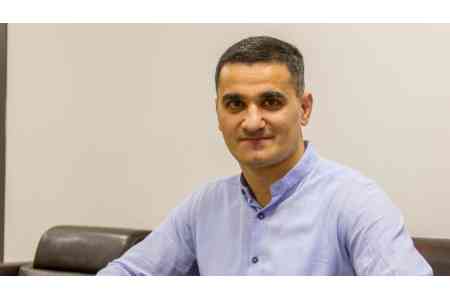
ArmInfo. Armenian political scientist Karen Igityan highlighted the main messages of Azerbaijani President Ilham Aliyev regarding Russia, which he voiced in a recent interview with local media.
As Igityan noted on his Facebook page, firstly, Aliyev accused Russia of colonialism. The political scientist noted that this narrative was enshrined in the constitutional act of October 1991, in education and elsewhere. "It is noteworthy that Aliyev also accused Persia of colonialism, instead of the myth, common in Azerbaijani historiography, that the history of Iran (the Safavids, Qajars, etc.) is part of the history of the Azerbaijani state, since, according to this myth, Turkic Azerbaijanis ruled Iran," Igityan added. According to the expert, Aliyev also stated that "the Azerbaijani people lived under colonial rule for centuries: in ancient times, during the Russian Empire, during the Persian Empire, and during the Soviet Union-it was nothing other than colonialism."
Furthermore, Igityan noted that the Azerbaijani leader again mentioned the closure of the Berdzor corridor in the presence of Russian peacekeepers. The political scientist quoted an excerpt from Aliyev's interview: "At meetings in Brussels, I repeatedly told my Armenian counterpart that we should not test their patience, that we can at any moment completely take control of the so-called 'Lachin corridor,' regardless of who is there or what others say."
As Igityan explained, the very presence of Russian troops was unacceptable to Aliyev. Therefore, as the political scientist noted, the Azerbaijani president had carried out ethnic cleansing against the Armenians of Artsakh and forced out the Russian military. To support his claims, he cited Aliyev's statement that he "could have stopped in Shushi and declared that he had thereby won Armenia, but he noticed that 2,000 Russian officers and soldiers were stationed in the area, and therefore began a criminal war and ethnic cleansing."
The political scientist also cited a passage in which the Azerbaijani president speaks veiledly about Russia. In this passage, as Igityan noted, Aliyev states that recently "many exciting events involving Azerbaijan have occurred in the region, unrelated to Armenia, and which Azerbaijan has navigated with dignity, demonstrating that the country should be treated with respect, as it will not tolerate rudeness, insolence, or attempts at dictatorship, for which it needs a combat-ready army."
In light of this statement, the political scientist urged the question of what other events have occurred in the region, besides the deterioration of Russian-Azerbaijani relations following the plane crash.
Regarding Aliyev's latest statements about Armenia gaining a connection with Russia via a railway through Azerbaijani territory, and Baku's interest in a North-South route through Astana, Igityan expressed his conviction that these are further ploys by the Azerbaijani president in an attempt to entice both sides to open a corridor. "I think Aliyev is being disingenuous here again, trying to lure everyone into opening the corridor by promising certain future opportunities. He promises everything to get what he wants, and then breaks everything. Just like after November 10 (the trilateral statement of November 9/10, 2020, which ended hostilities in the Nagorno-Karabakh conflict zone - ed.)," the political scientist explained.
The expert noted that the Azerbaijani president also described how he constantly "sold out" his partners and even "allies" to Western countries, explaining how Armenia and Russia were circumventing sanctions. "A kind of 'insider,' as one of his partners once called him. He backed down a bit and continued making promises," Igityan noted.
In this regard, he cited another excerpt from Aliyev's interview, in which the Azerbaijani president calls for attention to Armenia's GDP and trade turnover with Russia. As Igityan noted, Aliyev noted that "when the Russian-Ukrainian war began, trade turnover between Armenia and Russia was around $2 billion, and two years later, that figure had reached $12 billion," adding that this clearly demonstrates the situation.
According to Aliyev, as Igityan emphasized, "this is a clear mechanism for circumventing sanctions-as they say, parallel imports or imports from the 'gray zone.'"













 Armenian experts, leading Turkish think tanks discuss prospects for expanding cooperation
  Political Scientist: As long as the opposition remains silent, Pashinyan can use Plan B and secure a constitutional majority
 US-Iranian memorandum more beneficial for Iran from political and economic perspective - expert
  Political analyst: While Pashinyan pledges peace with Azerbaijan, Baku continues promoting the "Western Azerbaijan" project
 Political analyst: In light of new realities, Yerevan may propose advancing peace process with Baku without constitutional referendum
 Zakharova: Armenia`s pro-EU pivot poses economic security risks to EAEU member states
 It`s time for South Caucasus countries to think of South Caucasus as single, unified region - RA premier
  Pashinyan: Armenia and Azerbaijan should leave each other alone
 Moscow sees situation with Armenia as attempt to attack Russia-involving integration associations - Russian presidential aid
 Zakharova: Armenia views relations with Russia as tool for financially securing reorientation toward EU
 The Armenian Minister of Justice and the EU Ambassador discussed visa liberalization issues for Yerevan.
 Azerbaijan`s aggressive plans against Armenia became possible in wake of Pashinyan`s decisions on Artsakh - expert
  Zakharova: Russia sent a note of protest to Armenia over the act of vandalism at the "Mother Armenia" memorial in Gyumri
 Samvel Karapetyan proposes creating a post-election opposition coalition
 Artsakh`s Cultural Heritage Ombudsman called on Moscow to respond to destruction of WWII monuments by Azerbaijan in occupied NKR
 Prosecutor General`s Office petitions Central Electoral Commission for criminal prosecution of Robert Kocharyan
 Dutch Prime Minister expresses his support for Armenia`s democratic reform and economic diversification agenda
 Heritage: It`s time for Armenia`s opposition to present people with legitimate alternative to power
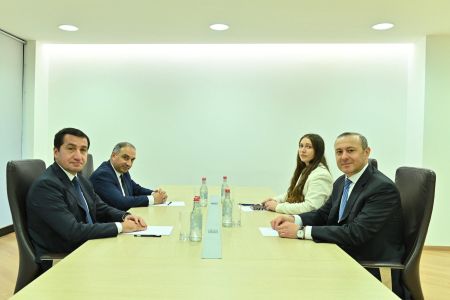 RA Security Council Sec, Assistant to President of Azerbaijan hold negotiations in Dilijan
  CEC Neutralizes PAP: Three Political Forces to Enter Armenian Parliament Following Election Vote